Knowledge Chemical Engineering Education How Pilot Plants Study Catalytic Kinetics and Selectivity: Bridging Lab & Scale-up
Author avatar

Tech Team · LABPARK

Updated 3 months ago

How Pilot Plants Study Catalytic Kinetics and Selectivity: Bridging Lab & Scale-up


The critical link between a catalyst’s molecular design and its industrial performance lives in the pilot plant. Chemical engineering unit operations pilot plants facilitate the study of catalytic reaction kinetics and selectivity by providing a rigorously controlled environment where temperature, pressure, residence time, and catalyst dosage can be precisely varied while product distributions are continuously monitored. This allows researchers to dissect how homogeneous or heterogeneous catalysts steer a reaction toward specific regioisomers or enantiomers—exactly the capability needed to develop chiral pharmaceuticals or optimize fine-chemical syntheses.

Pilot plants transform selectivity studies from small-scale curiosity into scalable engineering. They merge precise kinetic measurement with real-world operating constraints, letting you isolate reaction mechanisms and quantify regio- and enantioselectivity under conditions that actually mirror production—where impurities, recycle streams, and heat management make or break catalyst performance.

How Pilot Plants Unlock Kinetic and Selectivity Studies

A pilot reactor is not just a larger flask. It’s a kinetic laboratory that gives you the power to independently control every variable that matters.

Precision Parameter Control Reveals Kinetic Truths

Catalytic rates are exponentially sensitive to temperature and concentration. A jacketed batch reactor or a continuous tubular reactor in a pilot plant maintains isothermal conditions down to fractions of a degree. Integrated dosing pumps then allow you to systematically alter reactant concentrations, mapping the reaction rate (v = Δc/Δt) as a function of concentration. Using this data, you apply either the integral method—plotting, say, 1/[B] vs. t to confirm second-order behavior—or the differential method to determine rate constants and activation energies. Without this level of control, kinetic parameters remain guesswork, and selectivity cannot be rationally tuned.

Measuring Selectivity Directly from Product Distributions

Regioselectivity and enantioselectivity are inherently tied to the relative rates of competing pathways. A pilot plant’s sampling ports and online analytical sensors (GC, HPLC, chiral detectors) let you track the concentration of each isomer over time. For example, in the alkylation of benzene with ethylene, you measure not only the main product ethylbenzene but also the undesired diethylbenzene, directly calculating selectivity. In chiral synthesis, enantiomeric excess (ee%) is monitored by integrating a chiral column with the reactor outflow. This real‑world data connects the kinetic models you fit—like a first- or second-order rate law—to the actual branching ratios of the catalytic cycle.

Bridging the Chasm: Why Pilot Scale Matters for Catalysis

Laboratory glassware can measure intrinsic kinetics, but it intentionally excludes the messy realities that dictate true catalyst performance. Pilot plants fill that void.

Simulating Industrial Realities Without Guesswork

Real feed streams carry trace impurities that slowly poison active sites. Large‑scale recycle loops concentrate by‑products, altering the effective residence time and shifting selectivity patterns. Inside a pilot plant, you intentionally introduce these impurities or run extended campaigns to measure catalyst deactivation and regeneration cycles. This ensures that a catalyst that looks brilliantly selective in a pristine batch experiment doesn’t fail catastrophically when faced with recycled solvent or a slightly off‑spec feedstock. The ability to run reactions continuously for hundreds of hours under controlled pressure and temperature is the only way to verify long‑term selectivity stability.

Isolating Kinetics from Reactor Design for Scale‑up

Once a reaction mechanism (stoichiometry, rate laws, kinetic constants) is solidly established, you can decouple the chemistry from the equipment. Pilot plants let you switch the same catalytic system between a plug‑flow reactor and a continuous stirred‑tank reactor (CSTR). A CSTR’s back‑mixing often dilutes the concentration of key intermediates, altering the regioisomer ratio; a plug‑flow reactor might push selectivity toward the kinetic product. By running both configurations, students and engineers see how selectivity is a delicate balance of chemical kinetics and reactor hydrodynamics—and they learn to design the vessel that maximizes the right isomer.

Understanding the Trade-offs

Pilot plants are powerful, but they demand an honest look at their limitations.

Scale is still not full scale. Heat and mass transfer gradients in a 10‑liter reactor differ from those in a 10‑cubic‑meter vessel, so you must apply dimensionless numbers carefully when interpreting selectivity trends. Cost and complexity are high. Maintaining precise temperature control, high‑pressure seals, and online analytics requires significant investment and trained personnel. Catalyst deactivation can be accelerated in small channels due to higher surface‑area‑to‑volume ratios, making lifetime predictions optimistic. Finally, safety risks with exothermic reactions under pressure necessitate rigorous hazard analysis; a pilot plant is not a teaching tool to approach casually. Acknowledge these trade‑offs early, and you’ll design experiments that yield data you can trust.

Making the Right Choice for Your Goal

Your specific objective dictates how you deploy a chemical engineering pilot plant for selectivity studies.

  • If your primary focus is undergraduate kinetic education: Use a simple jacketed batch reactor with a straightforward reaction (e.g., ester hydrolysis) to plot concentration‑time data and visually confirm reaction order. Add a chiral substrate later to make enantioselectivity tangible.
  • If your primary focus is chiral pharmaceutical process development: Prioritize continuous plug‑flow reactors with rigorous temperature control. Monitor enantiomeric excess online and deliberately spike feed with a known poison to map the deactivation‑selectivity relationship before scale‑up.
  • If your primary focus is catalyst screening under realistic feeds: Run extended CSTR campaigns with recycled by‑products. Measure not only initial activity and selectivity but also the rate of selectivity loss over time—because a catalyst that loses enantioselectivity after 50 hours is worthless in production.

Pilot plants give you the lever to move from “the catalyst was selective” to “the catalyst will remain selective under exactly these predictable, controllable conditions.” That’s the insight that builds reliable, profitable processes.

Summary Table:

Key Aspect Lab Scale (Glassware) Pilot Plant Scale
Parameter Control Basic temperature/concentration control High-precision isothermal & dosing control
Selectivity Tracking Intrinsic selectivity in static systems Real-time product distribution & ee% tracking
Industrial Realism Pristine feeds, no recycling Handles trace impurities, recycle loops, & deactivation
Reactor Versatility Limited to standard batch setups Interchangeable PFR, CSTR, & batch systems

Accelerate Your Chemical Engineering Research and Education

At LABPARK, we empower universities, research institutes, and enterprises to bridge the gap between laboratory chemistry and industrial scale-up. Our premium Educational and Vocational Unit Operations Pilot Plants in chemical engineering, bioprocess & biotech, and environmental & water treatment are designed to deliver precise kinetic control and reliable selectivity data.

Ready to enhance your lab's capabilities and train the next generation of engineers? Contact us today to find the perfect pilot plant solution for your institution!

Related Products

People Also Ask

Related Products

Multi Functional Catalytic Reaction and Reactor Evaluation Educational Unit Operations Pilot Plant

Multi Functional Catalytic Reaction and Reactor Evaluation Educational Unit Operations Pilot Plant

Bench-scale educational pilot plant for catalytic reaction and reactor evaluation, integrating fixed bed, fluidized bed, and stirred tank reactors. Students compare reactor designs, evaluate catalysts, and study reaction kinetics and hydrodynamics. Perfect for unit operations labs in chemical engineering curricula.

Fixed Bed Gas Solid Catalytic Reaction Educational Pilot Plant

Fixed Bed Gas Solid Catalytic Reaction Educational Pilot Plant

Fixed-bed gas-solid catalytic reaction unit operations pilot plant for chemical engineering education. Features split-furnace, mass flow controllers, PID control, safety interlocks. Ideal for heterogeneous catalysis, reactor dynamics, catalyst evaluation studies. Fully customizable configurations for university laboratories and academic research.

Micro-Scale Gas-Solid Catalytic Reaction Educational Pilot Plant

Micro-Scale Gas-Solid Catalytic Reaction Educational Pilot Plant

Explore heterogeneous catalysis with this micro-scale gas-solid catalytic reaction educational pilot plant. Designed for university labs, it enables hands-on study of reaction kinetics and transport phenomena in a benchtop packed bed reactor with high-precision flow control and touchscreen automation.

Educational Unit Operations Pilot Plant for Intraparticle Diffusion Effective Factor Measurement

Educational Unit Operations Pilot Plant for Intraparticle Diffusion Effective Factor Measurement

Designed for chemical engineering university labs, this pilot plant allows hands-on determination of catalyst particle intraparticle diffusion effective factors and gas-solid reaction kinetics using a fixed-bed tubular reactor with industrial touchscreen control, bridging theory and practical reactor design.

Internal Circulation Gradient Free Catalytic Reaction Educational Pilot Plant

Internal Circulation Gradient Free Catalytic Reaction Educational Pilot Plant

Internal circulation gradient free catalytic reaction educational pilot plant for chemical engineering unit operations. Provides isothermal gradient free operation and hands on study of heterogeneous catalysis kinetics and mass transfer with precise control. Ideal for academic labs.

Fluidized Bed Gas Solid Catalytic Reaction Educational Pilot Plant

Fluidized Bed Gas Solid Catalytic Reaction Educational Pilot Plant

Our educational fluidized bed gas-solid catalytic reaction pilot plant is ideal for chemical engineering labs. Students study fluidization dynamics, catalyst evaluation, and process control hands-on. Features include a customizable reactor, touchscreen HMI, and safety interlocks for safe, curriculum-aligned experiments.

Fixed-Bed Chemical Reaction and Gas Dust Tar Removal Unit Operations Pilot Plant

Fixed-Bed Chemical Reaction and Gas Dust Tar Removal Unit Operations Pilot Plant

Integrated educational pilot plant for studying catalytic gas-solid reactions and downstream gas purification. Features dual fixed-bed reactor, three-stage heating, and touchscreen control for hands-on engineering training. Ideal for chemical and environmental engineering curricula.

Methanol Synthesis and Catalyst Performance Evaluation Educational Unit Operations Pilot Plant

Methanol Synthesis and Catalyst Performance Evaluation Educational Unit Operations Pilot Plant

Bench-scale methanol synthesis and catalyst evaluation educational pilot plant for chemical engineering labs to study catalytic kinetics, high-pressure operations, process control, and unit operations under realistic conditions with industrial safety features, precision gas delivery, data acquisition, and intelligent monitoring.

Crude Benzene Hydrogenation Educational Unit Operations Pilot Plant

Crude Benzene Hydrogenation Educational Unit Operations Pilot Plant

Advanced pilot plant for higher education, enabling hands-on study of crude benzene hydrogenation and gas-liquid catalytic reactions. Triple-stage reactor system with precision flow and temperature control, AI-driven PID, remote monitoring, and comprehensive safety interlocks. Customizable for curriculum integration.

Methane Cracking Educational Unit Operations Pilot Plant

Methane Cracking Educational Unit Operations Pilot Plant

This bench-scale methane cracking educational pilot plant provides hands-on catalytic conversion training with a 1000°C furnace, seven mass flow controllers, and real-time automation for safe, curriculum-aligned experiments. Designed for university teaching of unit operations and reaction engineering.

Multi-Reactor Educational Pilot Plant for Reaction Engineering Unit Operations

Multi-Reactor Educational Pilot Plant for Reaction Engineering Unit Operations

Integrated bench-scale educational pilot plant for chemical engineering teaching featuring fixed bed fluidized bed and stirred tank reactors with web-based digital twin controls and safety interlocks for hands-on unit operations and reaction engineering comparative studies in one compact system.

Ethylbenzene Dehydrogenation Educational Unit Operations Pilot Plant

Ethylbenzene Dehydrogenation Educational Unit Operations Pilot Plant

Ethylbenzene dehydrogenation educational pilot plant replicates industrial styrene production, offering hands-on experience with fixed-bed reactors, catalyst activation, regeneration, automated process control. Designed for university chemical engineering labs, it enables study of gas-solid catalysis, catalyst deactivation, steam regeneration, and safety interlocks.

Carbon Dioxide Hydrogen Methanol Synthesis Educational Unit Operations Pilot Plant

Carbon Dioxide Hydrogen Methanol Synthesis Educational Unit Operations Pilot Plant

Hands-on educational pilot plant for methanol synthesis from carbon dioxide and hydrogen. Enables practical study of high-pressure catalysis, unit operations, and process control. Features real-time data acquisition, safety systems, and customizable experiment modules for undergraduate and graduate chemical engineering laboratories.

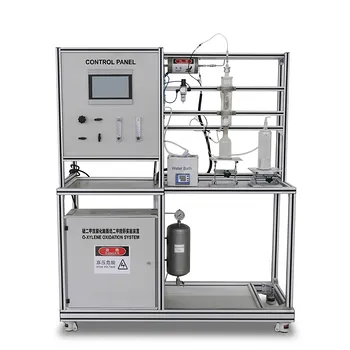
O-Xylene Oxidation to Phthalic Anhydride Educational Unit Operations Pilot Plant

O-Xylene Oxidation to Phthalic Anhydride Educational Unit Operations Pilot Plant

Explore our bench-scale educational pilot plant for o-xylene oxidation to phthalic anhydride, featuring a fixed-bed tubular reactor with visual observation, precise temperature control, and safety systems, ideal for chemical engineering hands-on training and industrial simulation, designed for university unit operations.

Multi-Stage Stirred Tanks in Series Residence Time Distribution and Mixing Performance Determination Educational Pilot Plant

Multi-Stage Stirred Tanks in Series Residence Time Distribution and Mixing Performance Determination Educational Pilot Plant

Explore residence time distribution and mixing performance in series stirred tanks with this educational pilot plant. Real-time conductivity sensors, interactive 3D simulation, and industrial-grade PC for chemical engineering lab training. Customizable to curricula.

Residence Time Distribution and Reactor Flow Characteristics Determination Educational Pilot Plant

Residence Time Distribution and Reactor Flow Characteristics Determination Educational Pilot Plant

This versatile educational pilot plant is designed for comprehensive study of residence time distribution and reactor flow characteristics, featuring multiple CSTRs in series, a tubular reactor, variable recycle loop, and automated real-time data acquisition, perfect for hands-on chemical engineering education.

100L Continuous Loop Hydrogenation Educational Unit Operations Pilot Plant

100L Continuous Loop Hydrogenation Educational Unit Operations Pilot Plant

This 100L continuous loop hydrogenation pilot plant is designed for chemical engineering education, featuring 316 stainless steel construction, advanced gas-liquid mass transfer components, explosion-proof safety systems, and a 15.6-inch touchscreen with 5G connectivity, cloud data logging, bridging theory and industry.

Carbon Dioxide Hydrogenation Methanol Synthesis Educational Unit Operations Pilot Plant

Carbon Dioxide Hydrogenation Methanol Synthesis Educational Unit Operations Pilot Plant

Pilot-scale educational system for carbon dioxide hydrogenation to methanol. Designed for unit operations teaching, it features a fixed-bed reactor, three-stage heating, dual mass flow controllers, and a 15.6-inch touchscreen with data acquisition. Perfect for chemical engineering and sustainable energy courses.

Multi-Functional Special Distillation Educational Pilot Plant

Multi-Functional Special Distillation Educational Pilot Plant

Versatile multi-functional special distillation pilot plant for chemical engineering education. Supports continuous, vacuum, azeotropic, reactive, extractive distillation. Transparent glass columns enable real-time visual observation of hydrodynamics and separation processes.

Tubular Reactor Flow Characteristics Determination Educational Unit Operations Pilot Plant

Tubular Reactor Flow Characteristics Determination Educational Unit Operations Pilot Plant

Educational pilot plant for investigating tubular reactor flow characteristics and residence time distribution Features adjustable recycle for plug flow and backmixing studies industrial touchscreen interface and real-time data acquisition Ideal for chemical engineering unit operations laboratory training and education


Leave Your Message