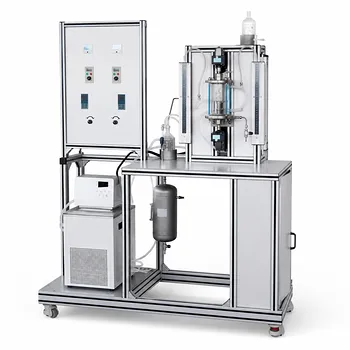
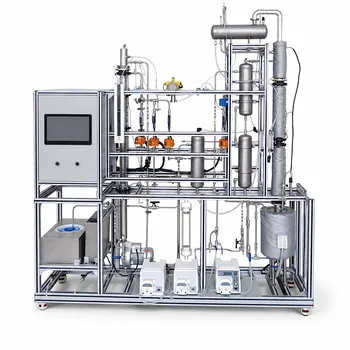
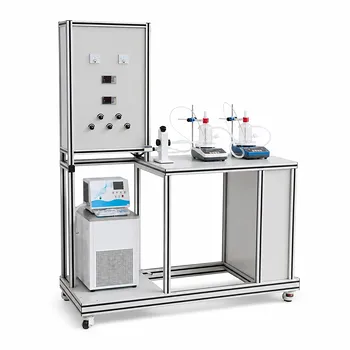
You can’t control what you can’t measure. Chemical engineering unit operations pilot plants transform abstract mass transfer theory into tangible, executable data. By precisely controlling agitation speed, fill level, and solvent properties, these scaled-down reactors allow you to experimentally determine the volumetric gas-liquid mass transfer coefficient (kLa) for multiphase reactions like catalytic hydrogenation. This direct measurement reveals whether your overall process rate is governed by physical transport or by intrinsic catalytic kinetics—a distinction that dictates the success of any scale-up.
The pilot plant is your diagnostic tool for mass transfer. It lets you map kLa across realistic operating conditions, enabling you to predict and prevent hydrogen starvation, catalyst deactivation, and selectivity loss when moving from lab to production scale.
Why kLa Matters More Than You Think in Hydrogenation
The Physical Bottleneck No Reactor Can Escape
Hydrogen must cross a gas-liquid interface before it ever touches the catalyst. That step—governed by kLa—often becomes the slowest part of the whole transformation. A reactor with a low kLa starves the liquid of hydrogen, even if the catalyst itself is lightning-fast.
The Hidden Costs of Hydrogen Starvation
When the dissolved hydrogen concentration plunges, three dangerous things happen. First, the observed reaction rate becomes tied to mixing, not chemistry, making scale-up unpredictable and posing safety hazards. Second, the catalyst surface can irreversibly deactivate due to adsorbed intermediates and metal leaching. Third, reaction selectivity—especially chiral selectivity in asymmetric hydrogenations—can collapse or even flip to the opposite enantiomer. In pilot plants, measuring kLa helps you spot and fix these vulnerabilities before they become plant-scale disasters.
The Damkohler Number: Your Process’s Report Card
The Damkohler number (Da) compares the maximum reaction rate to the maximum mass transfer rate. A Da > 1 tells you the reaction is mass-transfer-limited; a Da < 0.1 means kinetics dominate. By measuring kLa in the pilot plant and knowing your catalyst kinetics, you can compute Da and instantly diagnose whether you need better mixing, higher pressure, or a more active catalyst.
The Pilot Plant as a kLa Measurement Laboratory
The Non-Reactive Gas Uptake Method
The most straightforward protocol involves degassing a solvent under vacuum, introducing hydrogen to the headspace, and restarting agitation. A fast-response pressure transducer records the headspace pressure drop as gas dissolves. The rate of pressure decrease directly yields kLa without the complexity of a running reaction.
Step-by-Step Protocol
First, the solvent is degassed under vacuum with the agitator running. The agitator is then stopped, hydrogen is fed up to a target pressure, and the gas inlet is closed. When agitation resumes, pressure drops. Plot the transformed pressure data using the first-order rate equation: [ \ln\left[\frac{P_i - P_f}{P - P_f}\right] \cdot \frac{P_f - P_0}{P_i - P_0} = (k_La)t ] The slope of the linear portion gives kLa for that exact configuration. Alternatively, the initial slope of the pressure decay (dP/dt) can be used for a rapid estimate. This hands-on experiment turns the pilot plant into a precise mass transfer sensor.
The Knobs You Turn to Measure and Optimize kLa
Pilot plants let you systematically vary the parameters that control kLa. Agitation rate, agitator type and vertical position, reactor fill level, the presence of baffles, and the use of a subsurface sparge line all strongly affect the measured coefficient. Solvent properties (viscosity, density, and gas solubility) and operating temperature also shift kLa. By mapping kLa across these variables, you build a transfer coefficient “map” for the reactor—a map that is essential for scale-up correlations and for teaching fundamental transport phenomena.
Understanding the Trade-offs
The Gap Between Measurement and Reality
The non-reactive uptake method is clean and safe, but it doesn’t perfectly mirror a live hydrogenation. In a real reaction, gas bubbles may be consumed at the interface, and catalyst particles can alter bubble breakup and coalescence. The measured kLa serves as a vital baseline; you must still validate it against reactive hydrogen uptake data for critical processes.
The Danger of Averaging
A single kLa value can mask spatial non-uniformities. In large pilot reactors, mass transfer is often better near the impeller and poorer in stagnant zones. Treating kLa as a uniform number may lead to under-mixing in the scaled reactor if not accompanied by hydrodynamic studies or CFD validation.
Solvent and Suspension Effects
Solvent choice changes kLa through viscosity and surface tension, while catalyst loading can alter the gas-liquid interfacial area. A kLa measured only in pure solvent may overestimate transfer rates during actual three-phase operation. Savvy users run kLa experiments with representative slurries or at least account for these shifts when interpreting data.
Making the Right Choice for Your Goal
Once you understand the power and limits of pilot-plant kLa measurement, align your experiments with your primary objective. Here’s how to proceed:
- If your primary focus is mastering fundamental transport phenomena: Systematically vary agitation, fill level, and gas flow rate in the pilot plant while recording pressure decay curves. Use the resulting kLa data to explore mass transfer theory, dimensionless numbers, and validate CFD simulations.
- If your primary focus is scaling up a catalytic hydrogenation: Determine kLa for both your lab-scale and pilot-scale reactors under identical simulated process conditions. Calculate Damkohler numbers to identify controlling regimes, and ensure the scaled vessel provides sufficient kLa to maintain hydrogen saturation and avoid starvation-driven deactivation or selectivity loss.
- If your primary focus is protecting catalyst activity and product selectivity: Maintain a kLa high enough that dissolved hydrogen concentration stays close to equilibrium. Use pilot plant data to set agitation and pressure targets that keep Da < 0.1, guaranteeing the reaction, not mass transfer, dictates the outcome.
- If your primary focus is building robust scale-up correlations: Gather kLa data over a wide range of power-per-volume inputs and gas superficial velocities. Correlate your pilot-scale kLa with Sherwood number and Reynolds number to develop predictive models for commercial reactor design.
With a pilot plant converted into your personal mass transfer laboratory, you move decisively from guessing about hydrogen transport to engineering it with precision.
Summary Table:
| Parameter | Impact on $k_La$ | Optimization Strategy |
|---|---|---|
| Agitation Speed | Controls bubble breakup and shear rate | Increase RPM to maximize interfacial area |
| Gas Sparging | Determines initial bubble size and distribution | Use subsurface sparging to boost contact time |
| Solvent & Slurry | Viscosity and solids alter gas coalescence | Adjust slurry concentration to maintain transport |
| Reactor Internals | Baffles and impeller design eliminate dead zones | Optimize geometry for uniform mixing |
Master Mass Transfer & Unit Operations with LABPARK
Bridge the gap between theoretical chemistry and industrial scale-up. LABPARK provides premium Educational and Vocational Unit Operations Pilot Plants in chemical engineering, bioprocess & biotech, and environmental & water treatment.
Designed specifically for universities, research institutes, and enterprises, our pilot plants empower users to experimentally determine mass transfer coefficients ($k_La$), optimize multiphase reactions, and build robust scaling models.
Ready to elevate your engineering lab? Contact LABPARK today to find the perfect pilot plant system for your curriculum or research needs!
Related Products
- Dual-Drive Stirred Gas-Liquid Mass Transfer Coefficient Determination Pilot Plant
- Liquid-Liquid Mass Transfer Coefficient Determination Educational Pilot Plant
- Absorption and Desorption Educational Unit Operations Pilot Plant
- Packed Bed Absorption Educational Unit Operations Pilot Plant
- Carbon Dioxide Absorption and Desorption Educational Pilot Plant for Carbon Capture Studies
People Also Ask
- How does temperature affect mass transfer rates in chemical engineering educational pilot plants?
- How do pilot plants study gas solubility in polymer melts at high pressures? Key Mass Transfer Insights
- How does column packing affect absorption intensification, and how is it evaluated experimentally?
- Why Compare Membrane-Reservoir Models with Pilot Plant Data? Ensure Successful Process Scale-Up
- How does k_La affect hydrogenation scale-up? Critical insights for pilot reactors.