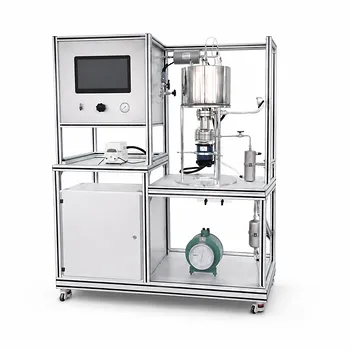
When a gas-liquid-solid reaction produces insoluble precipitates or fouls the catalyst, pilot plants don’t simply scale down industrial tricks—they embed smart reactor selection and real-time deactivation diagnostics.
Slurry reactors are the go-to choice when insoluble products threaten to plug fixed beds, because the fluidized motion keeps solids suspended and the reactor open. For catalyst fouling—whether by coke, metals, or sintered particles—moving fixed‑bed or fluidized‑bed reactors allow continuous or semi‑continuous catalyst replacement and regeneration without shutting down the pilot plant. This deliberate alignment of reactor configuration with physical‑chemical behavior ensures uninterrupted operation and meaningful data collection.
Complex three‑phase reactions in pilot plants are accommodated by matching reactor hydrodynamics to the failure mechanism: slurry reactors prevent mechanical blockage by suspended solids, while moving or fluidized beds solve catalyst deactivation through on‑stream renewal. The pilot plant then becomes a diagnostic platform to pin down exactly how and why the catalyst loses activity.
Reactor Selection for Problematic Three‑Phase Reactions
Choosing the right reactor type is the first and most powerful line of defense. The primary reference frames this as a simple but non‑negotiable rule: let the behavior of the solids dictate the reactor configuration.
Slurry Reactors for Insoluble Products
When the reaction product is insoluble in the liquid phase, it will precipitate inside the reactor.
In a fixed‑bed configuration, these solids settle and rapidly form blockages that shut down flow.
A slurry reactor circumvents this by keeping the solid catalyst and any precipitated products in constant motion.
The turbulent liquid‑gas mixture suspends all fine particles, preventing settling and pore plugging.
This means a pilot plant can run continuously, even when producing a solid by‑product, without operator intervention to clear blockages.
The slurry design also gives excellent heat transfer and uniform temperature control, which is critical for kinetically sensitive three‑phase systems.
Researchers can therefore collect consistent rate data without the noise of random channeling or hot spots caused by local clogging.
Moving and Fluidized Beds for Catalyst Fouling
Catalyst deactivation from metal deposition (demetallization) or carbon laydown demands a different strategy.
In a traditional fixed bed, the catalyst inventory is trapped—once it fouls, the entire run must stop for replacement.
Moving fixed‑bed reactors overcome this by slowly withdrawing spent catalyst from the bottom while adding fresh catalyst at the top.
This semi‑continuous renewal keeps the average activity stable and mimics industrial guard‑bed or ebullated‑bed concepts.
For heavier duty, fluidized‑bed reactors go further: the entire catalyst bed is fluidized by the gas and liquid, allowing continuous circulation through a regenerator unit on the pilot scale.
Both options enable long uninterrupted runs, which is essential for testing catalyst lifetimes and deactivation kinetics.
The pilot plant can then record a true deactivation curve, not one cut short by a pressure‑drop spike from a plugged bed.
Beyond Reactor Choice: Diagnosing and Managing Deactivation
A pilot plant’s real power comes from its ability to turn the reactor into a diagnostic tool. Once the hardware keeps the process running, the focus shifts to understanding why activity declines.
Running Extended Pilot Runs to Distinguish Reversible from Irreversible Deactivation
Supplementary references show how pilot plants are intentionally used to run a reaction for 50 hours or more while tracking conversion and selectivity.
For example, a platinum‑impregnated silica catalyst for preferential CO oxidation may slowly lose performance.
Researchers can then manipulate conditions—applying repeated reduction treatments—to see how much activity can be recovered.
What returns is reversible deactivation, such as platinum oxide reduction; what never comes back is irreversible, like metal sintering that permanently reduces active surface area.
This experimental distinction directly shapes regeneration protocols and catalyst formulation choices.
Without the pilot plant’s extended‑run capability and analytical instrumentation, such mechanistic insights remain hidden.
Integrating Regeneration Protocols
Once a deactivation mechanism is identified, the pilot plant becomes a testbed for countermeasures.
In a moving bed reactor, partial regeneration can be performed on a slipstream, while the main reactor continues operating.
For slurry systems, in‑situ chemical treatments, such as acid washing to remove metal foulants, can be trialed during a run.
The pilot plant’s flexibility thus lets you compare the economics and effectiveness of different regeneration strategies side‑by‑side.
Trade‑offs and Practical Constraints
No reactor configuration is without its downsides. An objective technical advisor must lay these out plainly.
Slurry Reactor Downsides
The very turbulence that prevents plugging also causes catalyst attrition and erosion of reactor internals.
Fine catalyst particles must be continuously separated from the liquid product, which adds a complex filtration step downstream.
Additionally, slurry reactors can exhibit backmixing, reducing per‑pass conversion and complicating kinetic modeling.
Pilot plant operators must carefully weigh these costs against the benefit of clog‑free operation.
Moving Bed Complexity
A moving bed reactor introduces mechanical solids‑handling equipment that can be tricky to scale down.
Catalyst feeding and withdrawal systems risk bridging or segregation, and the engineering overhead can be high for a pilot‑scale unit.
Fluidized beds, while elegant, require precise control of gas‑liquid‑solid fluidization and may need an additional external regenerator loop.
Both options demand more instrumentation and safety interlocks than a simple fixed bed.
Downstream Separation of Insoluble Products
A slurry reactor may suspend the solid product, but you still need to recover it.
Pilot plants often integrate modular filtration units—plate‑and‑frame filters or rotary vacuum filters—immediately after the reactor.
This allows direct study of filtration kinetics, cake washing, and solvent recovery.
The arrangement converts a potential problem (solids in the liquid) into a teachable unit‑operation sequence that mirrors industrial reality.
Making the Right Choice for Your Pilot Plant Goal
The optimal configuration is not universal—it depends on what you are trying to learn or demonstrate.
- If your primary focus is preventing reactor blockage from insoluble products: Base your design around a slurry reactor, and pair it with a small‑scale filtration module to study solid‑liquid separation.
- If your primary focus is quantifying catalyst lifetime and regeneration effectiveness: Deploy a moving fixed‑bed or fluidized‑bed reactor that allows continuous catalyst withdrawal and recycling without interrupting the run.
- If your primary focus is mechanistic deactivation research: Use any reactor type that enables long‑term stable operation, but ensure you have the analytical tools to perform controlled in‑situ treatments (reduction, oxidation, acid wash) and track recovery.
- If your primary focus is teaching the underlying hydrodynamics and kinetics: A transparent‑walled scaled‑down slurry or fluidized unit can make particle motion visible and directly connect theory to observation.
A well‑chosen pilot plant reactor doesn’t just cope with insoluble products or catalyst fouling—it transforms those challenges into the very data that drives process innovation.
Summary Table:
| Reactor Type | Key Application | Main Advantage | Major Challenge |
|---|---|---|---|
| Slurry Reactor | Insoluble product precipitation | Prevents clogging; excellent heat transfer | Catalyst attrition; requires downstream filtration |
| Moving Fixed-Bed | Slow catalyst deactivation | Semi-continuous catalyst replacement | Mechanical complexity of solids handling |
| Fluidized-Bed | Rapid catalyst fouling | Continuous circulation to regenerator loop | Complex fluidization control and safety loops |
Scale Up Your Chemical Engineering Research with LABPARK
Handling complex three-phase reactions requires robust, well-designed equipment that bridges the gap between laboratory chemistry and industrial reality.
LABPARK designs and manufactures high-performance Educational and Vocational Unit Operations Pilot Plants specializing in:
- Chemical Engineering (including multiphase catalytic reaction systems)
- Bioprocess & Biotech
- Environmental & Water Treatment
We help universities, research institutes, and enterprises achieve precise process control, reliable kinetic data, and hands-on training platforms.
Ready to equip your facility with advanced pilot-scale solutions? Contact LABPARK today to discuss your custom project requirements with our engineering team.
Related Products
- Fixed Bed Gas Solid Catalytic Reaction Educational Pilot Plant
- Fluidized Bed Gas Solid Catalytic Reaction Educational Pilot Plant
- Micro-Scale Gas-Solid Catalytic Reaction Educational Pilot Plant
- Two-Dimensional Fluidization Hydrodynamics Educational Pilot Plant for Unit Operations Training
- Educational Unit Operations Pilot Plant for Intraparticle Diffusion Effective Factor Measurement
People Also Ask
- How do reactor pilot plants safely study gas-solid reactions? Master kinetics with thermal & flow control.
- How does the Mears criterion evaluate transport resistance? Key Guide to Intrinsic Kinetics
- Why is a multibed configuration necessary for exothermic reactions? Optimize your pilot plant trajectory.
- Fluidized vs. Fixed Bed Reactors: Comparing Heat & Complexity in Pilot Plants
- How is the friction factor determined for fixed-bed pilot plants? Select the best pressure drop correlation.