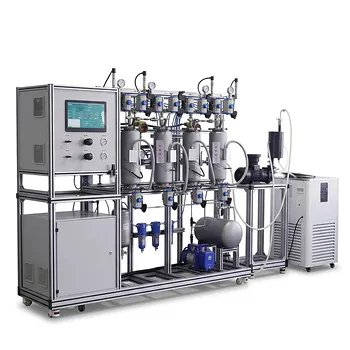
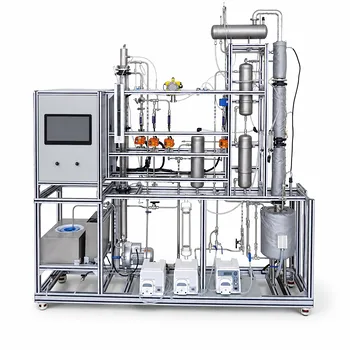
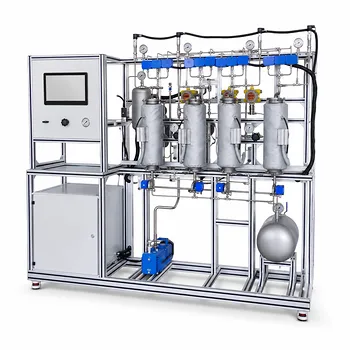
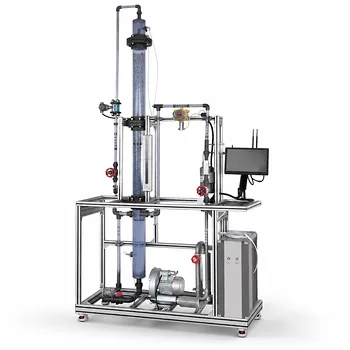
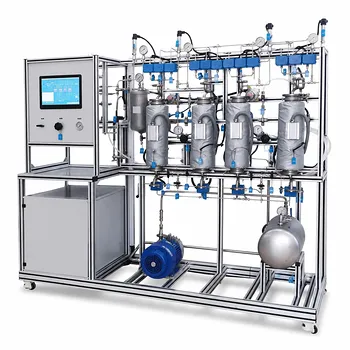
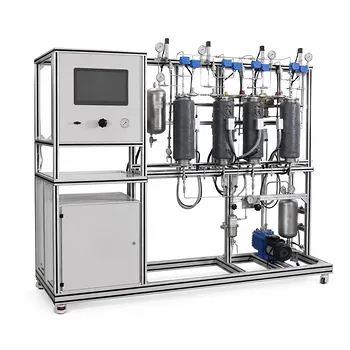
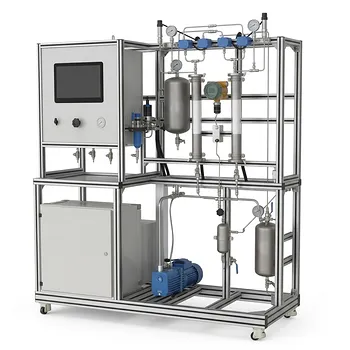
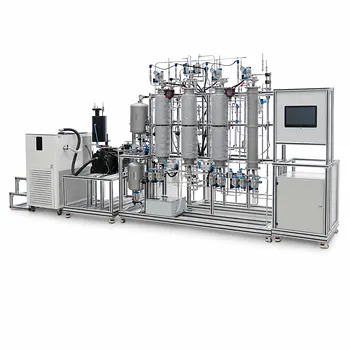
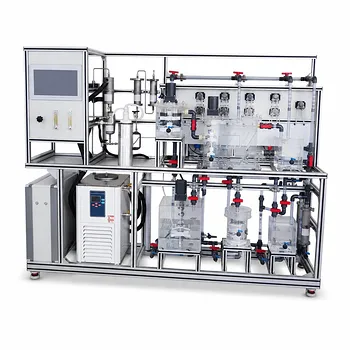
The power of a unit operations pilot plant lies in making the invisible visible. A laboratory-scale gas absorption and stripping pilot plant transforms abstract mass transfer equations into tangible, measurable phenomena. By running a packed column with a safe solute-solvent system like carbon dioxide and water, students can directly observe how counter-current flow, liquid-to-gas ratios, and thermodynamic conditions govern the efficiency of removing or recovering a solute from a gas stream.
A unit operations pilot plant serves as a bridge between theory and industrial practice. It provides a controlled environment to experimentally verify mass transfer coefficients, column flooding limits, and the impact of equilibrium shifts—turning textbook principles into hands-on engineering intuition.
The Heart of the Demonstration: Counter-Current Contact and Key Variables
The pilot plant’s core function is to create intimate, counter-current contact between a gas and a liquid phase. This simple arrangement unlocks a world of measurable engineering parameters.
Creating the Core Absorption/Stripping Setup
A typical educational unit features a packed column where the liquid solvent enters from the top and the gas mixture enters from the bottom. This counter-current flow maximizes the concentration driving force along the entire column height. The plant is instrumented with gas sensors at the inlet and outlet and precise flow controllers for both phases, enabling quantitative mass balances.
Measuring What Matters: L/G Ratio, Flooding, and Pressure Drop
Students can deliberately vary the liquid-to-gas (L/G) ratio to see its direct impact on outlet solute concentration. By pushing the liquid or gas flow rates to extremes, they can observe column flooding—the point where liquid is entrained upward or downward flow is restricted—and measure the corresponding pressure drop across the packing. This teaches the hydraulic limits of real equipment, a critical operational consideration no textbook can fully capture.
Driving Mass Transfer: The Role of Phase Equilibrium and Kinetics
Beyond hydraulics, the pilot plant is a thermodynamic playground. The solubility of a gas in a liquid is not a fixed constant; it responds to changes in operating conditions.
Manipulating Temperature and Pressure to Shift Equilibrium
With integrated thermal control systems and pressure regulation valves, the plant lets users increase pressure or lower temperature to dramatically enhance gas absorption. Reversing the conditions—raising temperature or reducing pressure—shifts the equilibrium the other way, forcing the dissolved gas to desorb. This demonstrates the fundamental thermodynamic lever that makes industrial solvent regeneration possible.
Physical vs. Chemical Absorption: A Tale of Two Mechanisms
The pilot plant’s modular fluid handling allows a direct comparison between two fundamentally different mass transfer mechanisms. Running the column with water and carbon dioxide illustrates physical absorption, where capacity depends purely on solubility. Switching to a reactive solvent, such as a dilute alkaline solution to absorb the same acidic gas, shows chemical absorption. Students can measure how chemical reaction dramatically increases the volume of gas dissolved per unit of solvent and lowers the equilibrium partial pressure, cementing the link between reaction kinetics, stoichiometry, and mass transfer rates.
Bridging Theory and Practice: Design and Operating Calculations
The true educational value of a pilot plant emerges when students confront the difference between designing a column and predicting the performance of an existing one.
Calculating Tower Height vs. Predicting Performance
Design calculations answer the question: “How tall must this column be to achieve 95% removal?” Using methods like the Kremser equation or graphical integration, students estimate the number of theoretical stages or the height of a transfer unit. They then run the plant under those design conditions to validate their work. Conversely, operating calculations start with a real column and ask: “What happens to the outlet concentration if I double the liquid flow rate?” The plant provides the real-time data to compare predicted performance from mass balances against actual measured outlet concentrations, highlighting the real-world role of efficiency factors and non-ideal contact.
Quantifying Efficiency with Mass Transfer Coefficients
To move beyond black-box observation, plant measurements allow students to calculate overall mass transfer coefficients (K_Ga or K_La). By taking liquid samples at different packing heights and applying solute mass balances, they can determine the rate of mass transfer per unit volume per unit driving force. This exercise directly validates Fickian transport models and shows how the coefficient changes with flow rates, turning a theoretical constant into a dynamic variable.
The Complete Picture: Closed-Loop Absorption and Stripping
Industrial processes rarely stop at absorption; the solvent must be regenerated. A pilot plant can close this loop, demonstrating the full economic and environmental logic.
Demonstrating Solvent Regeneration and Environmental Applications
By coupling two columns—one for absorption and one for air stripping—the plant becomes a closed-loop system. The rich solvent from the absorber is sent to the top of a stripping column, where an inert gas (like air) carries the solute out. This teaches students the principle of solvent regenerability and directly mirrors industrial applications like removing volatile organic compounds from wastewater or recovering hydrogen chloride. The energy cost of the shift in equilibrium conditions becomes a tangible design constraint.
Modular Configurations for Enhanced Learning
To extend learning, many pilot plants feature a modular design. Instructors can connect two absorption columns in series or use columns with adjustable bed heights and tray counts. This allows students to experimentally verify that increasing contact volume or the number of stages directly improves separation efficiency—a powerful physical confirmation of the theoretical stage concept.
Understanding the Trade-offs and Limitations
Objectivity is essential. A pilot plant is an approximation, not a perfect replica of an industrial unit. The primary limitations include:
- Simplified solvent systems: Safe systems like CO2-water avoid the hazards of industrial solvents but do not exhibit the same complex wetting, foaming, or corrosion behaviors.
- Measurement fidelity: While gas sensors and flow controllers provide good data, the accuracy of mass balance closure is limited by sensor precision and potential end effects in short laboratory columns, requiring careful error analysis.
- **Scale-down effects:**The fluid dynamics of small-diameter columns can be dominated by wall flow rather than ideal plug flow, causing measured mass transfer coefficients to deviate from correlations developed for larger towers.
Acknowledging these gaps trains students to critically evaluate experimental data and understand the limits of idealized models.
Making the Right Choice for Your Educational Goal
The way you utilize the pilot plant should align with the core lesson you want to teach.
- If your primary focus is plant operation and hydraulics: Push the unit to its flooding limits and map the pressure drop curve, showing students the safe operating window of a real contactor.
- If your primary focus is thermodynamics and phase equilibrium: Use temperature and pressure variation experiments with a physical absorption system, and then contrast that with a chemical absorption run to reveal the power of reaction-enhanced mass transfer.
- If your primary focus is process design methodology: Have students perform a full design calculation for a target separation, run the column under those predicted conditions, and then conduct operating sensitivity analyses by varying the L/G ratio to test their predictive models.
- If your primary focus is environmental or sustainability concepts: Operate the plant in a closed absorption‑stripping loop to demonstrate solvent regeneration, energy consumption, and the principle of circular material flows.
A unit operations pilot plant does not just demonstrate what absorption and stripping look like; it reveals why they work, and under what conditions they might fail. That critical understanding is what transforms a student into an engineer.
Summary Table:
| Key Concept | Lab Implementation | Educational Value |
|---|---|---|
| Hydraulics & Flow | Varying Liquid-to-Gas (L/G) ratios in a packed column | Visualizes column flooding and measures real-time pressure drops |
| Thermodynamics | Adjusting temperature and pressure controls | Demonstrates equilibrium shifts for physical vs. chemical absorption |
| Mass Transfer | Sampling concentration profiles across packing heights | Calculates mass transfer coefficients ($K_{G}a$) & validates design calculations |
| Process Loop | Coupling absorption with an air stripping column | Illustrates industrial closed-loop solvent regeneration |
Elevate Your Chemical Engineering Lab with LABPARK
Bridge the gap between textbook theory and real-world industrial practice. LABPARK provides premium Educational and Vocational Unit Operations Pilot Plants in chemical engineering, bioprocess & biotech, and environmental & water treatment. Designed specifically for universities, research institutes, and enterprises, our modular systems allow students and researchers to safely demonstrate complex mass transfer operations like gas absorption and solvent stripping.
Ready to enhance your hands-on engineering curriculum? Contact our experts today to find the perfect pilot plant configuration for your institution!
Related Products
- Multi-Component Gas Pressure Swing Adsorption Pilot Plant for Unit Operations Education
- Absorption and Desorption Educational Unit Operations Pilot Plant
- Carbon Dioxide Absorption and Desorption Educational Pilot Plant for Carbon Capture Studies
- Dual-Mode Gas Absorption and Desorption Unit Operations Training Pilot Plant
- Carbon Dioxide Adsorption and Capture Educational Unit Operations Pilot Plant
People Also Ask
- How does Pressure Swing Adsorption (PSA) technology operate? Optimize gas separation with pilot plants.
- How is the direction and driving force of mass transfer determined in a gas absorption unit operations pilot plant?
- How do two-film & penetration theories apply to gas absorption pilot plant teaching? Key pedagogical insights.
- How does partial pressure behavior influence gas absorption pilot plants? Master Mass Transfer
- What are the limitations of Henry's Law in gas absorption pilot plants? Avoid critical lab errors.