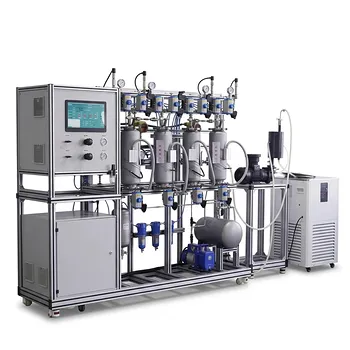
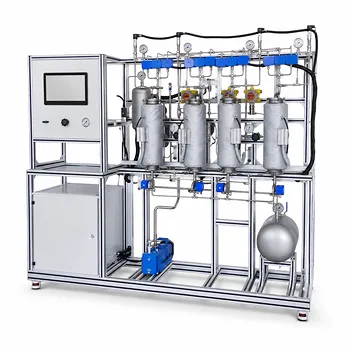
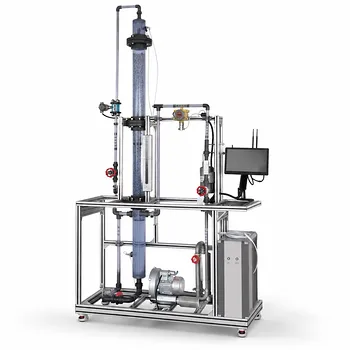
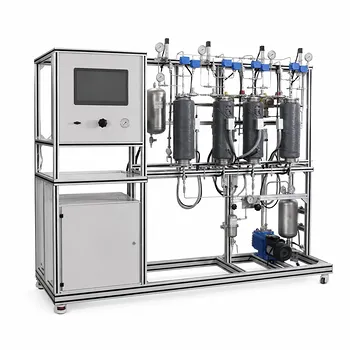
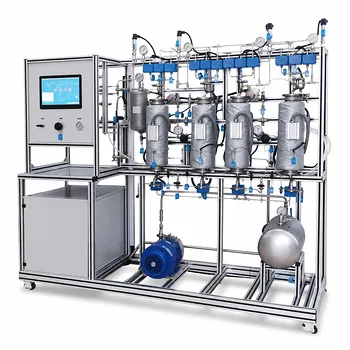
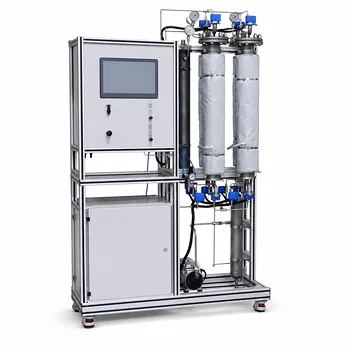
To demonstrate both absorption and desorption processes in a gas absorption pilot plant, you precisely manipulate temperature and pressure to shift the phase equilibrium. Operating at higher pressure and lower temperature forces a gas like CO₂ to dissolve into the liquid solvent (absorption). Conversely, reducing the pressure or raising the temperature decreases solubility, causing the dissolved gas to be released back into the gas phase (desorption). In a well-instrumented pilot plant, thermal control systems and pressure regulation valves let you cycle between these conditions, directly observing the reversible mass transfer that underpins industrial solvent-based separation operations.
At its core, the demonstration hinges on one thermodynamic truth: gas solubility in a liquid increases with pressure and decreases with temperature. By altering these two variables, you control the equilibrium driving force, dictating whether mass transfer flows into the liquid or back into the gas. The real educational value, however, lies in understanding the trade‑offs between the sheer driving force and the kinetic rate of mass transfer.
The Thermodynamic Foundation: Pressure, Temperature, and Solubility
The direction of gas transfer—absorption or desorption—is determined by the distance from equilibrium. Temperature and pressure are the knobs that set this equilibrium target.
Henry’s Law Quantifies the Driving Force
At low to moderate concentrations, Henry’s Law governs the relationship: p = H · c*, where p is the partial pressure of the solute gas, c** is the equilibrium liquid concentration, and H is the temperature‑dependent Henry’s constant.
For absorption to occur, the actual liquid concentration c must be lower than c*; the gas dissolves to close that gap.
For desorption, c must exceed c*; the liquid releases gas to return to equilibrium.
Shifting the Equilibrium Target with Pressure
Increasing the total system pressure raises the solute’s partial pressure, which directly increases c* (if H is constant).
A higher c* creates a larger concentration driving force for absorption.
Conversely, lowering the pressure reduces c*, and if the liquid already contains dissolved gas, it becomes supersaturated—triggering desorption.
Shifting the Equilibrium Target with Temperature
Raising the temperature increases Henry’s constant H, meaning the liquid’s capacity to hold the gas diminishes.
For the same partial pressure, c* drops, making a previously saturated liquid now oversaturated. This drives stripping or desorption.
Cooling the solvent does the opposite: H decreases, c* rises, and the liquid can accept more gas, promoting absorption.
Practical Control in a Unit Operations Pilot Plant
Educational pilot plants are built to make these equilibrium shifts tangible. The equipment translates thermodynamic concepts into observable flow rates, column temperatures, and outlet gas compositions.
Pressure Manipulation Through Back‑Pressure Regulators
Absorption columns often operate at elevated pressures (e.g., 2–10 bar gauge) by throttling a back‑pressure control valve on the gas outlet.
For desorption, you reduce pressure—sometimes even applying vacuum—allowing the dissolved gas to flash out.
The same column can demonstrate both modes simply by changing the pressure setpoint, showing students how a single vessel can switch roles.
Temperature Control via Heat Exchangers and Jackets
A common setup recirculates solvent through a heating or cooling system.
For absorption, the solvent is cooled (say to 10–15°C) before entering the top of the column.
For desorption, the solvent is heated (e.g., to 50–80°C) so that as it contacts a stripping gas or simply experiences a pressure drop, the solute is released.
Demonstrating a Full Absorption–Desorption Cycle
Pilot plants often connect two columns in a loop to mimic industrial solvent regeneration.
In the first (absorber), you maintain high pressure and low temperature to capture CO₂ from a flue gas stream.
The loaded solvent then passes through a heat exchanger into a second (stripper), where you lower the pressure and raise the temperature to release a concentrated CO₂ stream and regenerate the solvent for reuse.
The Hidden Challenge: Balancing Thermodynamics and Kinetics
While the equilibrium story is clean, the real mass transfer rate is shaped by both the driving force and the speed of molecular diffusion. The two do not always align, and pilot plants are ideal for exploring this tension.
The Influence of Temperature on Diffusion
The gas‑phase diffusion coefficient D scales with T³/² and inversely with pressure.
Raising the temperature accelerates molecular diffusion, which can increase the mass transfer coefficient and speed up how quickly equilibrium is approached.
However, the same temperature rise reduces the equilibrium driving force. In certain regimes, you may observe that a slightly cooler column actually absorbs more gas overall because the thermodynamic benefit outweighs the kinetic penalty.
The Influence of Pressure on Diffusion
Higher pressure increases the equilibrium solubility but slows down diffusion (since D ∝ 1/p).
This means an absorption column at very high pressure might need a taller packing to compensate for the slower molecular movement, even though the final capacity is greater.
Pilot plant experiments can map the net absorption rate as a function of pressure, revealing the optimum point where the driving force and diffusivity are balanced.
Understanding the Trade‑offs and Limitations
No parameter change comes without a cost. A thoughtful demonstration must account for these real‑world constraints.
The Diffusion‑Equilibrium Dilemma
If you focus exclusively on solubility (very low temperature, very high pressure), you might be rewarded with large driving forces but penalized by slow mass transfer rates due to reduced diffusivity.
The “best” performance is often found at intermediate conditions that provide sufficient driving force without throttling kinetics. A pilot plant allows you to verify this experimentally, teaching that process optimization is rarely about extremes.
Equipment and Safety Boundaries
Pilot‑scale columns have design limits for pressure and temperature. Exceeding them risks mechanical failure or solvent boiling.
Using a safe solute‑solvent system like carbon dioxide and water avoids toxic or corrosive hazards, letting students focus on the physics rather than chemical dangers.
Even with water, demisting and proper venting are essential when flash desorbing large gas volumes.
The Complexity of Cyclic Operation
Demonstrating a full loop requires careful coordination: the absorber’s exit pressure must match the stripper’s inlet, and heat integration between the two columns can dramatically affect energy efficiency.
A simple demonstration might keep the two steps thermally independent, but an advanced experiment can highlight how a regenerative heat exchanger between the loaded and lean solvent streams reduces utility demand—mirroring real industrial designs.
Making the Right Choice for Your Demonstration Goal
Your chosen temperature and pressure setpoints should serve the specific learning objective. The same plant can tell many different stories.
- If your primary focus is fundamental thermodynamics: Use a single absorber, fix the liquid flow rate, and systematically vary pressure while holding temperature constant (or vice versa). Measure outlet gas concentration to plot the corresponding change in solubility and confirm Henry’s Law.
- If your primary focus is mass transfer kinetics: Operate at a moderate pressure and explore a range of temperatures. Calculate the overall mass transfer coefficient from the measured concentration profiles to see how the diffusion‑driven acceleration competes with the solubility loss.
- If your primary focus is process integration and cyclic efficiency: Connect two columns in a closed loop. Tune the absorber to high pressure/low temperature and the stripper to low pressure/high temperature, then measure the solvent regeneration efficiency and the purity of the desorbed gas.
- If your primary focus is control and transient behavior: Step‑change the pressure or temperature setpoint and observe the time‑dependent shift from absorption to desorption. Use online gas sensors to capture the dynamic response of the column.
By thoughtfully pairing temperature and pressure adjustments with clear measurement protocols, you turn a simple pilot plant into a living illustration of the thermodynamic and kinetic principles that govern every gas–liquid separation process.
Summary Table:
| Process | Temperature | Pressure | Solubility ($c^*$) | Mass Transfer Direction | Primary Use Case |
|---|---|---|---|---|---|
| Absorption | Lower (Cooling) | Higher | Increases | Gas dissolves into liquid | Flue gas scrubbing / CO₂ capture |
| Desorption | Higher (Heating) | Lower (or vacuum) | Decreases | Gas released from liquid | Solvent regeneration / stripping |
Elevate Process Education & Research with LABPARK
Bridge the gap between thermodynamic theory and industrial practice. LABPARK designs and delivers high-performance Educational and Vocational Unit Operations Pilot Plants in:
- Chemical Engineering (including gas absorption/desorption columns)
- Bioprocess & Biotech
- Environmental & Water Treatment
Tailored for universities, research institutes, and enterprises, our pilot plants feature precise temperature and pressure controls, safety safeguards, and robust data acquisition. Empower your students and researchers to master complex mass transfer dynamics firsthand.
Contact LABPARK today to discover the ideal pilot plant solution for your lab!
Related Products
- Dual-Mode Gas Absorption and Desorption Unit Operations Training Pilot Plant
- Multi-Component Gas Pressure Swing Adsorption Pilot Plant for Unit Operations Education
- Carbon Dioxide Adsorption and Capture Educational Unit Operations Pilot Plant
- Packed Bed Absorption Educational Unit Operations Pilot Plant
- Absorption and Desorption Educational Unit Operations Pilot Plant
People Also Ask
- How do temperature and pressure affect gas absorption and desorption? Optimize Pilot Plant Performance
- How do two-film & penetration theories apply to gas absorption pilot plant teaching? Key pedagogical insights.
- How does partial pressure behavior influence gas absorption pilot plants? Master Mass Transfer
- How is the direction and driving force of mass transfer determined in a gas absorption unit operations pilot plant?
- How to model chemical absorption as physical absorption? The pilot plant simplification criterion.