Knowledge Chemical Engineering Education How can the Hatta number guide gas absorption optimization? Master pilot plant mass transfer.
Author avatar

Tech Team · LABPARK

Updated 1 month ago

How can the Hatta number guide gas absorption optimization? Master pilot plant mass transfer.


For a fast reaction (√M > 3), increasing turbulence is a dead end—you must optimize chemical parameters. The Hatta number (√M) instantly tells the operator whether the absorption rate is controlled by what happens inside the liquid film or by what happens in the bulk liquid. This single dimensionless group acts as a diagnostic tool that prevents wasted effort and guides you straight to the control lever that actually matters.

The Hatta number uncouples mass transfer optimization into two distinct strategies. A value greater than 3 signals that the reaction is so fast it finishes inside the liquid film, rendering physical mixing improvements powerless. A value less than 1 signals that the reaction is so slow it only happens in the bulk, making the liquid holdup volume of your equipment the make-or-break design variable. Misreading this regime is the most common reason pilot-plant optimization campaigns fail.

Reading the Regime Map Correctly

What the Hatta Number Physically Represents

The Hatta number (M) is the ratio of the maximum possible reaction rate in the liquid film to the maximum diffusional transport rate through that same film. It tells you where the gaseous reactant is consumed.

  • √M > 3 (M ≫ 1): The reaction is fast. It is completed entirely within the thin liquid film adjacent to the gas-liquid interface. The bulk liquid sees virtually no dissolved gas.
  • √M < 1 (M ≪ 1): The reaction is slow. The gas diffuses through the film essentially unreacted and accumulates in the bulk liquid, where the chemical transformation eventually occurs.
  • 1 < √M < 3: The reaction is moderate. Consumption happens both in the film and in the bulk. Optimization becomes a balancing act.

The Critical Phase Transition

This classification shifts how the pilot plant operator thinks. The moment √M crosses roughly 3, the bulk liquid becomes chemically irrelevant for gas absorption. The liquid film itself becomes a tiny, self-contained reactor. The operator must abandon the reflex to “mix harder” and instead focus on the chemistry happening inside that film.

Optimizing When √M > 3 (The Chemical Regime)

Why Physical Mixing Stops Working

In the fast reaction regime, the rate of absorption is governed by ( k_L \cdot \sqrt{M} ) times the interfacial concentration. Because √M is large, the liquid-phase mass transfer coefficient ((k_L)) becomes overwhelmed by the reaction term. The absorption rate becomes insensitive to (k_L), meaning changes in impeller speed or superficial gas velocity—the classic knobs for improving (k_L a)—will deliver zero improvement.

The pathway to higher mass transfer is inside the liquid film, not in the turbulent eddies.

  • Select a more reactive absorbent, such as switching from a carbonate solution to an amine or a caustic solution for CO₂ absorption.
  • Increase the reactant concentration in the absorbent. A higher concentration of the active species steepens the concentration gradient inside the film, driving the reaction plane closer to the interface and accelerating absorption without any hardware changes.
  • Operate at a higher temperature if the reaction activation energy is high, as this selectively increases the rate constant while having a milder effect on diffusivity.

The Interface Concentration Lever

Once you recognize that physical diffusion from the gas side is the sole remaining resistance, the final lever is increasing the interfacial concentration of the gaseous species. This means raising the gas-phase partial pressure of the solute (e.g., increasing system pressure or enriching the gas stream). This is a direct multiplier on the absorption flux and becomes the primary operating variable.

Optimizing When √M < 1 (The Bulk Regime)

The Dominance of Liquid Holdup

If √M is less than 1, the liquid film is transparent to the gas. The slow, rate-determining step is the chemical reaction in the bulk liquid. The overall rate of gas consumption becomes proportional to the liquid holdup volume multiplied by the intrinsic reaction kinetics. Increasing the interfacial area ((a)) or (k_L) through aggressive sparging will only saturate the bulk liquid with unreacted gas, creating a bottleneck. The genuine solution is to give the liquid phase more space and time to react.

Equipment Selection Becomes the Strategy

On a pilot skid, this directly translates to column choice:

  • Choose a bubble column over a packed column. A bubble column provides a significantly larger liquid fraction (holdup) for a given vessel size, increasing the effective reactor volume.
  • Operate in a semi-batch mode with a large liquid inventory rather than a continuous thin-film flow. This maximizes the liquid residence time, ensuring the bulk reaction can reach completion.
  • If a continuous column is fixed, reduce the liquid throughput to increase the liquid residence time. The Hatta diagnosis tells you that conversion, not flux, is your pacing metric.

Avoiding Misguided Optimization

The Most Expensive Misdiagnosis

The single greatest pitfall in gas absorption pilots is using physical mass transfer correlations ((k_L \propto P_v^{0.4})) to fix a chemically limited problem. If an operator increases agitator power by 50% while √M > 3, the only measurable result is a higher electricity bill. The absorption rate will remain flat.

The Reverse Hazard

Conversely, treating a slow reaction system (√M < 0.5) as a diffusion problem and trying to improve it by changing the solvent’s chemistry is futile. The gas is already fully available in the bulk; the bottleneck is the kinetic rate constant. The protocol is to characterize the intrinsic kinetics separately and then scale up the liquid holdup, not to hunt for a more exotic absorbent.

Making the Right Choice for Your Pilot Operation

Armed with a calculated √M, your optimization decision tree becomes strictly fact-based.

  • If your calculated √M is greater than 3: Stop tweaking the stirrer and sparger. Increase the absorbent concentration, raise the operating pressure, or test a chemically more aggressive reactant.
  • If your calculated √M is between 1 and 3: You are in a mixed regime. Optimize both interfacial area (via gas dispersion with a disc turbine impeller) and the liquid holdup/reactant concentration, then deconvolute their effects using the enhancement factor theory.
  • If your calculated √M is less than 1: Maximize the liquid-phase residence time. Switch to a bubble column configuration, lower your liquid flow rates, or increase the liquid level in your reactor vessel.

The Hatta number’s power is that it eliminates guesswork, directing your time and budget to the single variable that will actually move the needle.

Summary Table:

Hatta Number (√M) Reaction Regime Rate-Limiting Step Key Optimization Strategy
√M > 3 Fast Diffusion in Liquid Film Increase reactant concentration, raise operating pressure, or use a more reactive absorbent.
1 ≤ √M ≤ 3 Moderate Mixed (Film & Bulk) Balance both gas dispersion (interfacial area) and liquid holdup/residence time.
√M < 1 Slow Kinetics in Bulk Liquid Maximize liquid holdup volume and residence time (e.g., use bubble columns, reduce flow rate).

Scale Up Your Chemical Engineering Training with LABPARK

Mastering complex mass transfer principles requires robust, real-world experimental setups. LABPARK provides premium Educational and Vocational Unit Operations Pilot Plants in chemical engineering, bioprocess & biotech, and environmental & water treatment.

Specially designed for universities, research institutes, and enterprises, our advanced pilot plants help operators translate theoretical dimensionless groups like the Hatta number into practical operational success.

Ready to elevate your laboratory’s capabilities? Contact us today to explore our custom pilot plant solutions!

Related Products

People Also Ask

Related Products

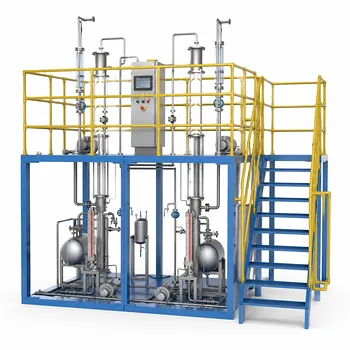
Dual-Mode Gas Absorption and Desorption Unit Operations Training Pilot Plant

Dual-Mode Gas Absorption and Desorption Unit Operations Training Pilot Plant

Industrial-scale pilot plant for gas absorption and desorption training in chemical engineering. Features dual-mode operation with real and simulated materials, transparent columns for flow visualization, and customizable design. Supports independent or combined loops for hands-on unit operations experiments.

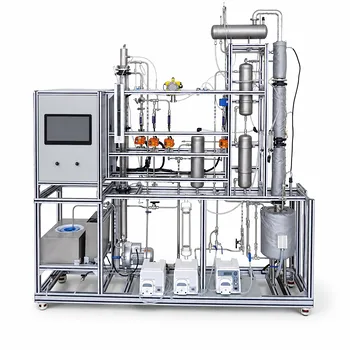
Carbon Dioxide Absorption and Desorption Educational Pilot Plant for Carbon Capture Studies

Carbon Dioxide Absorption and Desorption Educational Pilot Plant for Carbon Capture Studies

Explore carbon dioxide absorption and desorption with this educational pilot plant. Transparent columns visualize mass transfer; electric heating simulates industrial solvent regeneration; touchscreen interface enables data monitoring. Ideal for chemical engineering, bridging theory and practice.

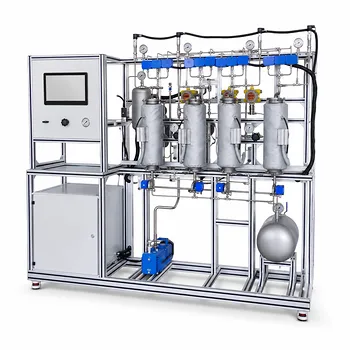
Carbon Dioxide Adsorption and Capture Educational Unit Operations Pilot Plant

Carbon Dioxide Adsorption and Capture Educational Unit Operations Pilot Plant

Advanced laboratory pilot plant for teaching carbon dioxide adsorption and capture unit operations. Features four-tower adsorption system with 400°C heating jackets, high-precision CO2 and O2 sensors, and 15.6-inch touchscreen with wireless data logging. Ideal for chemical engineering education.

Absorption and Desorption Educational Unit Operations Pilot Plant

Absorption and Desorption Educational Unit Operations Pilot Plant

Dual packed column absorption and desorption pilot plant for chemical engineering education, offering real-time mass transfer coefficient measurement, durable mobile frame, industrial touch-screen interface, and customizable design for varied laboratory curricula, enabling hands-on study of gas absorption and stripping.

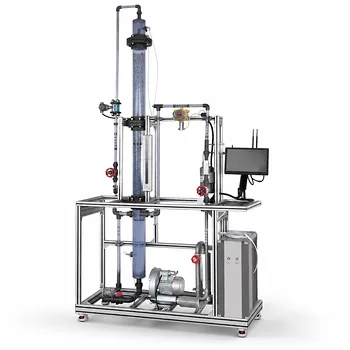
Packed Bed Absorption Educational Unit Operations Pilot Plant

Packed Bed Absorption Educational Unit Operations Pilot Plant

Study gas-liquid absorption, pressure drop, flooding, and mass transfer coefficients with this pilot plant. Transparent packed column, industrial touchscreen, real-time sensor data, automated analysis. Investigate two-phase flow, loading points, column efficiency. Comprehensive data logging and assessment software included.

Multi-Component Gas Pressure Swing Adsorption Pilot Plant for Unit Operations Education

Multi-Component Gas Pressure Swing Adsorption Pilot Plant for Unit Operations Education

Multi-component gas pressure swing adsorption pilot plant designed for unit operations education. Features four-tower configuration, IoT touchscreen control, dual regeneration, and real-time breakthrough curve analysis for engineering training with safety interlocks and mobile frame simulates industrial PSA processes.

Bench Scale Dual Column Gas Separation and Capture Educational Pilot Plant

Bench Scale Dual Column Gas Separation and Capture Educational Pilot Plant

This dual-column educational pilot plant provides hands-on teaching of gas adsorption, separation, and capture processes. It features stainless steel columns, regeneration up to 400°C, and a 15.6-inch touchscreen PLC for TSA and PSA studies in chemical engineering curricula, process simulation.

Bench Scale Carbon Dioxide Capture Educational Unit Operations Pilot Plant

Bench Scale Carbon Dioxide Capture Educational Unit Operations Pilot Plant

This bench-scale educational pilot plant simulates industrial CO₂ separation using a multi-tower adsorption system for hands-on engineering training. Students achieve ≥90% CO₂ purity while studying pressure swing adsorption, desorption kinetics, and process control in gas purification experiments.

Educational Pressure Swing Adsorption Ethylene Capture Unit Operations Pilot Plant

Educational Pressure Swing Adsorption Ethylene Capture Unit Operations Pilot Plant

Advanced educational pilot plant for pressure swing adsorption ethylene capture provides comprehensive hands-on training in industrial gas separation processes, featuring an eight-column PSA system, real-time data acquisition, and fully customizable design for chemical engineering unit operations laboratories and research.

Pressure Swing Adsorption Educational Unit Operations Pilot Plant

Pressure Swing Adsorption Educational Unit Operations Pilot Plant

Integrated bench-scale pressure swing adsorption pilot plant for hands-on teaching of gas-solid separation, mass transfer, and process optimization using nitrogen-oxygen model, featuring dual-column design, industrial touchscreen control, digital assessment suite, and customizable hardware and software configurations for educational laboratories.

Thermal Desorption Exhaust Gas and Tail Water Treatment Educational Pilot Plant

Thermal Desorption Exhaust Gas and Tail Water Treatment Educational Pilot Plant

Bench-scale educational pilot plant for treating thermal desorption exhaust gas and tail water integrates condensation, Fenton oxidation, precipitation, filtration, and carbon adsorption. Ideal for chemical engineering and environmental labs, teaching unit operations, process control, and real-time data analysis.

Carbon Dioxide Capture and Utilization Educational Pilot Plant for Unit Operations

Carbon Dioxide Capture and Utilization Educational Pilot Plant for Unit Operations

Educational pilot plant for carbon dioxide capture and utilization featuring four-tower adsorption, high-temperature regeneration, precise CO2 analysis, modern touchscreen control, real-time data, and robust construction for hands-on unit operations training in university labs with curriculum alignment and safe operation.

Multimodal Absorption and Desorption Pilot Plant for Unit Operations Training

Multimodal Absorption and Desorption Pilot Plant for Unit Operations Training

Multimodal absorption and desorption pilot plant for higher education labs. Bridges theory and industrial practice with transparent packed columns, three operational modes (real-material, simulated, semi-physical), and SCADA control. Students explore mass transfer, column hydraulics, and process control. Customizable.

Low Concentration Carbon Dioxide Capture Pressure Swing Adsorption Educational Pilot Plant

Low Concentration Carbon Dioxide Capture Pressure Swing Adsorption Educational Pilot Plant

Low-concentration CO2 capture pilot plant using Pressure Swing Adsorption for engineering education. Students gain practical experience in breakthrough curve measurement, adsorption dynamics, and variable analysis in a hands-on lab setting. Ideal for unit operations, mass transfer, and chemical engineering labs.

Fixed-Bed Chemical Reaction and Gas Dust Tar Removal Unit Operations Pilot Plant

Fixed-Bed Chemical Reaction and Gas Dust Tar Removal Unit Operations Pilot Plant

Integrated educational pilot plant for studying catalytic gas-solid reactions and downstream gas purification. Features dual fixed-bed reactor, three-stage heating, and touchscreen control for hands-on engineering training. Ideal for chemical and environmental engineering curricula.

Fluidized Bed Gas Solid Catalytic Reaction Educational Pilot Plant

Fluidized Bed Gas Solid Catalytic Reaction Educational Pilot Plant

Our educational fluidized bed gas-solid catalytic reaction pilot plant is ideal for chemical engineering labs. Students study fluidization dynamics, catalyst evaluation, and process control hands-on. Features include a customizable reactor, touchscreen HMI, and safety interlocks for safe, curriculum-aligned experiments.

Micro-Scale Gas-Solid Catalytic Reaction Educational Pilot Plant

Micro-Scale Gas-Solid Catalytic Reaction Educational Pilot Plant

Explore heterogeneous catalysis with this micro-scale gas-solid catalytic reaction educational pilot plant. Designed for university labs, it enables hands-on study of reaction kinetics and transport phenomena in a benchtop packed bed reactor with high-precision flow control and touchscreen automation.

Gas Phase Mixing and Residence Time Distribution Determination Educational Unit Operations Pilot Plant

Gas Phase Mixing and Residence Time Distribution Determination Educational Unit Operations Pilot Plant

Integrated lab system for gas-phase mixing and RTD determination. Supports pulse and step tracer methods with dual CSTR and PFR reactors, industrial components, and PC data logging. Provides hands-on study of non-ideal flow and reactor behavior for university students.

Educational Unit Operations Pilot Plant for Intraparticle Diffusion Effective Factor Measurement

Educational Unit Operations Pilot Plant for Intraparticle Diffusion Effective Factor Measurement

Designed for chemical engineering university labs, this pilot plant allows hands-on determination of catalyst particle intraparticle diffusion effective factors and gas-solid reaction kinetics using a fixed-bed tubular reactor with industrial touchscreen control, bridging theory and practical reactor design.

Gas-Solid Heterogeneous Separation Demonstration Educational Unit Operations Pilot Plant

Gas-Solid Heterogeneous Separation Demonstration Educational Unit Operations Pilot Plant

Comprehensive visual transparent gas-solid separation pilot plant for chemical engineering labs. Demonstrates gravity settling inertial settling cyclone and bag filter technologies. Enables real-time analysis of fluid-particle mechanics pressure drop and collection efficiency. Ideal for undergraduate unit operations courses.


Leave Your Message