Your pilot plant’s real bottleneck isn’t always obvious—it’s hidden in a dimensionless number. The Hatta number ($M^2$) directly compares the time it takes for a molecule to diffuse to the time it takes for it to react. In a gas-liquid reactor pilot plant, a simple calculation of $M^2$ reveals whether your process is limited by mass transfer (how fast the gas reaches the liquid) or by chemical kinetics (how fast the reaction itself proceeds). When $M^2$ is very small, the reaction is so slow that it happens leisurely in the bulk liquid, putting the kinetics in control. When $M^2$ is very large, the reaction is blisteringly fast and consumes the gas within the thin liquid film, making physical diffusion the rate-limiting step.
Identifying the rate-controlling step isn’t academic—it dictates every lever you can pull in your pilot plant. The Hatta number translates an invisible molecular tug-of-war into a clear diagnostic: it tells you whether to optimize your mixing, your chemistry, or your reactor geometry.
Why the Hatta Number Matters in Pilot Plant Work
A pilot plant exists to de-risk scale-up and validate models. Misinterpreting what controls your reaction rate can lead you to tune the wrong knobs and draw faulty conclusions. The Hatta number forces you to confront the fundamental question: “Is my reactor struggling to bring gas and liquid together, or is it simply waiting for a sluggish chemical transformation?”
Linking Reactor Performance to Fundamental Regimes
Without a regime classification, pilot plant data can seem contradictory. You might increase agitation and see no improvement—a classic sign that you are not in a mass-transfer-controlled regime. Conversely, if raising the temperature (which accelerates kinetics) does nothing, the reaction is likely diffusion-starved. The Hatta number gives you a predictive framework to anticipate these responses before you turn a single valve.
The Diagnostic Power of Dimensionless Ratios
$M^2$ is formally defined as the ratio of the characteristic time of diffusion to the characteristic time of reaction. It doesn’t just give you a magnitude; it tells you where the reaction is physically happening. A value that puts the reaction inside the stagnant film versus the well-mixed bulk has enormous consequences for how you design your pilot plant equipment and interpret your conversion data.
Decoding the Rate-Controlling Step with $M^2$
The raw calculated value of $M^2$ places your system into a clear regime. These regimes, in turn, directly name the rate-controlling step.
The Slow Reaction Regime ($M^2 \ll 1$): Kinetics Takes the Stage
When $M^2$ is much less than 1, the reaction is so slow that it can’t consume the gas quickly enough. The liquid film offers negligible resistance, and the dissolved gas penetrates deep into the bulk liquid.
In this regime, the chemical reaction rate becomes the bottleneck. The reactor behaves almost like a homogeneous liquid-phase system. This is critical in pilot plant operation: you can’t fix a low conversion rate by installing a more aggressive gas sparger. Instead, you must increase the temperature, raise the catalyst concentration, or select a more reactive absorbent.
The Fast Reaction Regime ($M^2 \gg 1$): Diffusion Takes Control
When $M^2$ is much greater than 1, the reaction is so rapid that it’s over before the gas molecule can even leave the liquid boundary film. The reactant concentration in the bulk liquid essentially drops to zero.
Here, mass transfer is the unequivocal rate-controlling step. All attempts to boost kinetics will fail. Your pilot plant levers shift entirely to the physical side: increasing interfacial area with a better packing or bubble distributor, or optimizing the liquid-phase turbulence to reduce film thickness. The Hatta number signals that your reactor's volume is being underutilized—the reaction is only happening in a tiny fraction of the liquid inventory.
The Instantaneous Reaction ($M^2 \to \infty$): A Diffusion-Only World
This is an extreme case of the fast regime. The reaction happens at a sharp plane within the film where the gaseous and liquid-phase reactants meet. The rate is dictated exclusively by how fast the two species can diffuse to that plane.
For a pilot plant, this means even the specific chemical species become secondary; the entire focus shifts to pure mass transfer enhancement. Operations must center on maximizing the physical mass transfer coefficient, as no amount of liquid-phase agitation beyond a certain point can help—it can only augment the gas-side resistance.
Understanding the Trade-offs and Pitfalls
The Hatta number is a powerful lens, but it’s not a crystal ball. Relying on it blindly in a complex pilot plant environment can lead to missteps.
The Assumption of a Pseudo-First-Order World
The classic $M^2$ derivation often assumes the liquid-phase reactant concentration is constant or the reaction is pseudo-first-order. In a real pilot plant, reactant depletion in a fast reaction can alter the local Hatta value. You must verify that the calculated regime holds across the entire column height.
Mixing and Non-Ideal Flow Can Blur the Boundaries
The Hatta number is film-theory-based. In a pilot bubble column or agitated tank with significant liquid backmixing, the clear boundary between “reaction in the film” and “reaction in the bulk” gets fuzzy. For systems with $M^2 \approx 1$, neither kinetics nor mass transfer solely controls the rate—both matter simultaneously. This mixed-control regime requires a combined analysis and forbids simple “either-or” troubleshooting.
Suitability for Pilot Plant Design vs. Operation
For equipment design, a high $M^2$ justifies spending capital on a high-surface-area packing. Operationally, however, that same high $M^2$ means you’ve already hit a mass-transfer ceiling. The Hatta number doesn’t just tell you what’s happening; it defines the set of economically viable solutions.
Making the Right Choice for Your Pilot Plant Goal
Applying the Hatta number effectively means matching its insight to your specific objective. Use these guides to direct your next step.
- If your primary focus is educational demonstration: Use $M^2$ to let students visually connect a theoretical regime shift to a real plant response. Change the temperature to move from the slow to fast regime and watch the reactor's sensitivity to stirring speed completely invert.
- If your primary focus is troubleshooting poor conversion: First, calculate $M^2$. If it is very large, stop modifying the chemical formula and start measuring your gas holdup and bubble size. If it is very small, raise the temperature or catalyst loading before re-evaluating.
- If your primary focus is scale-up validation: Ensure the $M^2$ value is matched between your pilot and full-scale plant, especially if you’re in the fast regime. Matching only the residence time or stirring power will fail catastrophically if you haven’t preserved the mass transfer regime.
- If your primary focus is optimizing reactor equipment: For $M^2 \ll 1$, prioritize reactors with large liquid holdup, like bubble columns. For $M^2 \gg 1$, prioritize equipment maximizing interfacial area and short diffusion paths, such as packed or spray columns.
The Hatta number strips away the complexity of a gas-liquid reaction to reveal the true bottleneck. When you let this dimensionless number guide your pilot plant design and operation, you stop solving the wrong problem and start engineering the right solution.
Summary Table:
| Hatta Number ($M^2$) | Reaction Regime | Rate-Controlling Step | Recommended Pilot Plant Action |
|---|---|---|---|
| $M^2 \ll 1$ | Slow | Chemical Kinetics | Increase temperature, catalyst loading, or reactant concentration |
| $M^2 \gg 1$ | Fast | Mass Transfer (Diffusion) | Enhance mixing, optimize packing, or improve bubble distribution |
| $M^2 \to \infty$ | Instantaneous | Pure Mass Transfer | Maximize interfacial area and physical mass transfer coefficient |
Optimize Your Chemical Engineering & Bioprocess Operations
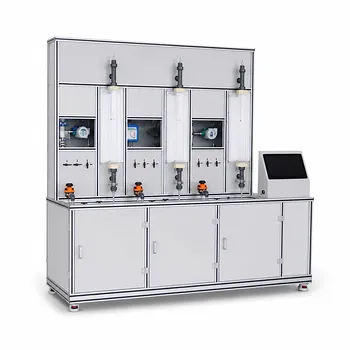
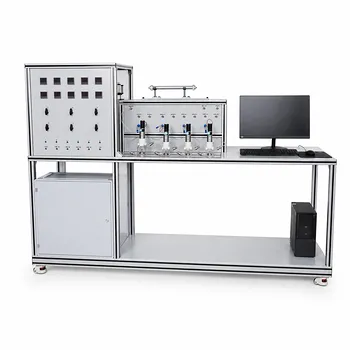
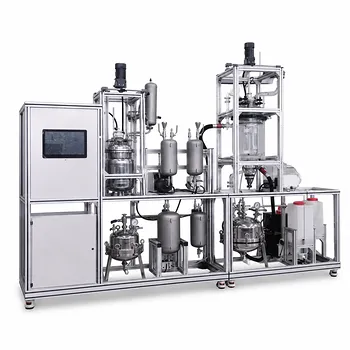
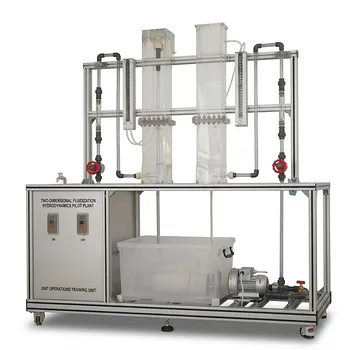
Struggling to scale up your gas-liquid reactions or accurately identify process bottlenecks? LABPARK is here to help. We design and deliver high-performance Educational and Vocational Unit Operations Pilot Plants across key domains:
- Chemical Engineering (including advanced gas-liquid reactor systems)
- Bioprocess & Biotech
- Environmental & Water Treatment
Tailored specifically for universities, research institutes, and enterprises, our pilot plants bridge the gap between theoretical calculations (like the Hatta number) and real-world industrial operations.
Ready to elevate your research, student training, or scale-up capabilities? Contact LABPARK today to discuss your custom pilot plant needs!
Related Products
- Fixed Bed Gas Solid Catalytic Reaction Educational Pilot Plant
- Fluidized Bed Gas Solid Catalytic Reaction Educational Pilot Plant
- Fixed-Bed Chemical Reaction and Gas Dust Tar Removal Unit Operations Pilot Plant
- Micro-Scale Gas-Solid Catalytic Reaction Educational Pilot Plant
- Two Phase Flow Pattern Velocity Resistance Measurement Educational Pilot Plant
People Also Ask
- How do reactor pilot plants safely study gas-solid reactions? Master kinetics with thermal & flow control.
- How does the Mears criterion evaluate transport resistance? Key Guide to Intrinsic Kinetics
- Fluidized vs. Fixed Bed Reactors: Comparing Heat & Complexity in Pilot Plants
- Why is a multibed configuration necessary for exothermic reactions? Optimize your pilot plant trajectory.
- How is the friction factor determined for fixed-bed pilot plants? Select the best pressure drop correlation.