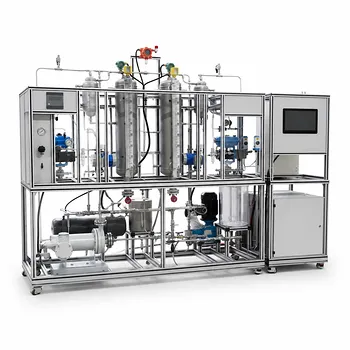
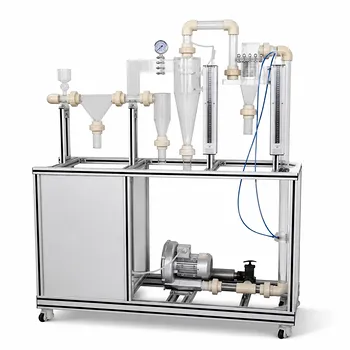
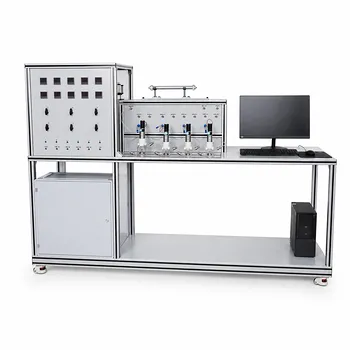
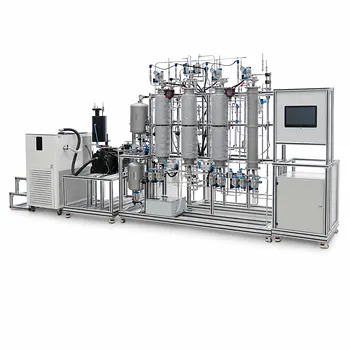
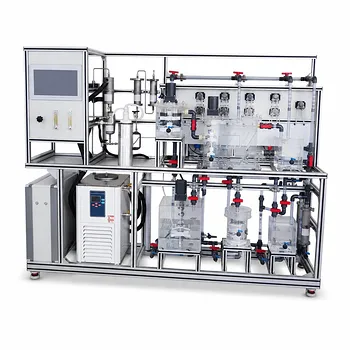
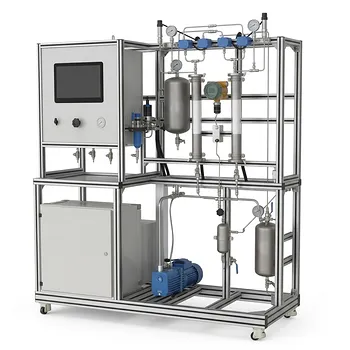
Selective H2S removal in an alkanolamine pilot plant is studied by deliberately exploiting the kinetic difference between H2S and CO2. You manipulate the same physical knobs—solvent flow rate, temperature, and gas-liquid contact time—that govern industrial tail-gas treaters, then measure how these variables push the system toward capturing H2S while slipping the slower‑reacting CO2. The plant transforms abstract reactor design equations into tangible cause‑and‑effect data you can trace on a trend chart.
The real power of the pilot plant is in making kinetic selectivity visible: by turning a few operating dials, you can directly observe how the nearly instantaneous H2S‑amine reaction is favored over the much slower CO2 absorption. Selectivity is not a fixed chemical property—it is a dynamic outcome of process conditions, and the pilot plant lets you map that outcome in detail.
The Deep Need: Why Selective Absorption Matters, and How the Pilot Plant Teaches It
When a gas treating unit processes sour streams containing both H2S and CO2, the economic and environmental ideal is selective removal of H2S—the reactive, toxic acid gas—while leaving the bulk of the CO2 in the treated gas. In educational and research settings, the alkanolamine‑based pilot plant becomes a powerful tool to demonstrate that selectivity is not something you buy with a better solvent; it is something you engineer through operating conditions. The plant compresses what would be months of plant‑scale trial‑and‑error into a few hours of systematic experimentation.
The Kinetic Foundation of Selectivity
Alkanolamines separate H2S from CO2 by exploiting a kinetic rift. H2S reacts with amines through a simple proton‑transfer mechanism that is effectively instantaneous. CO2, in contrast, must first dissolve and then follow a multi‑step reaction pathway—hydrating or forming a carbamate—that proceeds orders of magnitude slower. This kinetic gap means that if the gas‑liquid contact time is kept very short, the amine grabs the H2S while the CO2 does not have enough residence time to be absorbed in significant quantities. The pilot plant allows you to shrink or stretch that contact time deliberately.
How Pilot Plant Variables Control Selectivity
Every dial on the unit has a direct link to the kinetic advantage. Here are the primary levers and how they influence the experimental outcome.
Solvent Flow Rate and Liquid‑to‑Gas Ratio
Running the absorber at a low solvent circulation rate limits the total amine available, which starves the CO2 reaction while still providing enough alkalinity to strip H2S. By recording the H2S and CO2 concentrations in the treated gas as you vary the lean amine flow, you can pinpoint the liquid‑to‑gas (L/G) ratio that maximizes the H2S removal efficiency for a given CO2 slip target. The pilot plant’s flow controllers and in‑line gas analyzers make this mapping routine.
Temperature: A Double‑Edged Sword
The absorption of both acid gases is exothermic, but temperature influences the two reactions differently. The rapid H2S‑amine neutralization is largely diffusion‑controlled and less sensitive to moderate temperature changes. CO2 absorption, being chemically rate‑limited, accelerates noticeably as temperature rises. Keeping the absorber temperature modest—often between 35 °C and 45 °C for methyl diethanolamine (MDEA)‑based solvents—slows the CO2‑amine kinetics relative to H2S. The pilot plant’s jacketed column and temperature probes let you hold a tight isothermal profile and directly observe the selectivity shift.
Gas‑Liquid Contact Time and Column Configuration
The residence time of the gas in the absorption zone is the most direct selectivity knob. In a packed column, this is a function of the packing height and the gas velocity. Many educational pilot plants offer adjustable bed heights or modular column sections. By running experiments with, for example, 1 m versus 2 m of packing, you can show that the shorter bed delivers dramatically higher CO2 slip because the gas passes through before CO2 can react, while H2S removal stays high. This teaches the essential distinction between equilibrium‑limited and kinetically limited operations.
Monitoring and Analysis: Turning Data into Understanding
The pilot plant is instrumented to make the selective absorption phenomenon quantifiable.
Real‑Time Gas Analysis
On‑line H2S and CO2 analyzers at the absorber inlet and outlet are the primary eyes of the experiment. A sudden drop in H2S with a negligible change in CO2 as solvent flow increases immediately confirms kinetic selectivity. Plotting selectivity factor (α) —the ratio of H2S removed to CO2 removed—against the manipulated variable gives a clear, reproducible fingerprint of the operating window where selectivity is optimal.
Liquid‑Phase Loading Measurement
Sampling the rich amine and analyzing its H2S and CO2 loading (mol acid gas/mol amine) reveals what the gas analyzers cannot: how much of the solvent’s capacity is being consumed by unwanted CO2. When you see that at very low contact times the rich amine is loaded almost exclusively with H2S, you have direct evidence that the kinetic separation is working. Many pilot plants include a regeneration column, so you can close the loop and study how solvent loading affects selectivity in subsequent absorption cycles.
Understanding the Trade‑offs
No experimental learning is complete without confronting the compromises that real plants face. The pilot plant exposes these limits directly.
The Co‑Absorption Penalty
Chasing 100 % H2S removal inevitably pulls in more CO2. As the solvent flow rate or contact time increases, the H2S removal plateaus while CO2 absorption climbs steeply. The pilot plant makes this diminishing returns curve visible. The important lesson is that a commercial unit must accept a small H2S leak to keep the amine from becoming overloaded with CO2, which would raise regeneration energy and solvent circulation requirements.
Solvent Stability and Equipment Corrosion
The primary reference’s focus on MDEA is instructive, but tertiary amines bring their own challenges. Low‑contact‑time operation relies on a narrow kinetic window, and if the plant is pushed to absorb more CO2—perhaps because the H2S specification becomes extremely tight—the solvent may form corrosive degradation products. The pilot plant’s transparent sections (often present in educational units) or periodic fluid sampling teach students to watch for color changes and pH drops that signal solvent breakdown. Prolonged operation under these conditions would damage stainless‑steel internals in industrial equipment, a lesson that is far more impactful when seen firsthand.
Making the Right Choice for Your Goal
How you use the pilot plant depends on whether you are training operators, researching new solvents, or validating a process design.
- If your primary focus is teaching reactor engineering principles: Systematically vary the L/G ratio and column height to demonstrate the shift from kinetic to equilibrium control. Record the selectivity factor at each condition and ask students to predict the point where mass transfer becomes limiting for CO2 but not for H2S.
- If your primary focus is researching amine formulations: Use the plant as a screening tool. Compare a new formulated MDEA against a baseline under identical short‑contact‑time conditions, using the H2S/CO2 loading ratio in the rich amine as the key performance indicator.
- If your primary focus is troubleshooting a commercial SCOT or tail‑gas unit: Program the pilot plant to replicate the problematic temperature and flow profiles. Then apply small, controlled step changes—first to temperature, then to solvent rate—to isolate which variable is driving excessive CO2 absorption, building a direct solution roadmap.
By turning the physical knobs of the pilot plant, you gain an intuition for selective absorption that no textbook can replace—and you walk away with the ability to optimize a process where kinetics, not just equilibrium, define success.
Summary Table:
| Operating Variable | Optimal Setting for H2S Selectivity | Kinetic Mechanism & Impact |
|---|---|---|
| Solvent Flow Rate | Low Liquid-to-Gas (L/G) ratio | Starves the slower $CO_2$ reaction of amine while fully capturing fast-reacting $H_2S$. |
| Temperature | Modest (35°C – 45°C) | Suppresses the reaction rate of $CO_2$ without affecting the diffusion-controlled $H_2S$ reaction. |
| Contact Time | Short (lower packing height) | Prevents $CO_2$ from having enough residence time to dissolve and react, maximizing $CO_2$ slip. |
Elevate Your Chemical Engineering Lab with LABPARK
Ready to bring advanced kinetic separation and mass transfer concepts to life? LABPARK provides premium Educational and Vocational Unit Operations Pilot Plants in chemical engineering, bioprocess & biotech, and environmental & water treatment.
Whether you are a university upgrading your teaching labs, a research institute validating new amine formulations, or an enterprise looking to optimize industrial gas treating units, our pilot plants deliver the reliability, precision, and safety you need.
Contact LABPARK today to consult with our engineers and request a custom quote for your facility!
Related Products
- Fixed-Bed Chemical Reaction and Gas Dust Tar Removal Unit Operations Pilot Plant
- Alkaline Membrane Water Electrolysis Educational Pilot Plant Unit Operations Training System
- Dual-Mode Gas Absorption and Desorption Unit Operations Training Pilot Plant
- Multi-Modal Distillation Unit Operations Training Pilot Plant
- Multi-Reactor Educational Pilot Plant for Reaction Engineering Unit Operations
People Also Ask
- When to transition from PID to adaptive control in pilot plants? Key process indicators.
- How do deviations in estimating latent heat impact pilot plant thermal systems? Avoid hardware mis-sizing.
- Why Compare Predicted and Experimental Excess Enthalpy? Key to Accurate Pilot Plant Scale-up
- Why Use PTFE & Hastelloy in Chemical Pilot Plants? Prevent Corrosion & Ensure Safety
- How to study gasification in pilot plants? Compare exit gas composition & efficiency