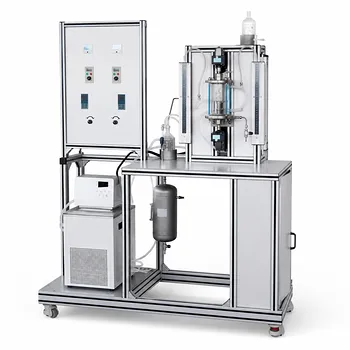
The volumetric mass transfer coefficient, $k_La$, is the single most powerful diagnostic in a gas-liquid pilot plant—it tells you whether your process is limited by mixing or by chemistry. Researchers measure it by monitoring how quickly a gas dissolves into a liquid under controlled hydrodynamic conditions. The two most robust pilot-scale methods are pressure-decay (gas uptake) and dynamic dissolved-oxygen profiling. Both directly quantify the rate at which the gas overcomes interfacial resistance. Knowing $k_La$ is crucial because it defines the Damköhler number (Da), the dimensionless ratio that separates a reaction-controlled regime from a mass-transfer-controlled one. This single parameter then dictates every scale-up decision: from impeller speed and catalyst loading to reactor pressure and sparger design.
Understanding $k_La$ is what turns a pilot plant from a simple demonstration unit into a predictive scale-up tool. It reveals whether you should invest in higher agitation, a better catalyst, or higher pressure. Without it, scaling a multiphase reaction is a leap of faith; with it, scale-up becomes a rational, data-driven process.
From Pilot Plants to Process Insight: Why $k_La$ Matters
The Damköhler Number: Your Scale-Up Compass
The primary reason to measure $k_La$ is to calculate the Damköhler number (Da). Da compares the maximum physical mass-transfer rate to the maximum intrinsic reaction rate.
When Da > 1, the physical transfer of gas into the liquid is slower than the chemical reaction—the system is mass-transfer limited. The reaction starves for dissolved gas.
When Da < 0.1, the kinetics are the bottleneck—the system is reaction-controlled. The liquid is saturated with dissolved gas, and the catalyst or temperature drives the performance.
This stark transition is what guides process optimization. If you are mass-transfer limited, you must improve mixing, increase pressure, or alter the bubble size. If you are reaction limited, you might focus on catalyst loading or activation energy. The primary reference emphasizes exactly this: measuring $k_La$ lets you pinpoint the regime and then rationally adjust agitation speed, gas pressure, and catalyst selection.
The Scale-Up Imperative
Pilot plants exist to de-risk full-scale production. In gas-liquid systems, the $k_La$ changes dramatically with scale because the specific power input $(P/V)$ and bubble size distribution evolve. By measuring $k_La$ at the pilot scale, an engineer can predict whether heat removal, mass transfer, or kinetics will dominate at the production scale. Without this data, you risk building a plant where the reactor never delivers the dissolved gas the reaction needs, leading to poor yields and hazardous operating conditions. The supplementary references confirm that unit operations pilot plants are specifically designed to let users investigate these physical rate limitations before committing to capital expenditure.
How to Measure $k_La$ in a Gas-Liquid Pilot Plant
The primary reference highlights pressure uptake as the central technique, while supplementary references extend the toolkit to dissolved-oxygen methods and empirical correlations. All are accessible in a typical pilot plant equipped with a stirred tank reactor.
Method 1: The Pressure-Decay Approach (Gas Uptake in a Closed System)
This method directly embodies the principle described in the primary reference: monitoring system pressure over time during gas absorption.
First, the liquid is thoroughly degassed under vacuum with agitation to strip out any dissolved gas.
Agitation is then stopped, and the reactor headspace (the gas above the liquid) is pressurized with the target gas.
Agitation is restarted, and a fast-response pressure transducer records the falling headspace pressure as gas dissolves into the liquid.
The $k_La$ is extracted from the pressure-versus-time profile. A common model is a first-order decline toward the equilibrium pressure $P_{eq}$: [ \ln\left(\frac{P(t) - P_{eq}}{P_0 - P_{eq}}\right) = - (k_La) , t ] The slope of this linearized plot directly yields $k_La$. The primary reference adds that, as a rapid approximation, the initial slope $dP/dt$ at the moment agitation begins can also be used to estimate $k_La$.
Critical caveat: The gas and liquid must be at the same temperature before starting the agitator. Any thermal gradient will cause a pressure recovery that contaminates the pressure decay, mimicking slower mass transfer. The supplementary references specifically warn against this thermal trap.
Method 2: The Dynamic Gassing-Out Technique (For Oxygen Transfer)
When the gas is oxygen (e.g., in bioprocesses), the dissolved-oxygen (DO) probe becomes the primary sensor, giving a different, equally powerful pathway.
- The reactor is filled with the working liquid (water or a pseudomedium).
- Dissolved oxygen is purged by sparging nitrogen until the DO reading stabilizes near zero.
- Air or oxygen is sparged back at a set flow rate and agitation speed.
- The DO concentration $C_L$ is logged at regular intervals.
The data is fitted to: [ \ln\frac{C_{sat} - C_0}{C_{sat} - C_t} = (k_La) , t ] where $C_{sat}$ is the saturation concentration, $C_0$ is the initial (near zero) concentration, and $C_t$ is the concentration at time $t$. The slope of this straight line is $k_La$. This method is widely used in bioprocess training pilot plants because it avoids pressure sensors and directly measures the concentration driving force.
Calibrating with Empirical Correlations
Pilot plants are also ideal for calibrating predictive correlations. The supplementary references provide the Van’t Riet equation for air-water systems: [ k_La = 0.026 \left(\frac{P_g}{V}\right)^{0.4} Q^{0.5} ] where $P_g/V$ is the gassed power per unit volume and $Q$ is the gas flow rate. For ionic solutions that suppress bubble coalescence, the constants shift dramatically to $b_0=0.002$, $m=0.7$, $n=0.2$, reflecting a much stronger dependence on power input. To adapt these values for other gases in low-viscosity systems, the Fair method applies a diffusion coefficient ratio: [ (k_La){\text{system}} = (k_La){\text{air-water}} \left(\frac{D_{L,\text{system}}}{D_{L,\text{water}}}\right)^{0.5} ] These correlations are not substitutes for measurement; they are best viewed as interpolation tools validated by your own pilot-scale $k_La$ data.
Understanding the Trade-offs and Common Pitfalls
The Thermal Trap
As noted, any temperature difference between the gas and the liquid when agitation starts will create a false pressure signal—the gas cools or heats, changing the pressure independently of dissolution. Always allow thermal equilibrium before initiating the pressure-decay measurement. A vessel jacket or internal temperature sensor confirms stability.
Correlation Limitations and Surfactants
Empirical correlations like Van’t Riet are calibrated for pure water or simple electrolytes. If your system contains surfactants—such as antifoams, proteins, or organic byproducts—the bubble size and coalescence behavior change in ways the correlation cannot predict. An experimentally measured $k_La$ is mandatory in these cases. The supplementary references explicitly note that correlations should be calibrated with experimental data when surfactants are present.
Over-Reliance on a Single Method
The pressure-decay method assumes the gas-side resistance is negligible and that the liquid-phase concentration is uniform. In viscous or non-Newtonian fluids, both assumptions break down, and a dynamic gassing-out method may give a truer picture of the mass-transfer driving force. Choosing the wrong method for your fluid can lead to a $k_La$ that looks perfect on paper but fails at scale.
Making the Right Choice for Your Research Goal
The path you take depends on whether you are diagnosing a limitation, scaling a bioreactor, or doing early feasibility work.
- If your primary focus is identifying the rate-limiting regime: Run a pressure-decay experiment at multiple agitation speeds and plot the Da number. The point where Da crosses from >1 to <0.1 will show you exactly where extra mixing stops paying off, and you should instead invest in catalyst.
- If your primary focus is scaling up an aerobic fermentation: Use the dynamic gassing-out technique with actual broth or a well-characterized pseudomedium. Map $k_La$ against $P/V$ to build a scale-up curve that can be directly transferred to the production vessel.
- If your primary focus is early-stage feasibility without reaction: Measure $k_La$ in the pure solvent using pressure decay, then apply the Fair diffusion correction to estimate $k_La$ for your actual reactive gas (e.g., hydrogen instead of air). This gives a quick, cost-effective bounding estimate before committing to a reactive run.
By anchoring your reactor design in measured $k_La$ data, you transform scale-up from a trial-and-error exercise into a reproducible engineering discipline.
Summary Table:
| Method | Operational Principle | Primary Application | Key Operational Trap |
|---|---|---|---|
| Pressure-Decay | Monitors gas pressure drop over time during absorption in a closed system | Gas uptake & rapid regime diagnostics | Thermal gradients affecting pressure |
| Dynamic Gassing-Out | Logs dissolved oxygen (DO) concentration increase over time | Aerobic systems & bioprocess training | Requires precise DO probe calibration |
| Empirical Correlations | Calculates $k_La$ using power input and gas flow equations | Interpolation & baseline estimation | Inaccurate for systems with surfactants |
Accelerate Your Research & Scale-Up with LABPARK
Accurate determination of $k_L a$ is key to transitioning from bench to production. LABPARK offers premium Educational and Vocational Unit Operations Pilot Plants tailored for chemical engineering, bioprocess & biotech, and environmental & water treatment.
We help universities, research institutes, and enterprises de-risk their processes with reliable, highly instrumented pilot systems.
Ready to elevate your laboratory's capabilities? Contact us today to discuss your unit operations requirements!
Related Products
- Dual-Drive Stirred Gas-Liquid Mass Transfer Coefficient Determination Pilot Plant
- Multi Pump Fluid Transport Process Piping Unit Operations Training Pilot Plant
- Two Phase Flow Pattern Velocity Resistance Measurement Educational Pilot Plant
- Packed Bed Absorption Educational Unit Operations Pilot Plant
- Chemical Pipeline Assembly and Fluid Transport Practical Training Unit Operations Pilot Plant
People Also Ask
- How does temperature affect mass transfer rates in chemical engineering educational pilot plants?
- How do pilot plants study gas solubility in polymer melts at high pressures? Key Mass Transfer Insights
- How does column packing affect absorption intensification, and how is it evaluated experimentally?
- Why Compare Membrane-Reservoir Models with Pilot Plant Data? Ensure Successful Process Scale-Up
- How does k_La affect hydrogenation scale-up? Critical insights for pilot reactors.