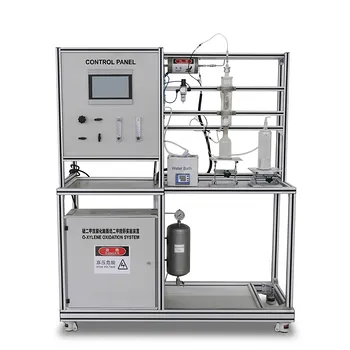
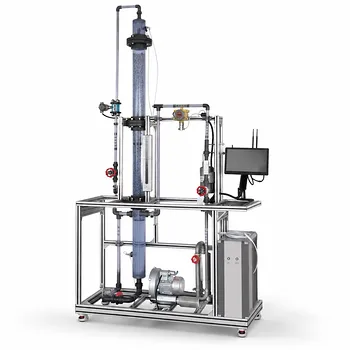
Pilot plants transform fixed-bed reactors from black boxes into transparent, data-rich research platforms. By integrating multi-point temperature sensors, researchers can map axial and radial temperature profiles in real time, directly observe hot-spot formation, and experiment with cooling strategies. These systems also allow them to study catalyst deactivation over extended runs, tracking how the hot spot moves and compensating through feed adjustments. This hands-on approach bridges the gap between theoretical models and real-world reactor behavior.
While temperature distribution and hot spots are immediate safety and performance concerns, the true value of a pilot plant is its ability to make catalyst aging visible and manageable. By replicating industrial conditions at a manageable scale, researchers gain the critical, time-based data needed to optimize reactor design and develop robust deactivation compensation strategies.
Mapping the Temperature Landscape
Understanding the thermal profile inside a fixed-bed reactor is the foundation of all subsequent control and catalyst studies. Pilot plants achieve this through deliberate sensor placement and experimental design.
The Power of Multi-Point Sensing
Multi-point temperature sensors are the eyes of your research. They are typically housed inside thermowells inserted directly into the reaction tubes.
This arrangement allows you to place multiple thermocouples at different heights and radial positions. The data stream reveals not just a single exit temperature, but the complete axial and radial temperature distribution.
Real-time mapping lets you visualize the precise location and magnitude of the exothermic peak. This level of detail is impossible to achieve with a single-point measurement.
Visualizing the Reaction Front
When you feed reactants into a fresh catalyst bed, the reaction is most vigorous near the inlet. This creates a pronounced hot spot, a sharp temperature spike.
The pilot plant's sensor array shows you exactly where this peak is located. You can then quantify the temperature differential (ΔT) between the bed’s hottest point and the cooling medium.
This direct observation is critical for validating computational fluid dynamics (CFD) models. It turns a theoretical simulation into a tangible, measured reality.
Mastering Hot-Spot Control
Once you can see a hot spot, you can begin to control it. Pilot plants serve as a testbed for multiple suppression strategies, each with distinct mechanisms.
The Cooling Jacket and Media Selection
The reactor’s shell side acts as the primary heat removal pathway. Researchers can experiment with different heat transfer media.
Common options include thermal oil, pressurized water, or molten salt. By changing the medium, you directly alter the heat transfer coefficient and the wall temperature boundary condition.
The pilot plant allows you to test automated cascade control loops. For example, a temperature controller can adjust the pressure of boiling water in the jacket, which instantaneously changes its saturation temperature to absorb more or less heat.
Feed and Dilution Strategies
Heat management begins before the reactants touch the catalyst. Adjusting the feed concentration is a direct lever; a higher reactant-to-inert ratio generates less heat per mole of feed in exothermic reactions.
Another powerful technique is diluting the catalyst bed at the inlet. You can mix the active catalyst with inert materials like alumina or spent catalyst.
This physical dilution spreads the reaction zone over a longer bed length. It reduces the peak temperature by lowering the volumetric rate of heat generation at the reactor’s entrance.
Inter-Stage Quenching
For highly exothermic processes, like azeotropic zeolite-catalyzed gas-phase alkylation, a single pass is too risky. A multistage fixed-bed reactor with inter-stage quenching is the industrial solution.
In a pilot plant, you can inject a cold fluid, such as cold ethene, directly between catalyst beds. This immediately absorbs the reaction heat and lowers the temperature of the stream entering the next stage.
Alternatively, you can manipulate the initial feed ratio. For a benzene-to-ethene reaction, maintaining a high ratio (e.g., 8–15 mol/mol) serves as a built-in heat sink, absorbing the exotherm and preventing temperature runaway.
Decoding Catalyst Deactivation
Catalyst longevity is an economic imperative. Pilot plants uniquely allow you to compress years of industrial operation into weeks, systematically studying the decline and learning how to compensate for it.
The Traveling Hot Spot
The primary reference highlights a powerful, visual indicator of aging: the hot spot’s movement. As the catalyst at the inlet slowly deactivates, the reaction zone is forced to migrate further down the bed.
A fresh bed shows a hot spot near the inlet. Over tens of hours, you will observe this peak temperature location slowly moving axially toward the outlet.
This is not a failure; it is a predictable behavior. The pilot plant data quantifies the migration rate, which is a direct measure of the deactivation kinetics.
The Compensation Strategy: Constant Conversion
The most elegant method for studying deactivation is the constant-conversion, variable-temperature operation mode. As the catalyst loses activity, the reactor will naturally produce less product at a constant temperature.
To counteract this, the pilot plant’s control system allows you to gradually raise the inlet temperature or the jacket temperature. You do this to maintain the target conversion level.
This generates a temperature ramp profile over time. By analyzing this profile and the conversion data, researchers can calculate the deactivation energy and kinetic parameters of the aging process.
Distinguishing Reversible vs. Irreversible Deactivation
Not all deactivation is permanent. Pilot plants designed for extended runs (e.g., 50 hours of continuous operation) are perfect for diagnostic experiments.
You can monitor a decline in CO conversion over an aged platinum catalyst. Then, you can introduce a repeated reduction treatment in-situ.
If conversion partially recovers, you have distinguished reversible deactivation (like platinum oxidation) from irreversible deactivation (like metal sintering). This teaches researchers to design effective regeneration protocols rather than simply discarding the catalyst prematurely.
Understanding the Trade-offs
No experimental setup is a perfect mirror of an industrial reactor, and every control action has a consequence. Objectivity is key.
The Scale-Up Gap
Exothermic control in a small-diameter pilot tube is deceptively easy. A lab-scale reactor has a high surface-area-to-volume ratio, making heat removal far more efficient than in a 3-meter-wide industrial vessel.
A safe, stable hot spot in the pilot plant does not guarantee thermal stability at scale. Researchers must always interpret their cooling data through the lens of scale-up correlations.
Conflicting Control Objectives
Compensating for deactivation by raising the temperature has a thermodynamic cost. For exothermic reactions like ammonia synthesis, the van 't Hoff equation dictates that the equilibrium constant (Kp) decreases as temperature rises.
You may maintain kinetic conversion while simultaneously shifting the thermodynamic equilibrium toward the reactants. The pilot plant lets you quantify this trade-off between rate and maximum achievable yield, a lesson that is central for students plotting ln(Kp) vs. 1/T.
Complexity and Safety Risk
Adding multi-point thermocouples inside a reaction tube disturbs the packing structure and flow distribution. More sensors generate more data but also introduce more potential leak paths and system complexity.
The safest pilot plants often use structured internals. A monolithic loop reactor with liquid recycle can limit the adiabatic temperature rise to just a few degrees, offering a safe but fundamentally different hydrodynamics platform that may not perfectly mimic a traditional packed bed.
Making the Right Choice for Your Research Goal
The specific pilot plant configuration and experimental protocol should be dictated by your primary objective. Focus your design of experiments on one core aim at a time.
- If your primary focus is reactor safety and model validation: Prioritize a system with dense, multi-point thermocouple arrays inside thermowells. Map the axial and radial temperature profile with different cooling media to generate high-fidelity data for your heat transfer models.
- If your primary focus is process optimization and hot-spot suppression: Use a reactor with inter-stage feeds or variable inlet mixing. Experiment with dilution, adjusted feed ratios, and jacketed control loops to find the most efficient strategy for maximizing throughput without exceeding temperature limits.
- If your primary focus is catalyst life cycle and deactivation kinetics: Choose a pilot plant capable of stable, extended runs over many days. Focus on the constant-conversion, variable-temperature protocol, and use the migration of the hot spot as your primary indicator, combined with post-mortem analysis for sintering or coking.
- If your primary focus is educational demonstration of thermodynamics: Keep the system simple and at steady state. Measure equilibrium product concentrations at several stable temperatures to construct a van 't Hoff plot and calculate the reaction enthalpy, making the abstract theory a tangible calculation from real, tabulated data.
A fixed-bed pilot plant is more than a piece of equipment; it is a diagnostic toolkit that makes the invisible dynamics of heat, flow, and catalytic decay fully visible, testable, and teachable.
Summary Table:
| Research Focus | Key Method / Technology | Primary Benefit |
|---|---|---|
| Temperature Mapping | Multi-point thermocouple arrays inside thermowells | Visualizes axial/radial profiles and reaction fronts |
| Hot-Spot Control | Cooling jackets, feed dilution, & inter-stage quenching | Suppresses thermal peaks and prevents runaway |
| Catalyst Deactivation | Traveling hot-spot tracking & constant-conversion mode | Quantifies aging kinetics and tests regeneration |
Accelerate Your Chemical Engineering Research & Education with LABPARK
Bridging the gap between theoretical reactor models and real-world industrial performance requires robust, high-fidelity experimental data. LABPARK provides premium Educational and Vocational Unit Operations Pilot Plants in chemical engineering, bioprocess & biotech, and environmental & water treatment designed specifically for universities, research institutes, and enterprises.
Whether you are training the next generation of engineers or optimizing advanced catalytic processes, our pilot systems deliver the precise control, multi-point sensing, and safety features you need to study critical reactor dynamics.
Ready to elevate your laboratory capabilities? Contact LABPARK today to discuss your custom pilot plant requirements!
Related Products
- Fixed Bed Gas Solid Catalytic Reaction Educational Pilot Plant
- Fixed-Bed Chemical Reaction and Gas Dust Tar Removal Unit Operations Pilot Plant
- Multi-Reactor Educational Pilot Plant for Reaction Engineering Unit Operations
- Ethylbenzene Dehydrogenation Educational Unit Operations Pilot Plant
- Educational Unit Operations Pilot Plant for Intraparticle Diffusion Effective Factor Measurement
People Also Ask
- Fixed-Bed vs. Fluidized-Bed Reactor: How to Choose the Right Pilot Plant for Gas-Solid Catalytic Reactions
- How to determine catalyst pore radius & porosity? Optimize your chemical engineering pilot plant.
- What reactor configurations study gas-solid reactions? Guide to key types and applications.
- How does identifying the rate-limiting step optimize reaction conditions? Pilot Plant Guide
- How do reactor pilot plants safely study gas-solid reactions? Master kinetics with thermal & flow control.