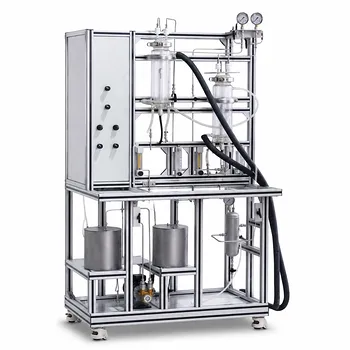
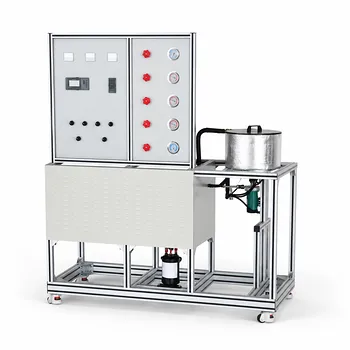
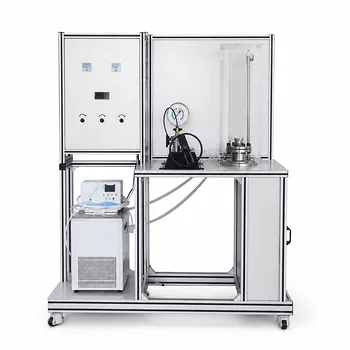
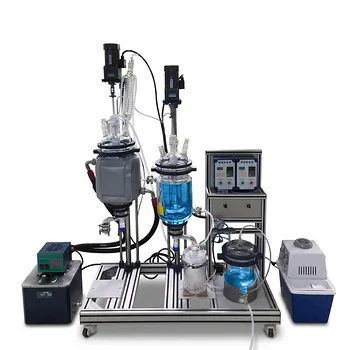
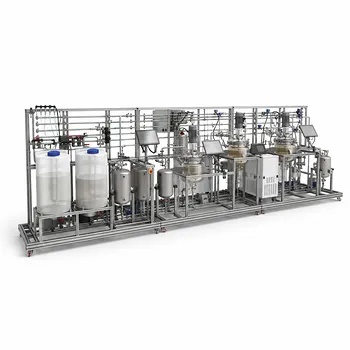
The Quartz Crystal Microbalance (QCM) becomes a powerful, real-time pollutant detector in pilot plants when its crystal is coated with a molecularly imprinted monolayer (MIM). This combination creates a synthetic receptor that selectively captures target molecules—like neonicotinoid pesticides—from flowing water. The captured mass shifts the crystal’s resonant frequency, yielding a concentration signal within minutes. It allows pilot plant teams to move beyond intermittent, lab-bound grab samples and observe decontamination dynamics as they happen, making it an ideal teaching and research tool for advanced water treatment.
Most pilot plants rely on slow, off-line chromatography for trace pollutant analysis. QCM sensors functionalized with MIMs change this by embedding real-time, selective detection directly into the process stream. The deep value is not just speed, but the ability to train operators and researchers on live monitoring protocols and kinetic studies of adsorption or degradation processes—skills that directly transfer to full-scale water safety management.
The Core Sensing Principle: From Mass to Signal
How a QCM Works in Water Monitoring
A QCM sensor is a piezoelectric quartz disk that oscillates at a precise frequency under an electric field. When mass is added to its surface, the frequency drops in direct proportion. This is the Sauerbrey relationship.
In water treatment, the bare crystal is almost useless for selectivity. Anything that sticks—bacteria, proteins, dissolved organics—causes a signal. That is why the molecularly imprinted monolayer (MIM) is the essential partner.
The Molecular Imprinting Edge
A MIM is a thin, polymer-like film created in the presence of a target template molecule. After polymerization, washing out the template leaves behind nanoscopic cavities that perfectly complement the shape, size, and chemical functionality of the target pollutant. These cavities behave like synthetic antibodies. They rebind the target with high affinity even in complex water matrices, rejecting interference from structurally similar compounds. The result is sensor selectivity that rivals biological assays but with far greater chemical and thermal stability.
Applying QCM-MIM in a Water Treatment Pilot Plant
Real-Time Monitoring of Decontamination Kinetics
The primary reference highlights pilot plants that integrate QCM sensors directly into a flowing water loop, after an adsorption column or an advanced oxidation reactor. A small slipstream is diverted through a temperature-controlled flow cell housing the coated crystal. The frequency is recorded continuously. This reveals the breakthrough curve or degradation profile of the target pesticide in real time.
Operators no longer need to collect fractions every ten minutes and wait for HPLC results the next day. They can see the moment the sensor signal changes, adjust process parameters immediately, and train on the cause-and-effect relationships between operational variables and removal efficiency.
Automated Sampling and Sensor Regeneration
A robust pilot plant setup includes an automated valve system to switch between sample water, clean buffer, and a regeneration solution. This sequence is critical. After each measurement cycle, a brief flush with a mild acid or organic solvent breaks the pollutant-cavity binding without damaging the MIM. The sensor returns to baseline, ready for the next cycle. This on-line regeneration is what transforms a single QCM crystal into a quasi-continuous monitor. It becomes a powerful hands-on exercise for students in method development, flow injection analysis, and sensor lifetime testing.
Verifying Selectivity Against Real-World Interferents
A well-designed training module exposes the QCM-MIM sensor to water spiked with the target pesticide alongside common background constituents—humic acid, inorganic ions, and non-target pesticides. The frequency response on a MIM-coated crystal is compared to that of a non-imprinted control monolayer. The dramatic difference in signal intensity teaches a fundamental lesson in analytical chemistry: how molecular recognition beats simple physical adsorption. This verification step is rarely feasible in a standard lab course but becomes routine with a pilot plant sensor bench.
Understanding the Trade-offs
Limitations of QCM-MIM Detection
Sensitivity in High-Turbidity Water. The QCM responds to any rigid mass accumulation. Fine particulates or fouling layers that are not removed by the sample filtration stage can produce a false positive signal. A protective guard filter upstream of the flow cell is mandatory, and its maintenance becomes part of the operational protocol.
Sensor Aging and Template Bleeding. Even well-polymerized MIMs can lose a small percentage of trapped template molecules over time, causing baseline drift and reduced binding capacity. Frequent calibration injections of a known standard are needed to correct for sensitivity loss. This is an excellent practical lesson in sensor quality control but can frustrate a novice expecting a “fit-and-forget” device.
Kinetic Slowness Relative to Optical Methods. The MIM rebinding process is diffusion-limited. A complete equilibrium measurement might take 5–15 minutes, which is fast compared to grab sampling but slower than direct UV absorbance. The pilot plant curriculum should explicitly contrast this kinetic characteristic with optical and electrochemical sensors, emphasizing that the trade-off is the outstanding molecular specificity gained.
Temperature and Viscosity Cross-Sensitivity. The QCM frequency is influenced by the density and viscosity of the contacting liquid. A sudden temperature change in the sample stream will mimic a mass shift. Therefore, the flow cell must be precisely thermostatted, and the reference crystal (a non-imprinted or blank channel) must be measured simultaneously. This complexity is an excellent teaching point about the real-world challenges of physical sensors but demands careful experimental design.
Making the Right Choice for Your Pilot Plant Goal
The optimal implementation of QCM-MIM technology depends on whether you prioritize education, process research, or method development.
- If your primary focus is student training: Use a well-characterized MIM for a tracer pesticide like imidacloprid at µg/L levels. Build the lab session around direct comparison of QCM kinetic curves with batch sample analysis. Emphasize automated sampling, regeneration cycles, and data interpretation over pushing detection limits.
- If your primary focus is process optimization research: Integrate the QCM sensor after multiple treatment units (e.g., UV/H₂O₂ and activated carbon). Use it to quantify residual concentrations in real time and to pinpoint the exact breakthrough point of an adsorbent bed under varying flow rates. Focus on sensor repeatability and data logging integration with SCADA.
- If your primary focus is method development for new pollutants: Prepare and characterize novel MIMs in-house. Use the pilot plant to challenge these sensors with real treated wastewater. Validate selectivity by spiking with structurally related compounds. The goal is to test the MIM’s resilience and to tweak the polymer composition based on observed cross-reactivity.
Embedding a properly configured QCM-MIM system into a pilot plant transforms water monitoring from a delayed analytical report into a live, interactive diagnostic tool that builds the practical competence needed for next-generation water safety.
Summary Table:
| Key Aspect | Description | Practical Insight for Pilot Plants |
|---|---|---|
| Core Principle | QCM detects mass shifts; MIM adds molecular selectivity. | Enables target-specific pollutant detection in complex water matrices. |
| Real-Time Tracking | Measures breakthrough curves and degradation kinetics. | Eliminates long wait times for HPLC/chromatography results. |
| Key Limitations | Sensitive to turbidity, temperature changes, and sensor aging. | Requires upstream guard filters, thermostatting, and regular calibration. |
| Primary Use Cases | Student training, process research, and sensor method development. | Adapts easily to different educational and research objectives. |
Elevate Your Lab's Capabilities with LABPARK Pilot Plants
To successfully implement advanced real-time sensing technologies like QCM, you need robust, reliable experimental platforms. LABPARK provides premium Educational and Vocational Unit Operations Pilot Plants specializing in chemical engineering, bioprocess & biotech, and environmental & water treatment.
Designed specifically for universities, research institutes, and enterprises, our pilot plants empower your students and researchers to master real-world monitoring, kinetic studies, and process optimization.
Ready to upgrade your lab? Contact LABPARK today to explore our custom pilot plant solutions and request a quotation!
Related Products
- Constant Pressure Filtration Educational Unit Operations Pilot Plant
- Multifunctional Membrane Separation Educational Pilot Plant with Ultrafiltration, Nanofiltration, Reverse Osmosis
- Centrifugal Pump Performance and Orifice Flowmeter Calibration Educational Pilot Plant
- Orifice and Venturi Flowmeter Calibration Educational Pilot Plant for Fluid Mechanics Laboratory
- Ion Exchange Water Purification Educational Pilot Plant for Engineering Unit Operations
People Also Ask
- How do educational unit operations pilot plants bridge theory and design? Bridge the Engineering Gap
- How do educational unit operations pilot plants address safety and waste management when scaling up?
- Why splitting a filtration batch doesn't always reduce cycle time? Pilot Plant Insights
- Why Demo Constant-Rate to Constant-Pressure Filtration on a Pilot Plant? Key Practical Insights
- How can researchers identify and resolve filter medium blinding? Optimize Your Pilot Plant Runs