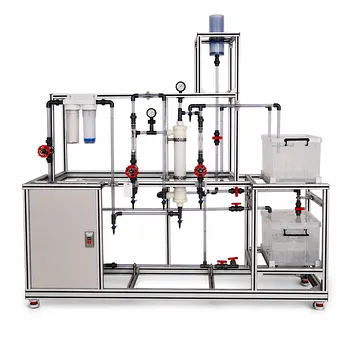
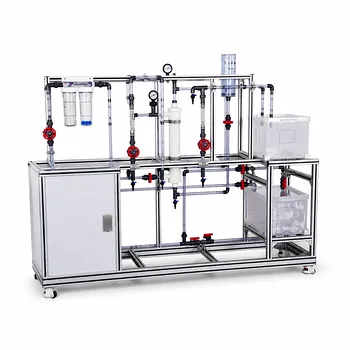
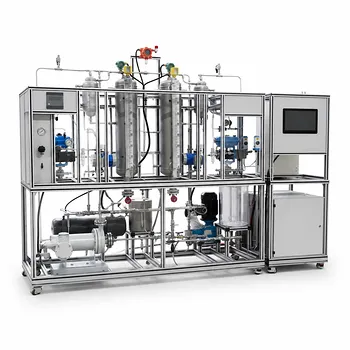
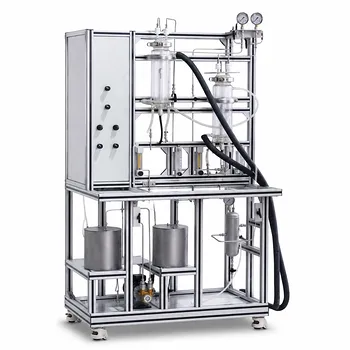
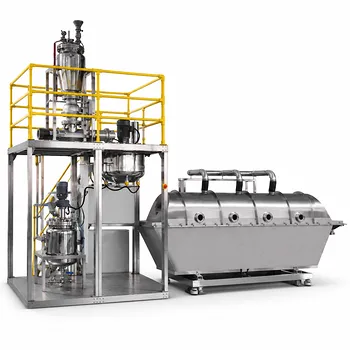
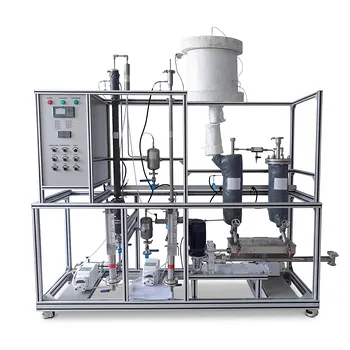
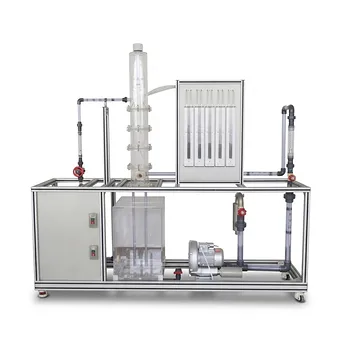
The most definitive way to simulate the mitigation of membrane fouling from suspended solids or harsh chemicals is to remove the liquid from the equation entirely. A membrane pilot plant can be reconfigured for vapor permeation, where the feed stream is first vaporized so that only gaseous components touch the membrane. This staged approach prevents direct contact between the liquid-phase foulants and the membrane selective layer, effectively eliminating the primary cause of fouling and chemical degradation. Process engineers can then directly observe a stable separation performance that would be impossible in a conventional liquid-contact setup.
The central insight: By integrating a distillation or vaporization module, a pilot plant transforms a liquid fouling challenge into a clean vapor-phase separation. This allows engineers to quantify the true separation efficiency of the membrane without the confounding effects of solids deposition or harsh chemical attack, while simultaneously validating a hybrid process design.
Why a Direct Liquid-Membrane Contact Fails
Standard membrane pilot setups expose the membrane to the full liquid feed, making fouling and degradation unavoidable. Suspended solids accumulate on the surface or inside pores, while aggressive chemicals can swell, plasticize, or chemically attack the polymer matrix.
The Fouling Cascade
Even trace amounts of solids trigger a rapid, self-reinforcing decline in performance.
- Initial deposition increases hydraulic resistance.
- Organic or inorganic scaling further blocks transport paths.
- Concentration polarization accelerates the formation of a gel layer or cake, crashing permeate flux.
The Chemical Degradation Risk
Harsh solvents, acids, or oxidizers do not just foul a membrane—they restructure its selective layer at the molecular level.
- Plasticization can reduce selectivity and mechanically weaken the material.
- Chain scission or hydrolysis permanently destroys the membrane’s separation capability.
- In a pilot test, this often results in unreliable data and a membrane that must be replaced prematurely.
The Core Strategy: Vapor Permeation as a Protective Shield
The solution is to avoid liquid-membrane contact altogether. This is where the pilot plant is reconfigured for vapor permeation, a hybrid approach that combines thermal pre-separation with membrane polishing.
How the Vapor Permeation Pilot Plant Works
The liquid feed first enters a distillation or vaporization module (often an integrated pilot-scale still).
- Only the volatile fraction of the feed is carried overhead as a saturated vapor.
- Suspended solids, non-volatile inorganic salts, and high-boiling harsh chemicals remain in the liquid phase, never reaching the membrane module.
The vapor stream then passes through the membrane module, where the desired permeation occurs in a clean, gaseous environment. Because the membrane encounters only vapor, the fouling and chemical degradation drivers are absent.
Why This Effectively “Simulates” Fouling Mitigation
Engineers can now observe what the membrane is capable of when fouling is removed as a variable.
- The pilot plant demonstrates a stable permeate flux and selectivity over extended runs, proving the mitigation concept.
- You can directly compare the performance with a liquid-phase pervaporation baseline using a clean feed—showing that the vapor-permeation configuration essentially restores the membrane’s intrinsic transport properties.
What You Can Measure and Validate in the Pilot Campaign
The reconfigured pilot plant delivers actionable engineering data, not just theoretical reassurance.
Separation Performance Under Real Conditions
- Permeate quality and flux are measured with the actual multicomponent feed, now free from solids.
- The selectivity for the target species remains consistent, enabling reliable scale-up calculations.
- The energy footprint of the integrated vaporization step is directly quantified, feeding into techno-economic assessments.
Long-Term Membrane Integrity
- Tangible evidence of fouling (transmembrane pressure drop, flux decline) does not appear over the run, confirming the protective effect.
- Chemical degradation markers—such as changes in membrane swelling or IR spectra—can be tracked and shown to remain flat when no liquid corrosive agents contact the surface.
Understanding the Trade-offs
Vapor permeation is not a universal answer. It introduces its own set of considerations that must be evaluated during pilot testing.
Thermal Energy Demand
Vaporizing the feed requires significant heat input.
- The pilot plant must capture the energy consumption data so that a fair comparison with alternative mitigation methods (like extensive pretreatment) can be made.
- The mitigation benefit must be weighed against the operational cost of the distillation module.
Limited Scope for Non-Volatile Target Compounds
If the target compound to be recovered is itself non-volatile, vapor permeation will leave it behind in the liquid phase.
- The pilot campaign must verify that the desired product is transported in the vapor stream; otherwise, the approach is irrelevant.
- For feeds containing both volatile and non-volatile valuable components, additional processing of the liquid residue would be required.
Not All Harsh Chemicals Are Left Behind
Some aggressive compounds (e.g., certain volatile organic acids) can partially vaporize and still reach the membrane.
- The pilot plant should include vapor composition analysis to confirm that no damaging species are slipping through.
- In such cases, a small polishing trap or a pH adjustment in the vapor line can be tested.
Making the Right Choice for Your Pilot Study
When you need to simulate—and prove—effective fouling mitigation for heavily contaminated or aggressive feeds, the pilot plant configuration is the key variable.
- If your primary focus is suspended solids elimination: Convert the pilot plant to vapor permeation mode; the particulate will never leave the vaporization chamber, and you will immediately see stable flux.
- If your primary focus is protection from harsh, non-volatile chemicals: Vaporize the feed first, and you will demonstrate a complete removal of the liquid-phase aggressive agents, preserving membrane integrity.
- If your primary focus is balancing cost and protection: Use the pilot plant to gather side-by-side data for vapor permeation versus a liquid-phase run with heavy pretreatment, then make a data-driven decision.
- If your primary focus is training operators on fouling control: Start with the vaporization bypass and show the ideal non-fouled state; then reintroduce the liquid feed to visually demonstrate the difference.
Moving the membrane contact point behind a vaporization barrier is the most direct, demonstrable way to simulate—and achieve—the mitigation of suspended solids and chemically aggressive foulants in a membrane pilot plant.
Summary Table:
| Feature / Parameter | Liquid-Phase Operation | Vapor Permeation (Mitigation Strategy) |
|---|---|---|
| Fouling Risk | High (solids block pores and membrane surface) | Extremely Low (solids are isolated in liquid phase) |
| Chemical Exposure | High (direct contact with harsh liquid solvents) | Low (only volatile compounds reach selective layer) |
| Flux Stability | Declines rapidly due to scaling and cake layer | Remains stable over extended operational runs |
| Energy Demand | Low (requires mainly pumping energy) | High (requires heat input for vaporization) |
Optimize Your Membrane Separation Processes with LABPARK
Are you looking to scale up chemical separations, protect your systems from fouling, or provide hands-on training? LABPARK offers advanced Educational and Vocational Unit Operations Pilot Plants in chemical engineering, bioprocess & biotech, and environmental & water treatment.
Designed specifically for universities, research institutes, and progressive enterprises, our robust pilot plants enable you to simulate complex process conditions, analyze fouling mitigation strategies, and gather reliable data for scale-up.
Ready to elevate your research and training capabilities? Contact LABPARK today to find the ideal pilot plant solution for your organization!
Related Products
- Ultrafiltration Membrane Separation Educational Pilot Plant
- Multi Functional Membrane Crystallization Educational Unit Operations Pilot Plant
- Multifunctional Membrane Separation Educational Pilot Plant with Ultrafiltration, Nanofiltration, Reverse Osmosis
- Hollow Fiber Ultrafiltration Membrane Separation Educational Pilot Plant
- Multi-Functional Membrane Separation Educational Pilot Plant for Unit Operations Lab
People Also Ask
- How do PEI, PVDF, and PSU membranes compare in pilot plants? Find the best fit.
- Pervaporation vs. Vapor Permeation: Handling Suspended Solids in Membrane Pilot Plants
- Why Use a Membrane Separation Pilot Plant vs. Lab Testing? Avoid Costly Scale-Up Failures
- Isotropic vs. Anisotropic Membranes: How to Choose the Best Pilot Plant Modules
- How do membrane pilot plants demonstrate synthetic vs biological membrane advantages?