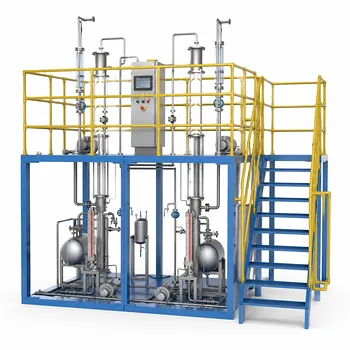
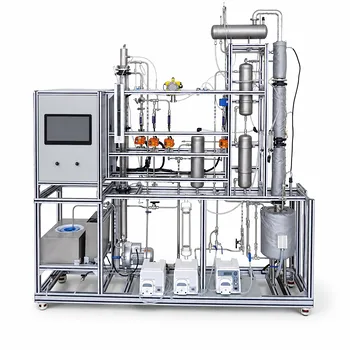
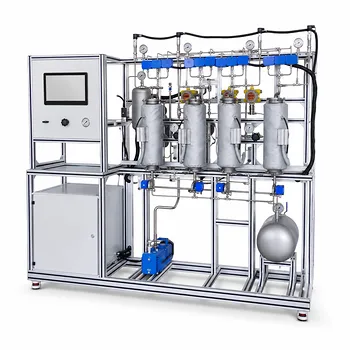
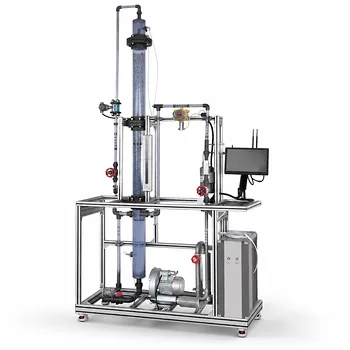
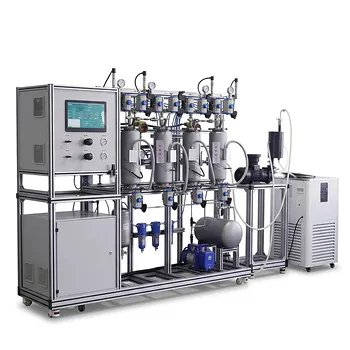
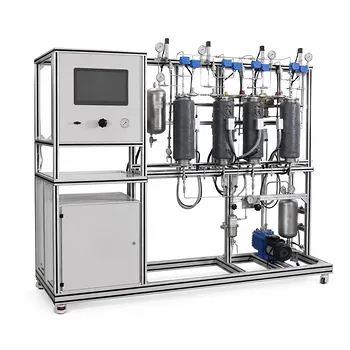
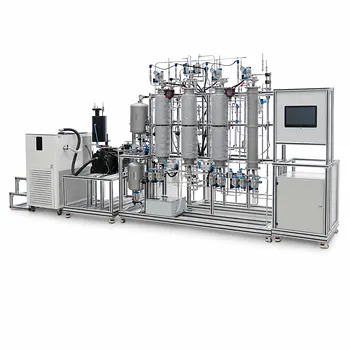
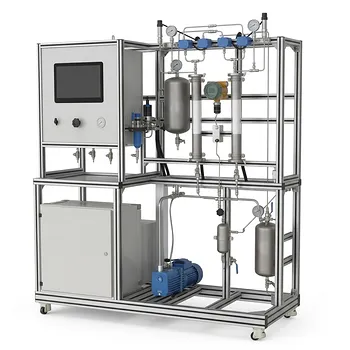
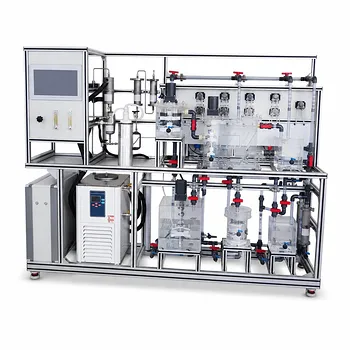
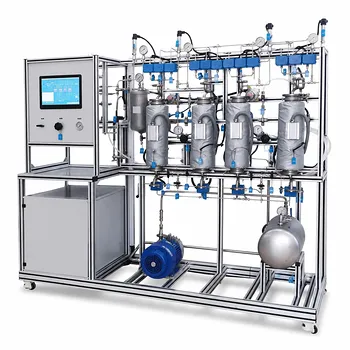
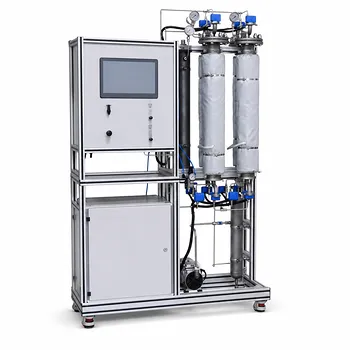
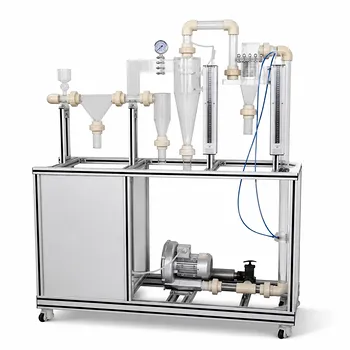
Gas absorption pilot plants transform the fundamental distinction between physical and chemical absorption from a theoretical diagram into a tangible, measurable experience. By running side-by-side experiments with a non-reactive solvent (e.g., water absorbing CO₂) and a reactive solvent (e.g., an amine or caustic solution absorbing CO₂), students directly observe how solubility alone contrasts with reaction‑driven solute removal. They quantify the difference through mass‑transfer coefficients, outlet concentrations, and thermal profiles, connecting lecture‑hall equations to the real‑world operation of flue‑gas desulfurization and carbon capture columns.
The core educational value lies not in simply proving that chemical absorption is “better,” but in giving students the tools to see, measure, and explain why it is—through the collapse of equilibrium back‑pressure, enhanced liquid‑film mass transfer, and the release of reaction heat. Pairing the two modes in a single pilot‑plant session turns an abstract concept into a durable engineering intuition.
Designing Experiments That Reveal the Core Mechanisms
The most effective way to teach the difference is to keep every operating condition identical except the solvent chemistry.
Physical Absorption: Letting Solubility Speak for Itself
In a physical absorption run—using water to absorb CO₂ or hydrocarbons into oil—students witness a process limited entirely by Henry’s Law.
The equilibrium partial pressure of the gas above the liquid defines the maximum possible dissolved concentration. Raising the column pressure or lowering the liquid temperature increases solubility, while warming the solvent drives gas back out. Because no reaction occurs, the liquid‑phase mass‑transfer resistance remains purely diffusive, and the temperature profile across the column stays essentially flat.
Chemical Absorption: Watching a Reaction Rewrite the Rules
Switching to a reactive solvent—such as monoethanolamine (MEA) for CO₂ or sodium hydroxide for acid gases—immediately shows how a chemical reaction accelerates the entire process.
The active component consumes dissolved gas within the liquid film, slashing the solute’s equilibrium partial pressure to near zero. This steepens the concentration driving force at the gas‑liquid interface, dramatically raising the overall mass transfer coefficient. Students frequently measure an absorption efficiency spike of 50 % or more relative to water under the same gas flow, even when the hydraulic conditions are unchanged.
Measuring the Enhancement Factor to Quantify the Difference
The pilot plant lets students calculate the enhancement factor E, the ratio of the chemical absorption flux to the physical absorption flux.
By recording inlet and outlet gas concentrations with online sensors and applying a material balance, they compute the volumetric mass‑transfer coefficient kₗa for each run. The jump in kₗa when moving from physical to chemical solvents becomes a numerical anchor for concepts like Hatta number and reaction‑diffusion regime. Instructors can also challenge students to predict the enhancement factor using simplified reaction‑kinetics models and compare their predictions to plant data.
Harnessing Pilot Plant Instrumentation to Capture Key Phenomena
A well‑instrumented pilot plant turns abstract reaction engineering concepts into visual, time‑resolved data streams that students can analyze in real time.
Temperature Profiles: The Thermal Signature of a Chemical Reaction
Physical absorption is nearly isothermal; chemical absorption is not.
When CO₂ contacts an amine solution, the exothermic reaction releases 60–80 kJ per mole, generating a measurable temperature bulge in the column that moves with the liquid flow. Students can correlate the location and magnitude of this bulge with the reaction rate and gas loading, learning to interpret non‑isothermal behavior as a direct indicator of reaction extent.
Column Hydraulics and Solvent Regeneration Loops
Pilot plants that include a desorber and solvent recirculation loop reveal the downstream implications of each mechanism.
Physical solvents like Selexol or cold methanol can be regenerated by simple pressure reduction, thanks to Henry’s Law. Chemical solvents, however, demand thermal regeneration at elevated temperatures (typically above 105 °C for amines). Students see the energy trade‑off: chemical absorption gives deeper purification but requires steam, while physical absorption suits high‑pressure feeds and avoids a reboiler, at the cost of lower single‑stage removal.
Bridging the Gap to Industrial Carbon Capture and Acid Gas Removal
These pilot‑scale experiments mirror the selection logic engineers apply to full‑scale plants.
- Amine‑based chemical absorption dominates post‑combustion carbon capture because it works at atmospheric pressure, handles low CO₂ partial pressures, and meets deep removal targets.
- Physical absorption processes like Rectisol or Selexol excel in integrated gasification combined cycle (IGCC) and natural gas treating, where high feed pressure (2‑5 MPa) makes solubility‑driven removal economical.
When students operate a pilot plant in both modes, they develop a direct feel for why operating pressure, feed gas composition, and purification goal dictate the choice between a reactive and a non‑reactive absorbent.
Understanding the Trade-offs and Avoiding Common Misconceptions
Objectivity demands acknowledging where the educational demonstration hits practical limits.
Safety and Operational Complexity
Most educational laboratories favor amine‑based chemical absorption because it runs at near‑ambient pressure and moderate temperatures (20‑40 °C). High‑pressure or cryogenic physical‑absorption pilot plants (such as a methanol‑based Rectisol unit at −54 °C) introduce significant safety, material, and utility costs that often outweigh their instructional benefit for core curriculum courses.
Cost and Chemical Handling
Chemical absorption brings its own burdens: amine solutions degrade over time, are corrosive, and require careful waste management. Physical solvents like water are nearly cost‑free, allowing students to focus exclusively on fluid mechanics and mass transport without the distraction of chemical inventory tracking. The most versatile teaching plants therefore offer quick‑swap solvent loops so an instructor can run a simple water‑based experiment in the morning and a reactive system in the afternoon.
When a Chemical System Behaves Like a Physical One
A valuable, often overlooked lesson is that not every reactive system demands a full chemical‑absorption analysis. If the reaction is slow enough that the dimensionless product kᵢ*τ (reaction‑rate constant times liquid‑phase residence time) is much less than 1, the solute has little time to react within the column. Under that condition, the mass‑transfer behavior collapses to a physical‑absorption model—a nuance students can explore by deliberately tuning liquid flow rate to shorten residence time, using the same data‑logging setup.
Making the Right Choice for Your Curricular Goals
The experiment you design should map to the engineering competency you want to build.
- If your primary focus is teaching solubility fundamentals and Henry’s Law: Use a water‑CO₂ system at varying pressures and temperatures; keep the chemical loop off‑line to isolate physical dissolution effects.
- If your primary focus is industrial carbon capture and reactive mass transfer: Run an amine‑based chemical absorption cycle, emphasizing temperature profiles, solvent loading, and the energy penalty of regeneration.
- If your primary focus is comparative system design: Run both modes back‑to‑back on the same gas stream, tasking students with determining the economic crossover point where a chemical solvent becomes justified over a physical one.
A thoughtfully instrumented gas‑absorption pilot plant does more than verify a textbook diagram—it gives students the data‑driven confidence to select, size, and optimize the separation technology that will define the next generation of clean energy infrastructure.
Summary Table:
| Feature | Physical Absorption | Chemical Absorption |
|---|---|---|
| Governing Principle | Henry's Law (Solubility-limited) | Reaction kinetics & equilibrium enhancement |
| Typical Solvents | Water, physical solvents (e.g., Selexol) | Amines (e.g., MEA), sodium hydroxide (NaOH) |
| Thermal Profile | Isothermal (nearly flat column temperature) | Exothermic (distinct temperature bulge) |
| Regeneration Method | Pressure reduction (flashing) | Thermal regeneration (requires high heat/steam) |
| Best Suited For | High feed pressure, bulk purification | Low partial pressure, deep purification (e.g., carbon capture) |
Elevate Engineering Education with LABPARK Pilot Plants
Bring complex mass transfer concepts to life in your laboratory. LABPARK designs and manufactures premium Educational and Vocational Unit Operations Pilot Plants in chemical engineering, bioprocess & biotech, and environmental & water treatment for universities, research institutes, and enterprises.
Our gas absorption pilot plants feature advanced instrumentation, real-time data logging, and versatile solvent loops, enabling students to compare physical and chemical absorption processes hands-on.
- Enhance Learning Outcomes: Bridge the gap between theory and industrial practice.
- Robust Safety & Quality: Built to industrial standards for safe academic operation.
- Customizable Solutions: Tailored configurations to meet your specific curriculum needs.
Ready to transform your engineering lab? Contact LABPARK today to discuss your project requirements!
Related Products
- Dual-Mode Gas Absorption and Desorption Unit Operations Training Pilot Plant
- Carbon Dioxide Absorption and Desorption Educational Pilot Plant for Carbon Capture Studies
- Carbon Dioxide Adsorption and Capture Educational Unit Operations Pilot Plant
- Absorption and Desorption Educational Unit Operations Pilot Plant
- Packed Bed Absorption Educational Unit Operations Pilot Plant
People Also Ask
- How do two-film & penetration theories apply to gas absorption pilot plant teaching? Key pedagogical insights.
- How is the direction and driving force of mass transfer determined in a gas absorption unit operations pilot plant?
- How does partial pressure behavior influence gas absorption pilot plants? Master Mass Transfer
- How to model chemical absorption as physical absorption? The pilot plant simplification criterion.
- Why does increasing flow fail to enhance absorption in fast chemical reactions? Pilot Plant Insights