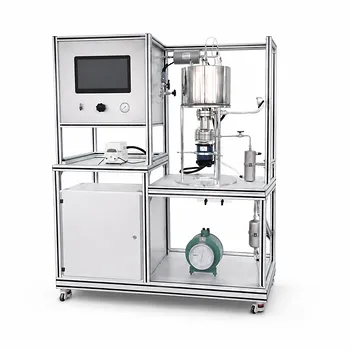
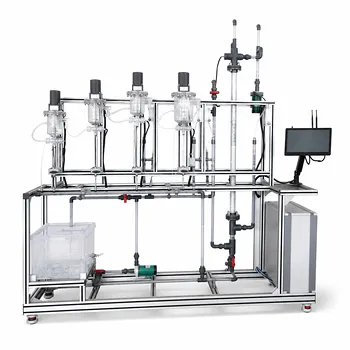
The key to achieving near-100% selectivity for an intermediate product lies not in a single magic setting, but in deliberately manipulating two distinct reaction regimes. In a photochemical pilot plant, you can drive the first reaction step into a diffusional subregime while keeping the unwanted secondary reaction locked in a kinetic subregime. By isolating these regimes and then exploiting the unique ability to instantly stop the reaction by turning off the UV light, the intermediate can be captured at near-complete formation before it degrades into the final product.
The core insight is this: 100% selectivity becomes practically achievable when you decouple the rate of the desired reaction from the rate of the side reaction using mass transfer and radiation field control, and then use the light source as an instantaneous "kill switch" to freeze the product distribution at the exact moment of maximum intermediate concentration.
Understanding the Consecutive Reaction Challenge
A consecutive reaction system follows the path A → R → S, where R is your valuable intermediate. The moment R forms, it can react further to produce S. Without intervention, the concentration of R peaks at a specific time before declining.
Why Traditional Reactors Struggle
In a conventional stirred tank, continuous backmixing keeps R in contact with reactive species for varying amounts of time. This inevitably pushes a fraction of R toward S, making 100% selectivity impossible in a steady state.
The Photoreactor Advantage
A photoreactor gives you two unique levers: you can control the rate of the first reaction by modulating the radiation field and mass transfer, and you can arrest the entire process simply by switching off the UV emission. This allows a fundamentally different optimization strategy.
The Core Principle: Isolating Reaction Regimes
The primary reference defines the pathway to high selectivity: run the first reaction path in a diffusional subregime and the second path in a kinetic subregime.
How Diffusional Control Protects the Intermediate
When the desirable first reaction (A → R) operates under diffusional control, its rate is limited by how fast A reaches the reaction zone. This slows the formation of R but, crucially, also starves the secondary reaction of the same reactive species needed to transform R into S.
How Kinetic Control Suppresses Side Reactions
Meanwhile, the unwanted reaction (R → S) is kept in a kinetic subregime. Its intrinsic reaction rate remains too slow to be significant on the time scale set by the first step. As the primary reference states, this allows the intermediate to reach near‑complete conversion before the secondary substitution becomes noticeable.
Key Operational Variables to Manipulate
In a pilot plant, you cannot change lamp internals continuously, but you can adjust mass transfer characteristics and radiation path length to lock in the regime separation.
Liquid Mixing Intensity and Interfacial Area
Agitation speed and sparger design control the gas‑liquid interfacial area and the liquid‑side mass transfer coefficient. Reduce mixing to a precise threshold: enough to support the first reaction, but not so vigorous that it accelerates the transport driving the second step.
Residence Time and Flow Rate
For a continuous photoreactor, volumetric flow rate (Q) sets the residence time. The supplementary references confirm that you optimize Q to ensure the material exits the most intensely irradiated zone before R can accumulate to a concentration that triggers fast secondary kinetics.
Reactor Outer Radius (rou)
Light intensity decays exponentially with distance from the lamp. Adjusting the outer reactor radius balances the radiation path length against photon absorption. A larger radius reduces average light intensity and can shift the first reaction toward the diffusional regime while leaving the second unaffected.
Reactor Configuration Matters
The physical configuration of the pilot plant powerfully influences backmixing, which is the enemy of intermediate selectivity.
Minimizing Backmixing
The supplementary references emphasize that for series reactions, spray towers and venturi loop reactors are far superior to bubble columns. They offer highly controlled contact times with minimal axial mixing, preventing already‑formed R from looping back into the reactive zone.
Flexible Feeding and Separation
If the goal is to maximize intermediate yield, pilot‑scale columns should allow for adjustable liquid holdup and multiple feed points. You can also integrate continuous removal of volatile by‑products—such as water in some photoreactions—to shift the equilibrium of the first step and shorten the risky residence time.
Understanding the Trade-offs
No optimization strategy is without cost, and the quest for 100% selectivity is no exception. Acknowledging these limitations builds a trustworthy, realistic guide.
The “Kill Switch” Is Not Instantaneous
Turning off the UV source stops photon‑driven reactions, but thermal or dark reactions can still proceed. The selectivity you capture is only as stable as the product stream’s thermal history after leaving the radiation zone.
Diffusional Limitation Reduces Throughput
Operating the desirable reaction in a diffusional subregime intentionally slows it down. This means longer residence times or larger reactor volumes for the same production rate, which can clash with economic targets at scale.
Model Precision Is Critical
The regime‑isolation approach requires accurate knowledge of mass transfer coefficients and kinetic constants across the experimental design space. Pilot‑plant data must be fed into a rigorous model; otherwise, you risk drifting into conditions where both reactions enter the kinetic regime and selectivity collapses.
Using Multivariate Optimization Tools
Pilot plants generate data for several competing responses—yield, impurity, throughput. The supplementary references highlight a structured way to find the sweet spot.
Desirability Functions for Multi‑Response Optimization
Each response is converted to a dimensionless desirability value (d) between 0 and 1. For intermediate selectivity, you would assign d=1 to 100% purity and d=0 to any unacceptable impurity level. The overall desirability (D) is then the geometric mean of all individual d-values.
Weighting Safety and Quality Over Raw Yield
You can assign weights (S) to prioritize, for example, product quality over conversion efficiency. If even trace S is catastrophic, its impurity desirability function can be made highly sensitive, forcing the optimizer to select conservative conditions that guarantee selectivity before maximizing throughput.
Making the Right Choice for Your Goal
Achieving 100% selectivity for an intermediate in a photoreactor pilot plant is a precise balancing act. The right tactical approach depends entirely on your primary objective.
- If your primary focus is fundamental kinetics research: Use the pilot plant to map the border between diffusional and kinetic regimes for both steps, and verify the regime‑isolation principle with deliberate light‑switching experiments.
- If your primary focus is educational demonstration of process intensification: Configure the plant with interchangeable reactors (spray tower, bubble column) to show students how backmixing alone can destroy selectivity, then demonstrate the recovery of purity using flow rate and radiation control.
- If your primary focus is process development for scale‑up: Model overall desirability across the full design space—including outer radius, flow rate, and mixing intensity—to identify the cost‑optimal point where selectivity exceeds your product specification without overly penalizing throughput.
- If your primary focus is producing a high‑value intermediate for downstream use: Integrate a quench zone immediately after the irradiation zone and implement real‑time spectroscopic monitoring of the intermediate concentration to trigger the UV shut‑off algorithm before the secondary reaction threshold is crossed.
You can push a well‑instrumented photoreactor pilot plant remarkably close to the ideal of 100% selectivity—provided you treat the light not just as an energy source, but as the most decisive process control element in your hands.
Summary Table:
| Key Variable | Optimization Action | Impact on Selectivity |
|---|---|---|
| Reaction Regime | Shift step 1 to diffusional, step 2 to kinetic | Suppresses secondary reaction, protecting the intermediate |
| Mixing Intensity | Reduce to a precise threshold | Limits the mass transfer driving the unwanted side reaction |
| Flow Rate (Q) | Optimize residence time in the reactor | Exits the radiation zone before intermediate degradation occurs |
| Reactor Design | Use spray towers or venturi loop reactors | Minimizes axial backmixing to prevent product degradation |
Elevate Your Research and Training with LABPARK Pilot Plants
To achieve precise reaction control and validate complex kinetics like intermediate selectivity, high-performance equipment is essential. LABPARK provides industry-leading Educational and Vocational Unit Operations Pilot Plants in chemical engineering, bioprocess & biotech, and environmental & water treatment for universities, research institutes, and enterprises.
Our custom-engineered pilot systems empower your team to transition seamlessly from theoretical modeling to hands-on optimization.
Contact LABPARK today to find the ideal pilot plant solution for your lab or facility!
Related Products
- Rising and Falling Film Evaporation Educational Unit Operations Pilot Plant
- Internal Circulation Gradient Free Catalytic Reaction Educational Pilot Plant
- Multi-Reactor Educational Pilot Plant for Reaction Engineering Unit Operations
- Fluidized Bed Gas Solid Catalytic Reaction Educational Pilot Plant
- Educational Unit Operations Pilot Plant for Intraparticle Diffusion Effective Factor Measurement
People Also Ask
- How to Select Natural vs. Forced Circulation Evaporators by Feed Type
- How do educational unit operations pilot plants bridge theory and design? Bridge the Engineering Gap
- How do educational unit operations pilot plants address safety and waste management when scaling up?
- How is the heat transfer area calculated for an evaporation unit operations pilot plant during experimental design? Guide
- How to select educational evaporator pilot plants for thermal & scaling solutions? Complete Guide