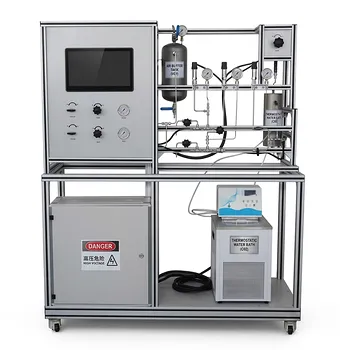
The conceptual leap from abstract reversible processes to real-world irreversibility happens when students operate a chemical engineering pilot plant to perform isothermal gas expansions. By comparing a single, sudden decompression against a series of smaller, stepwise pressure drops between the same initial and final states, they directly measure that the multi‑step path produces significantly more work—and therefore absorbs more heat—than the single‑step one. This hands‑on experiment proves that work and heat are path functions, while internal energy is a state function, and it frames the reversible process as the theoretical ceiling where work output is maximized.
The core insight: A pilot‑plant gas expansion rig lets students move from formulas to physical proof. Running the same overall pressure drop in one irreversibly fast step versus many near‑equilibrium steps reveals a quantifiable, repeatable difference in work output. The experiment cements that reversible processes are not just a textbook ideal—they are the limit real processes approach when irreversibilities are minimized, and pilot‑plant data provides the bridge between thermodynamic theory and practical process engineering.
How Gas Expansion Experiments in a Pilot Plant Demonstrate Path Dependence
The primary way a unit operations pilot plant brings reversible and irreversible processes to life is through isothermal expansion of a gas, typically air or nitrogen, under tightly controlled conditions. The system is instrumented with pressure transducers, a precision displacement sensor to track piston movement (or a turbine to measure work), and a temperature jacket to maintain the idealised isothermal condition.
The Single‑Step Irreversible Expansion
A compressed gas is suddenly released against a constant external pressure. The piston or diaphragm expands rapidly, and the system does a finite amount of work. Because the expansion is instantaneous, the gas never passes through equilibrium states—the pressure drop is unconstrained, and friction, turbulence, and finite‑time heat transfer generate irreversibilities. Students measure a relatively small work output (for a given initial and final volume, something like –10 J in a scaled‑down pilot‑plant exercise).
Multi‑Step Expansion: Moving Toward Reversibility
The same piston‑cylinder apparatus is operated in a series of small, controlled steps. The external pressure is reduced incrementally, and after each tiny drop the system is allowed to re‑equilibrate. With two steps, the work output increases; with four steps, it increases further. As the number of steps becomes large—effectively approximating a continuous reduction—the measured work climbs toward a maximum value (e.g., –16 J for the same overall state change). This trend directly demonstrates that increasing the number of stages reduces the “lost” work and approaches the reversible isothermal work given by –nRT ln(V₂/V₁).
Quantitative Proof: Measuring Work and Heat
For an ideal gas undergoing isothermal expansion, ΔU = 0, therefore Q = –W. Students record the electrical work input to a calibrated motor or the mechanical work done on a load cell, then compare the heat absorbed from the temperature‑controlled jacket. The data shows that while the initial and final internal energies are identical, the heat required from the bath grows in lockstep with the work done. No amount of abstract lecturing replicates this visceral proof that heat and work are path functions; internal energy is a state function.
The Deeper Lesson: State Functions, Path Functions, and the Meaning of Reversibility
The raw measurements feed a deeper conceptual transformation. A student who has tweaked the pilot‑plant valves and watched the work‑readout climb with more steps no longer sees “reversible” as a fuzzy synonym for “hypothetical.” They see it as the limit of a step‑function: the maximum work attainable for a given isothermal expansion, approached only when irreversibilities like sudden pressure drops, friction, and non‑infinitesimal temperature gradients are eliminated.
From Pilot‑Plant Data to the Carnot Principle
Because the reversible path yields the greatest work absorption, it also yields the highest conversion of heat into work in a cycle. Plotting work versus the number of expansion steps allows instructors to extrapolate the reversible maximum. Students then see why the Carnot efficiency represents an upper bound that any real heat engine’s performance can be compared against—and why chemical engineers strive to design processes with as many equilibrium stages as economically feasible.
Understanding the Trade‑offs and Limitations of the Demonstration
While this experiment is incredibly powerful, no pilot plant achieves a perfectly reversible process. Recognizing the gaps sharpens understanding.
- Heat leak and friction: Pistons have seals, valves have flow resistance, and the temperature jacket never fully eradicates thermal gradients. Each of these converts potential work into unrecoverable heat, keeping the measured maximum below the theoretical ideal.
- Instrumentation lag: Pressure transducers and data loggers have finite response times. In a fast single‑step expansion, the transient may be partially lost; in a very slow multi‑step run, drift and ambient heat exchange introduce noise. Students learn to distinguish meaningful signals from measurement artifacts.
- The danger of conflating “many steps” with reversibility: Simply adding steps does not guarantee reversibility if each step still happens across a finite pressure difference. The pilot plant must be controlled so that the driving force is vanishingly small—otherwise, the expansion remains irreversible, merely subdivided. The demonstration teaches students that reversibility requires both infinitesimal gradients and quasi‑static operation, not just a large number of steps.
- Scalability of the insight: While the gas expansion experiment isolates path dependence beautifully, other unit‑operation pilot plants (distillation columns, absorption towers) also illustrate that increasing the number of equilibrium stages approaches reversible operation—albeit in a more complex, multicomponent setting. These can be used to reinforce that the principle transcends a single piston‑cylinder apparatus.
Making the Right Choice for Your Teaching Goal
The way you deploy the pilot‑plant demonstration depends on what you want students to internalize.
- If your primary focus is the concept of state vs. path functions: Keep the experiment simple—contrast one‑step vs. a large, pre‑programmed number of steps and let students calculate ΔU, W, and Q. The stark numerical difference is the whole lesson.
- If your primary focus is the idea of a reversible limit: Vary the number of steps from 1 up to as many as the apparatus allows and have students plot work vs. 1/(number of steps). Extrapolate to an infinite number of steps to reveal the theoretical maximum work.
- If your primary focus is practical process understanding: Pair the expansion experiment with an economic analysis. Show that adding stages increases capital cost but also increases work output (or reduces work input for compression), thereby introducing the real‑world optimization problem chemical engineers face daily.
When students physically adjust the valves of a pilot plant and watch the work measurement respond, the difference between a reversible limit and an irreversible reality stops being a formula and becomes a tangible design principle they will never forget.
Summary Table:
| Feature | Single-Step (Irreversible) | Multi-Step (Approaching Reversible) |
|---|---|---|
| Expansion Speed | Rapid, sudden decompression | Slow, incremental pressure drops |
| Thermodynamic State | Non-equilibrium | Near-equilibrium at each stage |
| Work Output | Lower work output | Higher work output (approaches theoretical max) |
| Irreversibilities | High (friction, turbulence, heat loss) | Minimized |
Bring Thermodynamic Theory to Life in Your Lab
Bridge the gap between abstract textbook formulas and physical reality for your students. LABPARK provides state-of-the-art Educational and Vocational Unit Operations Pilot Plants in chemical engineering, bioprocess & biotech, and environmental & water treatment. Built specifically for universities, research institutes, and enterprises, our pilot plants deliver precise, repeatable data to make complex concepts like thermodynamic reversibility highly tangible and visually measurable.
Ready to elevate your engineering curriculum or research capabilities? Contact LABPARK today to explore our custom pilot plant solutions!
Related Products
- Throttling Effect Determination Educational Unit Operations Pilot Plant
- Two-Dimensional Fluidization Hydrodynamics Educational Pilot Plant for Unit Operations Training
- Gas Phase Mixing and Residence Time Distribution Determination Educational Unit Operations Pilot Plant
- Educational Unit Operations Pilot Plant for Intraparticle Diffusion Effective Factor Measurement
- Gas-Solid Heterogeneous Separation Demonstration Educational Unit Operations Pilot Plant
People Also Ask
- How does kinetic theory explain ideal vs real gas energy differences? Key Pilot Plant Insights
- How are open and closed system boundaries defined when evaluating material balances across educational pilot plant equipment?
- How can selective solvent dissolution and physical property differentials improve pilot-plant recovery?
- What are the cost estimation accuracy levels for educational pilot plants? A Budget Guide
- How to Address the Green Chemistry Training Gap? Transform Education with Pilot Plants