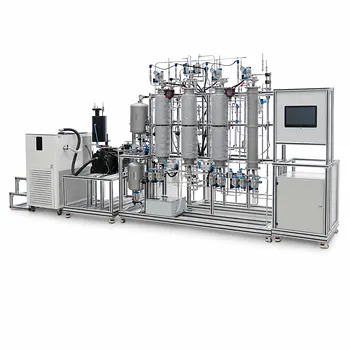
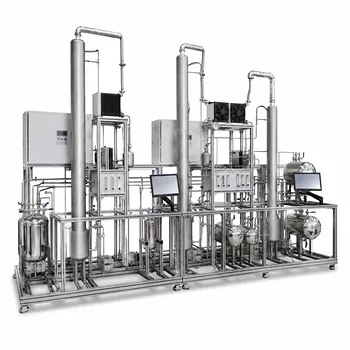
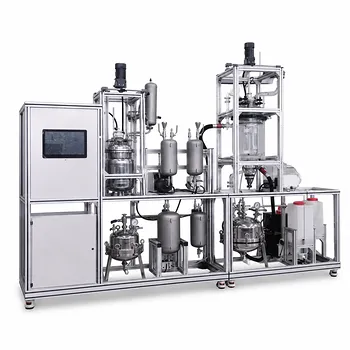
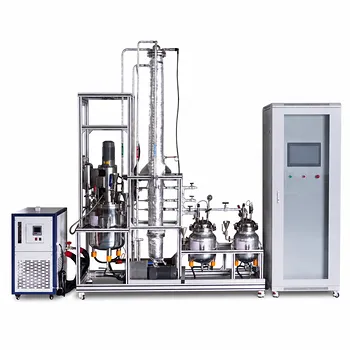
The separation sequence defines the plant. A unit operations pilot plant can be configured to demonstrate and study the differences between sequential, front-end deethanization, and front-end depropanization sequences by using a modular, multi-column distillation system that allows the physical reordering of the demethanizer, deethanizer, and depropanizer columns. By precisely controlling operating pressures, reboiler temperatures, and feed entry points, the pilot plant replicates the distinct thermal profiles of each industrial configuration, enabling direct observation of energy consumption, fouling risks, and component split efficiencies.
The true power of a pilot plant lies in its flexibility. To make a meaningful comparison between ethylene separation sequences, the system must be capable of rearranging column order, independently controlling cryogenic and high-pressure sections, and capturing real-time data on temperature gradients and fouling tendencies—exactly matching the defining conditions of each process.
The Core Principle: Modular Reordering of Unit Operations
Ethylene separation sequences are not about different apparatus—they are about the order in which the same distillation tasks are performed. A capable pilot plant simply rearranges its columns to mimic each flowsheet.
Reconfigurable Multi-Column Setup
The pilot plant must contain at least three fractionation columns—demethanizer, deethanizer, and depropanizer—each equipped with its own reboiler, condenser, and instrumentation. The columns are connected by flexible piping with valved bypasses so the feed can be routed to any column first.
Switching from sequential to front-end deethanization, for example, requires placing the deethanizer before the demethanizer. This is achieved by physically redirecting the feed stream to the deethanizer and routing its overhead to the demethanizer. Similarly, front-end depropanization moves the depropanizer to the front of the train.
Imitating Industrial Cryogenic Conditions
The demethanizer is the most demanding unit. Its condenser must reliably maintain overhead temperatures between ‑96 °C and ‑120 °C, as called for in high-pressure and low-pressure sequences. This requires a cascade refrigeration system or a supply of liquid nitrogen, along with high-performance insulation to minimize heat leak.
A key study variable is the demethanizer operating pressure. Running at low pressure (e.g., 3–5 bar) dramatically reduces the refrigeration load compared to a high-pressure demethanizer (30–35 bar), a trade-off that becomes immediately measurable in pilot plant utility consumption.
Replicating High-Temperature Reboiler Duty
In front-end deethanization, the deethanizer reboiler operates at a significantly higher temperature than in the sequential arrangement because it handles a heavier feed containing C3+ components. The pilot plant must be able to raise the reboiler temperature above 100 °C and hold it there to realistically simulate the conditions that trigger diene polymerization and fouling.
This requires a heating medium with sufficient thermal stability (e.g., high-pressure steam or a thermal oil loop) and temperature sensors strategically placed on the reboiler tubes to detect the onset of hot spots and coking deposits.
Comparing the Three Sequences in Practice
Once the hardware is configured, the educational and research outcomes come from operating each sequence under identical feed conditions and observing the differences.
Establishing the Baseline with Sequential Separation
Sequential separation is the most intuitive and historically most common configuration. Demethanizer first, then deethanizer, then depropanizer. It serves as the experimental baseline for teaching because it isolates the coldest step upfront and reduces downstream column loadings in a predictable manner.
Students can measure how the sequential arrangement excels in adapting to feed composition changes. The pilot plant can be challenged with different cracked gas feedstocks—varying the ethane/propane ratio—to demonstrate how the sequential train maintains stable product purities without major operational adjustments.
Reducing Refrigeration Load with Front-End Deethanization
When the demethanizer and the cold box represent the highest energy consumers, front-end deethanization offers a clear advantage. By removing the C2- fraction overhead of the deethanizer before deep chilling, the amount of gas that must be cooled to cryogenic temperatures is substantially reduced.
In the pilot plant, this is observed directly through the demethanizer condenser duty. The refrigeration system draws less power, and the temperature approach in the cold box heat exchangers can be monitored to confirm a smaller flow of ultra-cold gas. However, the same run also demonstrates the penalty: the deethanizer bottoms, rich in C3+ diolefins, exposes the reboiler to elevated fouling risk—visible as declining heat transfer coefficients over time.
Minimizing Fouling Risk with Front-End Depropanization
Placing the depropanizer first, in a front-end depropanization sequence, removes butadiene and other heavy, fouling-prone components early. This configuration is especially beneficial when cracking feedstocks that produce a significant amount of C4+ components.
In practice, the pilot plant shows a cleaner cold section. The demethanizer reboiler and the deethanizer remain free of polymer deposits, and pressure drops across the columns remain stable. The trade-off is that the depropanizer itself must now handle the full feed at a higher temperature, so its own reboiler design and monitoring become critical for long-term operation.
Critical Measurements and Observable Phenomena
A pilot plant provides more than just configuration flexibility—it gives direct access to data that simulation alone cannot fully capture.
Real-Time Energy and Purity Profiling
Instrumentation across every column tracks temperature profiles, reflux ratios, and product stream compositions. With in-line gas chromatography or spectroscopy, students can see how ethylene purity varies when the sequence order changes. The energy metric—kJ per kg of ethylene produced—can be calculated by summing reboiler duties and compressor work, enabling a direct side-by-side economic comparison of the three sequences.
Visualizing Fouling Mechanics
Transparent sections or sight glasses in the deethanizer reboiler (where equipped) allow visual observation of fouling. In a front-end deethanization run, the formation of polymer globules or a film on heat transfer surfaces becomes apparent. The pilot plant can then be used to test mitigation strategies, such as anti-foulant injection or reboiler temperature ramping, providing invaluable hands-on insight that static textbooks lack.
Understanding the Trade-offs of Pilot-Scale Studies
Pilot plants are powerful, but they also have inherent limitations that must be acknowledged to avoid misinterpretation.
The Scale-Down Gap in Tray Efficiency
Industrial demethanizers often require 80 to 150 trays due to the vanishingly small relative volatility between ethylene and ethane. A pilot column with 10–20 high-efficiency trays cannot reproduce the same number of stages. The measured separation will be limited, and students must learn to interpret results in terms of height equivalent to a theoretical plate (HETP) and know that stage efficiencies in pilot plant columns can differ from those in large-diameter columns.
Cryogenic Safety and Equipment Cost
Sustaining temperatures below ‑100 °C with pilot-scale equipment demands robust safety interlocks and materials compatible with low-temperature embrittlement. The cost of the refrigeration unit and the expertise required to operate it safely can be significant. This means the pilot plant must be designed as a dedicated teaching and research tool, not an ad-hoc assembly.
Simplifying the Cold Box
A full industrial ethylene plant employs a complex, highly integrated cold box to recover refrigeration. In a pilot plant, this is often simplified to a series of heat exchangers and external refrigeration utilities. The energy savings of process-to-process heat integration are therefore understated, and the reported energy differences between sequences may be less dramatic than in a full-scale facility.
Making the Right Choice for Your Curriculum or Research Goal
How you configure the pilot plant depends on what you want your students or researchers to learn. Use the following focus areas to guide your experimental campaign.
- If your primary focus is teaching the fundamentals of cryogenic distillation: Start with the sequential sequence as a baseline. Its clear cause-and-effect relationship between the cold demethanizer and subsequent columns builds foundational understanding before introducing the more counter-intuitive front-end options.
- If your primary focus is optimizing energy consumption: Run back-to-back sequences with the same feed and compare total reboiler duty and refrigeration load. The front-end deethanization and front-end depropanization sequences will quantitatively demonstrate how moving the first split point can slash the deep-chilling requirement.
- If your primary focus is studying thermal fouling and operability risks: Operate the front-end deethanization configuration at elevated reboiler temperatures and monitor pressure drop and heat transfer coefficient over time. This yields direct evidence of diene polymerization that no simulation can provide.
- If your primary focus is validating process simulation models: Generate data from all three sequences on the same pilot plant, including column temperature profiles and product purity. The measured HETP and pressure drops serve as crucial calibration points for simulation software, bridging the gap between theoretical stage counts and real equipment.
The separation sequence is not just a flowsheet on a page. A properly configured unit operations pilot plant transforms it into a tangible, measurable system where thermodynamic principles, energy economics, and the gritty reality of fouling all become visible at once.
Summary Table:
| Separation Sequence | Key Advantage | Primary Operational Challenge |
|---|---|---|
| Sequential | Simple baseline; highly adaptable to feed fluctuations | High refrigeration load on upfront demethanizer |
| Front-End Deethanization | Lowers refrigeration duty by removing C2- overhead first | Elevated reboiler fouling risk from heavy C3+ fractions |
| Front-End Depropanization | Minimizes fouling in the cold section by removing C4+ early | Higher thermal load on the initial depropanizer column |
Scale Up Your Research with LABPARK Pilot Plants
To effectively study complex separation sequences, your lab needs flexible, reliable, and highly configurable equipment. LABPARK designs and manufactures premium Educational and Vocational Unit Operations Pilot Plants specializing in chemical engineering, bioprocess & biotech, and environmental & water treatment.
Whether you are a university teaching thermodynamic fundamentals, a research institute validating process simulations, or an enterprise optimizing industrial designs, our systems deliver the real-time data and physical adaptability you require.
Ready to elevate your engineering lab? Contact LABPARK today to discuss your custom pilot plant specifications!
Related Products
- Educational Pressure Swing Adsorption Ethylene Capture Unit Operations Pilot Plant
- Bio-fermentation Ethanol Production Practical Training Unit Operations Pilot Plant
- Ethyl Acetate Synthesis Unit Operations Pilot Plant for Practical Training
- Green Anhydrous Ethanol Refining Practical Training Pilot Plant
- Green Anhydrous Ethanol Purification Extractive Distillation Unit Operations Training Pilot Plant
People Also Ask
- How does Pressure Swing Adsorption (PSA) technology operate? Optimize gas separation with pilot plants.
- How to demonstrate physical vs chemical absorption using a pilot plant? A practical lab guide.
- How is moisture removal managed in an adsorption unit operations pilot plant? Dew Point Control Guide
- How do physical vs chemical adsorption impact pilot plant design? Key operational & regeneration strategies.
- What are the key differences between PSA and TSA? Choosing the Right Adsorption Pilot Plant