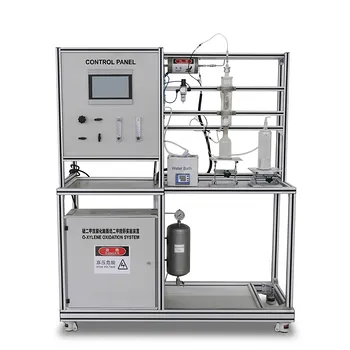
Is the Space Velocity method too simple to be trusted? A pilot-scale fixed-bed reactor is the exact tool chemical engineering students and researchers need to answer that question. By physically measuring raw material flow rates ((v_0)) and catalyst bed volume ((V_R)), you can calculate (SV = v_0 / V_R) and then validate whether scaling at a constant SV truly preserves conversion and selectivity—or whether hidden heat and mass transport effects make the method insufficient.
A pilot plant turns the Space Velocity equation from a theoretical shortcut into a testable, data-rich hypothesis. It lets you measure real temperature profiles, pressure drops, and outlet concentrations, exposing exactly where the SV method holds and where more complex models are required.
How Pilot Plants Bring the SV Method to Life
The Space Velocity method is not just a calculation—it is a design principle that assumes reactor performance depends primarily on the volume-based average residence time. Pilot-scale experiments force you to confront the reality behind that assumption.
The Core SV Scaling Relationship
The design equation is simple: (V_R = v_0 / SV). Given a target feed rate ((v_0)) and a known space velocity from smaller-scale tests, you compute the catalyst volume needed for a larger reactor. The method works brilliantly when the reaction is kinetically controlled and temperature gradients are negligible.
From Theory to a Concrete Measurement
In a teaching or research pilot plant, you don’t just look up SV from a textbook. You actively measure it using mass flow controllers and a precisely packed catalyst bed. You load the reactor, set a feed rate, and record the volume of catalyst. That hands-on process turns an abstract parameter into a physical, adjustable variable you can trust—or challenge.
A Step-by-Step Validation Workflow Using a Pilot-Scale Fixed Bed
A well-instrumented pilot reactor gives you the four building blocks needed to validate the SV method for a specific reaction system.
1. Characterize Your Reaction System with Real Data
Start by collecting online analytical data (gas chromatography, infrared analyzers) to measure conversion at a baseline SV. Simultaneously, use multi-point thermocouples to map the axial temperature profile. This establishes the real-world baseline against which all scale-up predictions will be tested.
2. Calculate the Required Bed Volume at Target Scale
Using the formula (V_R = v_0 / SV), determine how much catalyst you would need for a larger throughput while keeping SV constant. The pilot plant lets you physically change the catalyst bed height ((H_R)) or reactor diameter to imitate that future scale. You are no longer calculating in the abstract—you are assembling the very configuration you intend to scale.
3. Map Conversion and Selectivity Under Constant SV
Run the pilot reactor at the newly calculated bed volume and the same SV. Compare the outlet conversion and product distribution to the baseline. If the SV method is valid, the values should stay essentially unchanged. If they deviate, you have uncovered a scale-sensitive phenomenon—exactly the kind of discovery a researcher needs before committing to an industrial design.
4. Perform Sensitivity Analyses on Hidden Variables
Here is where pilot plants truly outpace models. You can deliberately vary catalyst shape (Raschig rings, multi-hole pellets), gas velocity ((u_0)), or coolant temperature while holding SV constant. Because mathematical models often mispredict parameters like effective thermal conductivity ((\lambda_e)) and wall heat transfer coefficients ((\alpha_w)), these live experiments reveal how sensitive the SV assumption is to realistic, non-ideal conditions.
Why a Pilot Plant Exposes the Limits of Pure SV Scaling
The real value of pilot-scale work is not just confirming the SV method, but understanding precisely when it breaks down. This is where a fixed-bed rig becomes a teaching instrument about scale-up safety and accuracy.
The Hidden Assumption of Uniform Kinetics
SV scaling assumes that intrinsic kinetics dominate and that transport resistances—internal pore diffusion, film mass transfer—remain identical across scales. In practice, a pilot plant equipped for catalyst shape comparison shows that larger industrial pellets may introduce diffusion limitations not present in the lab powder, altering the effective SV-performance relationship.
Hot Spots and Heat Transfer Realities
Exothermic fixed beds develop temperature peaks that grow as the reactor diameter increases. A pilot system with multi-point temperature sensors lets you observe hot spot formation and migration in real time. You can then test whether holding SV constant also controls the temperature profile—or whether additional adjustments to coolant type, gas velocity, or bed dilution are mandatory for safe scale-up.
Pressure Drop and Catalyst Geometry Trade-offs
Larger reactor diameters change the flow dynamics, and pilot experiments force you to measure pressure drop directly. By loading different catalyst geometries and measuring the resulting (\Delta P), you learn that the simple SV equation ignores a critical practical constraint. A reactor sized purely by SV might look perfect on paper but be economically unworkable due to excessive pressure drop in the industrial vessel.
Making the Right Choice for Your Scale-Up Study
A pilot-scale fixed-bed reactor lets you build a validation strategy tailored to your engineering goal. Use these goal-driven recommendations to decide how hard to lean on the SV method.
- If your primary focus is a quick, first-pass sizing of a catalyst bed: Use the pilot plant to confirm that conversion remains stable across a modest SV range. One or two data points at constant SV can give you enough confidence to estimate catalyst volume with reasonable engineering accuracy.
- If your primary focus is safe scale-up of a strongly exothermic or temperature-sensitive reaction: Do not stop at SV. Use the pilot rig’s temperature mapping to find the maximum acceptable gas velocity ((u_0)) and bed height that prevent runaway hot spots, even if that means deviating from the SV-based design.
- If your primary focus is catalyst selection and understanding transport limitations: Use the pilot plant to load different catalyst geometries and measure both conversion and pressure drop. Let the data teach you whether an industrial-scale reactor needs to operate at a lower SV than the lab recipe suggests.
- If your primary focus is validating a full reactor model: Use the pilot plant to generate robust experimental datasets of axial and radial temperature profiles, pressure drop, and exit composition. Compare these against your simulation code to refine kinetic parameters and heat transfer coefficients, building a model that outperforms any single SV assumption.
When you treat the pilot fixed-bed reactor as a live hypothesis test for the Space Velocity method, you move from theoretical scaling rules to verified engineering knowledge—precisely the kind of insight that builds both safe designs and genuine chemical engineering expertise.
Summary Table:
| Scale-Up Challenge | Space Velocity (SV) Assumption | Pilot Plant Validation Method |
|---|---|---|
| Reactor Sizing | Sizing depends solely on average residence time | Adjust catalyst bed volume ($V_R$) and flow rates ($v_0$) to verify conversion. |
| Thermal Management | Negligible temperature gradients (isothermal) | Use multi-point thermocouples to map axial temperature profiles and hot spots. |
| Pressure & Mass Transfer | Constant transport resistance across scales | Compare different catalyst shapes to measure actual pressure drop ($\Delta P$) and diffusion limits. |
Empower Your Research and Teaching with LABPARK
Bridging the gap between textbook equations and industrial reality requires hands-on, high-precision training systems. LABPARK provides premium Educational and Vocational Unit Operations Pilot Plants in chemical engineering, bioprocess & biotech, and environmental & water treatment.
Tailored for universities, research institutes, and enterprises, our pilot-scale reactors enable students and researchers to master scale-up methodologies, analyze real-world transport phenomena, and run safe, data-rich experiments.
Ready to elevate your engineering lab's capabilities? Contact LABPARK today to find the perfect pilot plant solution for your institution!
Related Products
- Fixed Bed Gas Solid Catalytic Reaction Educational Pilot Plant
- Fixed-Bed Chemical Reaction and Gas Dust Tar Removal Unit Operations Pilot Plant
- Multi-Reactor Educational Pilot Plant for Reaction Engineering Unit Operations
- Ethylbenzene Dehydrogenation Educational Unit Operations Pilot Plant
- Multi Functional Catalytic Reaction and Reactor Evaluation Educational Unit Operations Pilot Plant
People Also Ask
- Fixed-Bed vs. Fluidized-Bed Reactor: How to Choose the Right Pilot Plant for Gas-Solid Catalytic Reactions
- How to determine catalyst pore radius & porosity? Optimize your chemical engineering pilot plant.
- What reactor configurations study gas-solid reactions? Guide to key types and applications.
- How does identifying the rate-limiting step optimize reaction conditions? Pilot Plant Guide
- How do reactor pilot plants safely study gas-solid reactions? Master kinetics with thermal & flow control.