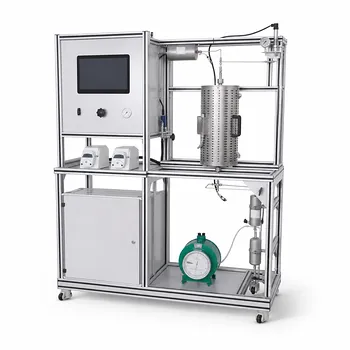
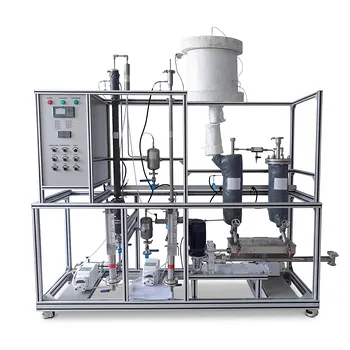
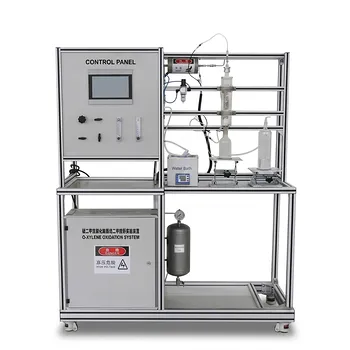
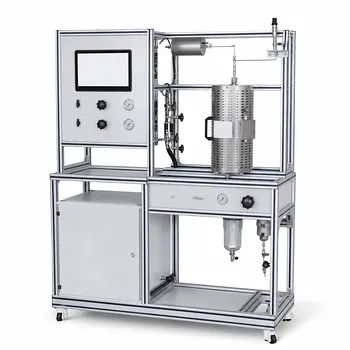
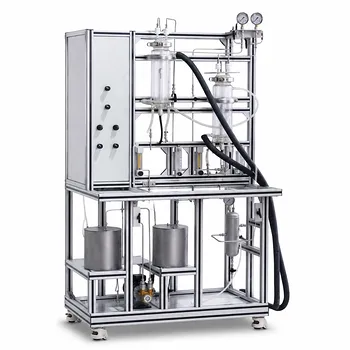
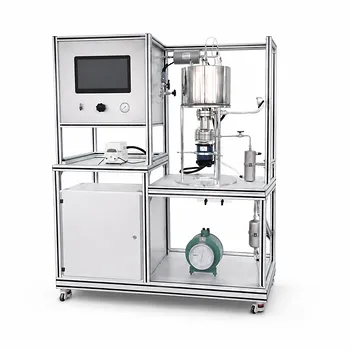
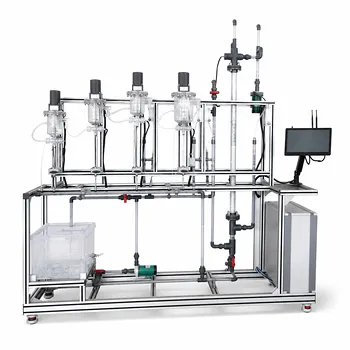
Demonstrating the thermodynamic and kinetic advantages of a multi-stage catalytic reactor starts with a pilot plant configuration that mirrors the true industrial process for selective hydrogen oxidation in styrene production. You can achieve this by arranging modular reactor sections with alternating catalytic beds—a dehydrogenation catalyst followed by a selective oxidation catalyst (Pt-group metals promoted by Sm and Li on alumina)—and injecting oxygen between the stages. This design directly shows how selectively combusting byproduct hydrogen shifts equilibrium, internally reheats the gas, and slashes the steam requirement.
The most effective pilot plant configuration for teaching these advantages deploys two distinct catalyst beds in series with an interstage oxygen feed. It directly proves that selective hydrogen removal re‑balances the thermodynamic equilibrium toward higher ethylbenzene conversion and provides the precise kinetic boost needed to sustain reaction rates without external reheating—a dual advantage that defines modern styrene monomer synthesis.
The Core Process: Selective Hydrogen Oxidation in Styrene Production
Styrene production from ethylbenzene is an equilibrium‑limited, endothermic dehydrogenation. The classical remedy is copious steam dilution, which adds a huge energy burden. In the advanced industrial process, selective oxidation of byproduct hydrogen is interleaved with dehydrogenation to overcome these limits.
Why Hydrogen Removal Matters
The dehydrogenation reaction (C_6H_5CH_2CH_3 \rightleftharpoons C_6H_5CH=CH_2 + H_2) is reversible. As hydrogen accumulates, the forward rate slows and conversion stalls. Removing hydrogen by selective combustion ((H_2 + 0.5O_2 \rightarrow H_2O)) lowers the product concentration, driving the equilibrium to the right according to Le Chatelier’s principle.
The Role of Internal Reheat
The hydrogen oxidation is exothermic and releases heat directly into the process stream. This internal temperature lift reheats the gas before the next dehydrogenation bed, eliminating the need for large interstage heat exchangers and reducing the steam‑to‑ethylbenzene ratio significantly.
Configuring the Pilot Plant to Demonstrate These Advantages
A well‑designed pilot plant replicates the staged bed arrangement in a safe, observable format. The system is built around modularly connected reactor tubes with independent temperature control and online analysis at each stage.
Alternating Catalyst Beds
The first bed contains a standard dehydrogenation catalyst (typically iron‑oxide based). The second bed holds a selective oxidation catalyst—usually a supported Pt‑group metal with promoters like Sm and Li on alumina—that selectively combusts hydrogen without attacking the valuable hydrocarbons. This clear physical separation lets students sample the gas and measure the composition shift before and after each stage.
Controlled Oxygen Injection Between Stages
Between the two beds, a mass flow controller introduces a precisely metered oxygen stream. The interstage zone is designed for rapid mixing and safe operation below the flammable limit. By varying the O(_2)/H(_2) ratio, students can directly observe the impact on hydrogen conversion and the resulting temperature rise, quantifying both equilibrium and rate effects.
Integrated Online Analysis
Gas chromatographs or process mass spectrometers at the inlet, mid‑point, and outlet measure ethylbenzene, styrene, hydrogen, oxygen, and water. The data shows how the intermediate oxidation removes hydrogen, increases the overall per‑pass conversion, and lowers the residual hydrogen content in the final product stream.
Demonstrating Thermodynamic Advantages
The configuration makes equilibrium concepts tangible. Students can test and validate the thermodynamic driving force that multi‑stage hydrogen removal provides.
Equilibrium Shift Through Product Removal
By comparing a run without oxidation (passing only through the first bed) against the full two‑bed configuration, the pilot plant reveals a significant jump in ethylbenzene conversion. The measured drop in hydrogen partial pressure after the oxidation bed correlates directly with the equilibrium constant, plainly illustrating the Le Chatelier effect.
Reduced Steam Demand
In a single‑bed system, high steam levels are needed to shift equilibrium and provide heat. The pilot plant’s second bed shows that once hydrogen is oxidized internally, the required steam‑to‑feed ratio can be drastically reduced while still achieving higher total conversion. A simple heat balance around each stage quantifies the energy saved.
Demonstrating Kinetic Advantages
Beyond equilibrium, the setup reveals how the multi‑stage approach overcomes kinetic hurdles that would otherwise cripple performance.
Internal Temperature Control Boosts Reaction Rate
The exothermic oxidation raises the gas temperature, exactly countering the cooling that occurs in the endothermic dehydrogenation step. The resulting temperature–concentration profile shows that the gas re‑enters the next dehydrogenation bed at a temperature where the reaction rate is kinetically viable—without needing an external furnace. This is directly analogous to interstage cooling used in SO(_2) oxidation to push conversion past 60–70%, just applied in reverse for an endothermic sequence.
Selective Oxidation Kinetics vs. Hydrocarbon Losses
By varying the oxygen flow and measuring styrene yield, students can map the selectivity window of the Pt‑group catalyst. The pilot plant demonstrates that the oxidation kinetics are tuned to combust hydrogen almost completely while keeping styrene and ethylbenzene conversion to CO(_2) minimal. This hand‑on optimization mirrors the delicate balance between boosting conversion and preserving product selectivity in commercial units.
Understanding the Trade‑offs
Even an ideal demonstration must reveal the practical compromises. A good pilot plant configuration highlights these honestly.
Oxygen‑Hydrocarbon Flammability and Safety
Introducing oxygen into a hot hydrocarbon stream creates a flammability risk. The pilot plant must incorporate inline oxygen analyzers, flow‑ratio safety interlocks, and emergency shut‑off valves that activate if the mixture approaches the lower explosive limit. This teaches the critical safety engineering required when designing commercial selective oxidation stages.
Catalyst Deactivation and Water Management
The Pt‑group catalysts can slowly deactivate due to thermal sintering or heavy hydrocarbon traces. The pilot plant should allow for periodic regeneration studies. Additionally, the water produced by oxidation can condense in cold spots; the system design must include heated tracing or condensate knock‑out pots to avoid measurement errors and corrosion, mirroring real‑world plant concerns.
Added Complexity vs. Single‑Bed Simplicity
A multi‑stage pilot plant with interstage feed demands more sophisticated control and data acquisition than a simple tubular reactor. The trade‑off is a longer startup time and higher capital cost—valuable lessons for students who will later evaluate the economics of process intensification versus traditional steam‑diluted systems.
Making the Right Choice for Your Goal
Pilot plant configurations are not one‑size‑fits‑all. Depending on your primary educational or research objective, you can adjust the modular design.
- If your primary focus is teaching equilibrium shift principles: Configure the plant with a simple two‑bed arrangement (dehydrogenation + oxidation) and a clear midpoint sampling port. Disable the oxidation bed initially, then activate it to show the conversion jump and the corresponding hydrogen‑partial‑pressure drop.
- If your primary focus is demonstrating intrinsic kinetic rate control: Include variable preheaters and interstage gas temperature probes. Run the experiment with and without interstage heating to quantify how the oxidation‑derived temperature kick restores the dehydrogenation rate before it falls into a kinetically sluggish regime.
- If your primary focus is process intensification and energy efficiency: Integrate a steam‑to‑feed ratio controller and compare the overall energy balance from a base case (high steam, single bed) to the multi‑stage, internally reheated case. Let students calculate the thermal energy saved per kilogram of styrene produced.
- If your primary focus is safety and control of staged oxidation: Add redundant oxygen sensors, automatic purge systems, and advanced process control loops that mimic industrial selective oxidation safeguards. Challenge users to optimize conversion while staying strictly within safe operating limits.
The right pilot plant is not just a piece of hardware—it’s a guided learning environment. By configuring it to reveal both equilibrium shifts and kinetic boosts simultaneously, you give students and researchers the definitive tool for mastering the reactor design principles that power modern styrene technology.
Summary Table:
| Feature/Component | Pilot Plant Configuration | Key Educational/Research Benefit |
|---|---|---|
| Catalyst Beds | Alternating dehydrogenation & selective oxidation beds | Direct proof of Le Chatelier’s principle via hydrogen removal |
| Interstage Feed | Controlled, safe oxygen injection between stages | Demonstrates internal reheat & reduced steam-to-feed ratio |
| Analysis System | Midpoint & outlet gas chromatography/mass spec | Quantifies conversion jumps, selectivity windows, & reaction kinetics |
| Safety Interlocks | Inline oxygen sensors & automatic shut-off valves | Teaches crucial process safety and explosion-limit prevention |
Bring Industrial Realism to Your Lab with LABPARK
Are you looking to effectively demonstrate advanced reaction engineering and process intensification concepts?
LABPARK provides state-of-the-art Educational and Vocational Unit Operations Pilot Plants in chemical engineering, bioprocess & biotech, and environmental & water treatment. Designed specifically for universities, research institutes, and enterprises, our modular pilot plants empower your students and researchers to analyze real-world thermodynamics and kinetics hands-on.
Ready to elevate your training and research capabilities? Contact LABPARK today to customize your pilot plant solution!
Related Products
- Ethylbenzene Dehydrogenation Educational Unit Operations Pilot Plant
- Crude Benzene Hydrogenation Educational Unit Operations Pilot Plant
- Methane Cracking Educational Unit Operations Pilot Plant
- Multi Functional Catalytic Reaction and Reactor Evaluation Educational Unit Operations Pilot Plant
- Steam Methane Reforming Hydrogen Production and Purification Educational Pilot Plant
People Also Ask
- What parameters & reactor configurations are needed for ethylbenzene dehydrogenation pilot plants?
- Why is steam dilution critical in dehydrogenation? Pilot Plant Control Guide
- Isothermal vs Adiabatic Reactors: Key Differences in Ethylbenzene Dehydrogenation Pilot Plants
- How do pilot plants help students verify material balances? Bridge Theory with Real-world Data
- Why is the steam-to-feedstock ratio critical in catalytic dehydrogenation? Learn the 3 key roles of steam.