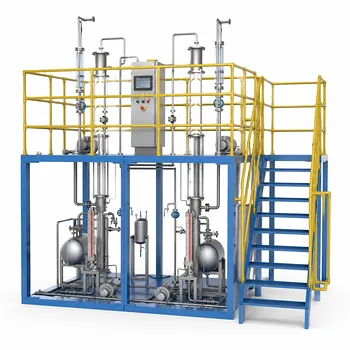
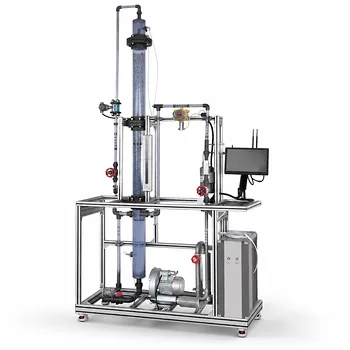
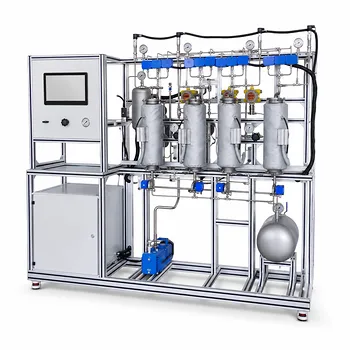
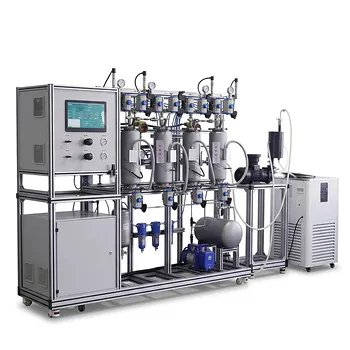
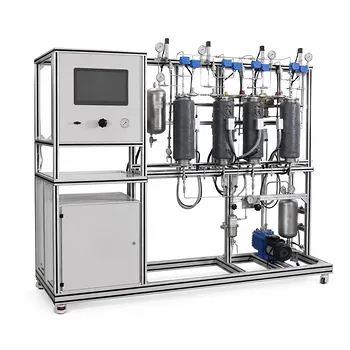
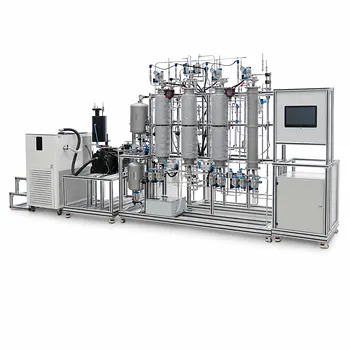
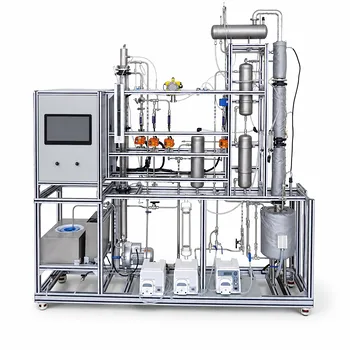
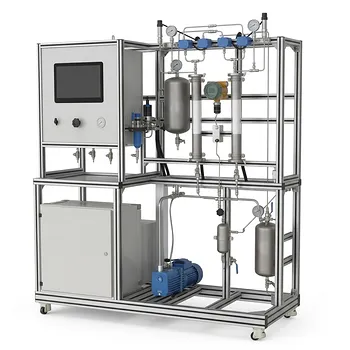
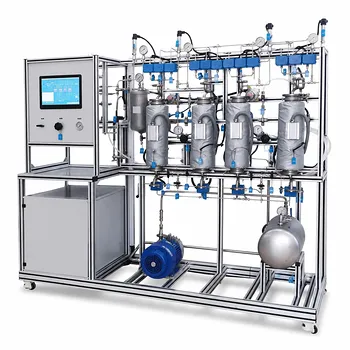
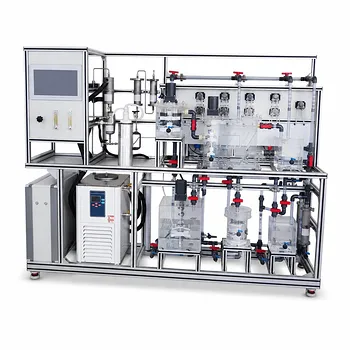
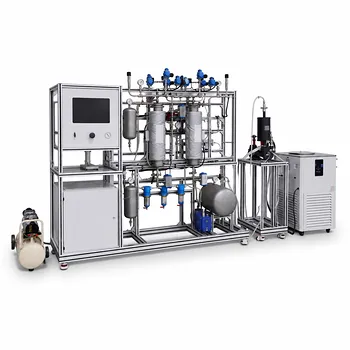
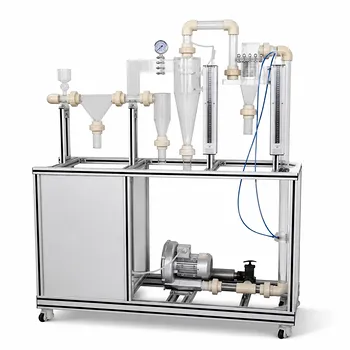
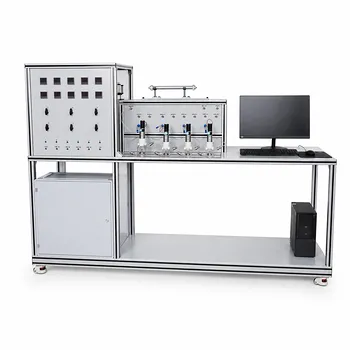
The key to configuring an absorption pilot plant for extended gas abatement training lies in modularity. By connecting two absorption columns in series or using a column with adjustable bed heights and tray counts, instructors turn a single-stage contactor into a multi-stage gas-cleaning train. Students then directly measure how increasing contact volume and the number of equilibrium stages boosts mass transfer efficiency, raises acid yield, and slashes the outlet concentration of a pollutant, mirroring industrial NOx recovery processes.
Building extended absorption into the pilot plant is fundamentally about expanding the mass transfer zone. Whether through series columns or variable-height internals, the configuration lets students quantify the design principle that drives industrial gas abatement: more contact stages mean less pollutant slip and more product recovery. The modular approach transforms a simple absorption demo into a full investigation of stage efficiency, scale‑up logic, and sustainability metrics.
Why Modular Configuration Is the Foundation of Extended Absorption Training
The surface need is to know how to set up the equipment. The deeper need is to give future engineers an intuitive feel for why adding length or stages changes the economics and environmental performance of a gas‑cleaning process. A modular design unlocks both.
The Expansion Principle: Series Columns and Adjustable Internals
The simplest path to extended absorption is to mount two absorption columns in series. Gas leaving the first column enters a second, where it is washed again with fresh or recycled solvent. This doubles the effective contact volume without over‑loading a single unit and clearly demonstrates that each additional stage drives the solute partial pressure lower, approaching thermodynamic limits.
Alternatively, a single column with an adjustable packed bed height or a variable number of trays can serve the same purpose. By changing the bed depth between runs—while keeping solvent flow and gas rate constant—students can isolate the effect of residence time and interfacial area on overall removal efficiency. Both configurations give the lab the ability to generate performance curves of outlet concentration versus effective height/stages, which is precisely the data needed to teach the concept of the Height of a Transfer Unit (H_OG) or the number of theoretical plates.
Connecting Theory to Data: Measuring the Improvement
A properly instrumented pilot plant makes the benefit of extended absorption tangible. Gas sensors at the inlet and outlet of each column section measure pollutant concentration in real time. When students switch from a single‑column to a dual‑column arrangement, they typically witness a step‑change reduction in the outlet gas concentration, even when the single column was already operating within design limits. For an acid‑gas system, they can also collect the liquid product and titrate for acid yield, directly validating the primary design goal: more absorption stages → higher solute capture → reduced atmospheric emissions.
Deepening the Lesson: Physical vs. Chemical Absorption in an Extended Setup
The same modular hardware can teach the critical distinction between physical solubility and reaction‑boosted mass transfer. Run the series columns with pure water and a sparingly soluble test gas (like CO₂). Students see a modest incremental improvement with each added stage, governed by Henry’s Law and a constant mass transfer coefficient.
Then switch to a reactive solvent—for example, an alkaline NaOH solution—and repeat the experiment. The removal efficiency jumps dramatically, and the benefit of extra stages becomes even more pronounced. The chemical reaction consumes dissolved solute in the liquid film, lowering the equilibrium back‑pressure and shrinking the mass transfer resistance. By comparing the two data sets, students quantify how chemical absorption amplifies the effect of additional contact volume—a direct lesson in why industrial NOx or acid‑gas scrubbers are designed with both chemical agents and multi‑stage contactors.
Using the Pilot Plant to Teach Design and Operating Calculations
Beyond the configuration itself, the series‑column or adjustable‑bed plant lets instructors bridge design and operating calculations. Before the run, students can apply the Kremser equation or perform graphical integration to predict the number of required stages for a target outlet concentration. They then execute the experiment, compare the actual measured outlet gas concentration to the prediction, and calculate the overall liquid‑phase mass transfer coefficient (Kₗa) or the Height of an Overall Transfer Unit (H_OG). Varying the liquid‑to‑gas ratio (L/V) between runs demonstrates that increasing the solvent flow further improves removal in a given configuration, but only up to the flooding point—giving a vivid illustration of hydraulic limits.
Understanding the Trade‑offs of an Extended Absorption Pilot Plant
While a multi‑stage or variable‑height setup is invaluable for demonstration, it introduces real costs and constraints that students must appreciate.
- Increased capital cost and footprint: A two‑column series arrangement requires two columns, additional pumps, and more floor space. A single column with movable internals is mechanically more complex and often more expensive to fabricate.
- Operational complexity: More stages mean more pressure‑drop monitoring points and a higher likelihood of channeling or maldistribution, especially if the packing is not perfectly installed after a height change.
- Solvent management: When using reactive solvents like amines or NaOH, safety protocols become more stringent. Hot regeneration for amine‑based systems adds utility costs and personal protective equipment requirements.
- Safe educational alternatives: For many core lessons, a simple CO₂‑water system in a two‑column series provides 90% of the learning value without hazardous chemicals, extreme pressures, or temperatures. That allows labs to focus on the mass transfer and stage‑addition principles without escalating risk.
The art of pilot‑plant design is to match the hardware complexity to the specific learning objective. A facility that starts with a safe, two‑column water‑CO₂ system and later can accommodate a reactive solvent when students are ready offers the best long‑term pedagogical flexibility.
Making the Right Choice for Your Training Goals
The “right” configuration depends entirely on what you want your students to internalize.
- If your primary focus is demonstrating the impact of equilibrium stages on removal efficiency: Start with two packed columns in series or a column with adjustable tray count, using a safe gas‑liquid pair like CO₂ and water. The incremental drop in outlet concentration with each added stage will speak for itself.
- If your primary focus is illustrating how chemical reactions amplify the benefit of extended contact: Configure the same series setup with an alkaline (e.g., NaOH) solvent. Then have students compare the removal curves with and without the reaction to quantify the enhancement.
- If your primary focus is teaching design versus operating calculations: Equip the plant with variable bed height and precise flow controllers. Let students run the column at several L/G ratios, predict performance via the Kremser equation, and validate their predictions while observing the approach to flooding.
- If your primary focus is simulating a full industrial acid‑gas recovery process: Move to an amine‑based chemical absorption system with two series columns and a small regeneration loop. This demonstrates the complete absorption‑stripping cycle, including heat effects, but requires significantly more infrastructure and safety oversight.
Extended absorption is not just about adding more pipe—it’s about giving students the tool to see, in real time, how process intensification and stage‑wise contact turn a laboratory curiosity into an industrially viable pollution control strategy. A thoughtfully configured pilot plant makes that connection unforgettable.
Summary Table:
| Configuration Type | Key Hardware Setup | Educational Focus | Best Applied To |
|---|---|---|---|
| Series Columns | Two packed columns connected in series | Demonstrating the impact of equilibrium stages | Multi-stage gas cleaning demos |
| Adjustable Internals | Single column with variable bed height/trays | Measuring residence time, H_OG, and scale-up | Design vs. operating calculations |
| Reactive Absorption | Series setup utilizing chemical solvents (e.g., NaOH) | Comparing physical vs. reaction-boosted absorption | Industrial scrubber simulation |
Bring Industrial-Scale Gas Abatement Training to Your Lab
Equip your students and researchers with hands-on experience in mass transfer and environmental engineering.
LABPARK provides state-of-the-art Educational and Vocational Unit Operations Pilot Plants in chemical engineering, bioprocess & biotech, and environmental & water treatment. Designed specifically for universities, research institutes, and enterprises, our modular systems allow you to easily configure series columns and adjustable beds for realistic gas abatement training.
Ready to upgrade your lab's training capabilities? Contact LABPARK today to get a tailored solution for your facility!
Related Products
- Dual-Mode Gas Absorption and Desorption Unit Operations Training Pilot Plant
- Packed Bed Absorption Educational Unit Operations Pilot Plant
- Absorption and Desorption Educational Unit Operations Pilot Plant
- Carbon Dioxide Adsorption and Capture Educational Unit Operations Pilot Plant
- Multi-Component Gas Pressure Swing Adsorption Pilot Plant for Unit Operations Education
People Also Ask
- How do two-film & penetration theories apply to gas absorption pilot plant teaching? Key pedagogical insights.
- How is the direction and driving force of mass transfer determined in a gas absorption unit operations pilot plant?
- How does partial pressure behavior influence gas absorption pilot plants? Master Mass Transfer
- How to model chemical absorption as physical absorption? The pilot plant simplification criterion.
- Why does increasing flow fail to enhance absorption in fast chemical reactions? Pilot Plant Insights