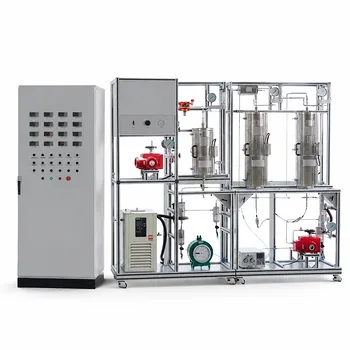
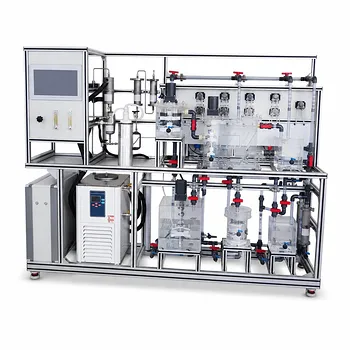
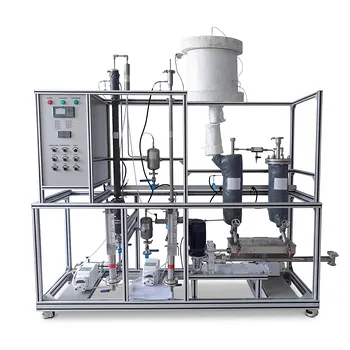
Studying highly exothermic catalytic reactions safely in the lab begins with a single design principle: you must physically separate the heat generation zone from the heat removal zone to prevent thermal runaway.
A chemical engineering pilot plant accomplishes this by using a structured reactor—most notably a monolithic loop reactor—where the catalyst is contained in a high-surface-area monolithic block and a large recycle stream of liquid or cold gas carries heat away to an external heat exchanger. This configuration limits the temperature rise across the catalyst to a few degrees, giving researchers a safe, fully controllable platform for investigating kinetics, catalyst deactivation, and heat transport without the risk of uncontrolled temperature spikes.
Managing the extreme exotherm of reactions like Fischer-Tropsch demands a reactor design that removes heat as fast as it is produced. A monolithic loop reactor with liquid recycle and external cooling provides the highest intrinsic safety margin for academic pilot plants, turning a potentially dangerous runaway reaction into a stable, instrumented experiment.
The Core Problem: Why Exothermic Reactions are So Dangerous in a Pilot Plant
Reactions like Fischer-Tropsch and gasoline synthesis release enormous amounts of heat—approximately 145 kJ per mole of -CH₂- formed in FT. In a small pilot-plant reactor, that heat can accumulate in seconds. Without immediate, deliberate cooling, the temperature soars, causing thermal runaway, instant catalyst deactivation, and even vessel rupture.
Academic and research pilot plants must therefore be engineered first for heat management, not just for residence time or conversion. The reactor becomes a heat exchanger as much as a chemical converter.
How Heat Overload Destroys a Valuable Experiment
A seemingly minor hotspot can invalidate an entire kinetic data set. As the catalyst bed overheats, reaction rates become dominated by mass transfer limitations and side reactions rather than intrinsic kinetics. Worse, the temperature excursion permanently sinters or fouls the catalyst, making repeatability impossible.
That’s why safe pilot-scale studies always start with a fundamental rule: the maximum temperature rise across the catalyst bed must be strictly bounded—ideally no more than 5–10°C. Achieving this in a highly exothermic system requires moving beyond simple jacketed tubular reactors.
The Core Strategy: Decoupling Heat Generation from Heat Removal
The most robust solution is to recycle a large excess of inert or product material through the catalyst bed. A liquid recycle loop reactor with a monolithic catalyst structure is the reference design for safe academic work.
In this arrangement, the catalyst is deposited on the walls of thousands of tiny parallel channels inside a ceramic or metallic monolith. The liquid (or gas) recycle stream flows through these channels at high velocity, absorbing reaction heat almost instantly and carrying it out of the reactor to an external heat exchanger. There, the heat is safely dissipated before the cooled stream returns to the reactor.
Why This Configuration Changes Everything
Because the external exchanger does the heavy lifting, the temperature rise in a single pass through the monolith can be kept extremely small. You can run a violently exothermic reaction at nearly isothermal conditions simply by adjusting the recycle ratio and coolant flow.
This approach also separates the residence time of the reaction from the residence time of the cooling loop. The reaction kinetics happen inside the monolith channels; the thermal management happens outside—giving you independent control over both.
How a Monolithic Loop Reactor Works in Practice
For a Fischer-Tropsch pilot study, the system would typically operate with a liquid wax-phase recycle. The heavy hydrocarbon waxes produced by the reaction themselves become the heat carrier.
Designing the Heat Removal Circuit
- The Monolith Reactor Section: Pre-heated syngas (CO + H₂) and the liquid recycle are co-fed to the monolithic block. The catalyst loaded in the wall channels triggers the exothermic chain‑growth reaction.
- Effluent Disengagement: Downstream, the gas and liquid phases separate. The unreacted syngas and gaseous products exit to analysis, while the hot liquid wax proceeds to cooling.
- External Heat Exchange: The hot wax passes through a heat exchanger—often cooled by a controlled-temperature thermal oil or pressurised water—where its temperature drops to the desired reactor inlet value.
- Recycle Loop: The cooled liquid is pumped back to the reactor inlet, completing the cycle. Precise PID-controlled mass flow controllers and calorimetric measurements let students calculate the exact heat duty and heat transfer coefficients.
This design not only guarantees safety but also turns the pilot plant into a teaching laboratory for heat transport phenomena. Students can vary the recycle rate and instantly observe the effect on the axial temperature profile, mapped by multiple embedded thermocouples.
Alternative Pilot Reactor Configurations for Exothermic Studies
While the monolithic loop reactor offers the highest inherent safety margin, several other pilot‑scale designs are also used, each with its own research focus.
Multitubular Fixed‑Bed Reactors with Boiling Water
This mimics the industrial shell‑and‑tube configuration. Narrow tubes packed with catalyst are surrounded by boiling water, generating steam to maintain a constant wall temperature. It is excellent for studying temperature profiles and steam‑side control, but requires careful pressure management and has a smaller turndown ratio.
Slurry‑Phase Reactors
Here, fine catalyst particles are suspended in an inert liquid. The high heat capacity of the liquid provides excellent thermal buffering, virtually eliminating hotspots. This makes it ideal for fundamental kinetic studies of very fast exothermic reactions, though product separation adds complexity.
Fluidized‑Bed Reactors with Internal Cooling Coils
For reactions that demand high heat transfer rates and continuous catalyst regeneration (like the Methanol‑to‑Olefins process), a fluidized bed with embedded boiler‑feed‑water cooling coils is the workhorse. Researchers can investigate catalyst deactivation by coke formation and the efficiency of thermal regeneration loops in a single, integrated unit.
Implementing Robust Safety Systems and Data Collection
Safe study does not rely on the reaction system alone. All pilot plants for highly exothermic reactions must be wrapped in multiple layers of protective instrumentation.
Beyond the Basic Thermocouple
The smallest pilot reactor should incorporate multi‑point thermocouple assemblies to map both axial and radial temperature profiles in real time. When students see a “hot spot” drifting downstream, they learn directly how catalyst deactivation shifts the reaction zone—and how to compensate by adjusting feed temperature or coolant flow.
The Non‑Negotiable Safety Interlocks
Every unit must include:
- Overpressure relief valves and burst discs.
- Blast shields around the reactor.
- Gas leak detectors for flammable or toxic species.
- Automated emergency shut‑off tied to high temperature, high pressure, or loss of flow.
These interlocks turn the pilot plant into a safe sandbox. Students can push conditions towards the edge of the operating envelope while knowing that the plant will protect itself and them.
Understanding the Trade‑offs
None of these configurations is without limitations, and understanding those limitations is just as important as mastering the technique.
The Complexity Barrier
A monolithic loop reactor with recycle requires precise control of the recycle pump, phase separation, and external heat exchanger. For a short‑duration teaching lab, the setup and cleaning time can be substantial.
Catalyst Handling Constraints
Monoliths are excellent for heat removal but can be difficult to load uniformly with catalyst. If the catalytic coating is uneven, local hot spots can form even with aggressive recycle, potentially leading to misleading kinetic data.
Scalability Lessons
A pilot‑plant design that is perfect for teaching thermal safety may not scale up economically. Students should be encouraged to compare the experimental results from the monolithic loop reactor with simpler multitubular or slurry systems to appreciate the industrial trade‑offs between capital cost, reliability, and heat management capability.
Making the Right Choice for Your Research Goal
The safest, most educationally rich platform is the one aligned with your primary learning objective. Choose your pilot‑plant configuration based on what you need to demonstrate.
- If your primary focus is demonstrating intrinsic thermal safety and studying pure heat removal kinetics: Use a monolithic loop reactor with liquid recycle. It gives you unmatched stability and clearly separates heat transfer from reaction control.
- If your primary focus is comparing catalyst formulations under industrial‑like heat management: Use a multitubular fixed‑bed reactor with boiling‑water cooling. Students can observe steam generation and learn about saturated‑liquid cooling directly.
- If your primary focus is studying catalyst deactivation and regeneration in a highly exothermic cycle: Use a dual fluidized‑bed system connected to an air‑fired regenerator. This directly shows the thermal management of continuous catalyst circulation.
- If your primary focus is simple accessibility for undergraduate unit‑operations labs: Start with a slurry‑phase reactor with ample internal cooling coils. It forgives many operating mistakes and still teaches the fundamentals of heat transfer control.
No matter which configuration you choose, the same principle applies: make heat removal the star of your pilot‑plant design, and you turn a potential hazard into the most powerful demonstration of chemical reaction engineering there is.
Summary Table:
| Reactor Type | Heat Removal Method | Best For | Safety Level |
|---|---|---|---|
| Monolithic Loop | Liquid/gas recycle & external heat exchanger | Kinetic studies & isothermal operation | Excellent (Highest) |
| Multitubular Fixed-Bed | Boiling water jacket (steam generation) | Industrial scaling & steam-side control | Good (Requires pressure control) |
| Slurry-Phase | Inert liquid suspension & cooling coils | Fast reactions & thermal buffering | Excellent |
| Fluidized-Bed | Internal cooling coils & catalyst circulation | Catalyst deactivation & regeneration studies | Good |
Bring Safe, Advanced Reaction Engineering to Your Lab
Teaching and researching highly exothermic processes requires robust, precision-controlled equipment engineered for absolute safety.
LABPARK provides state-of-the-art Educational and Vocational Unit Operations Pilot Plants in chemical engineering, bioprocess & biotech, and environmental & water treatment. Designed specifically for universities, research institutes, and enterprises, our pilot plants enable students and researchers to safely investigate complex reaction kinetics, heat transport, and catalyst deactivation with real-time safety interlocks.
Ready to upgrade your laboratory capabilities with industry-grade safety? Contact LABPARK today to find the perfect pilot plant configuration for your research goals!
Related Products
- Methanol Synthesis and Catalyst Performance Evaluation Educational Unit Operations Pilot Plant
- Carbon Dioxide Hydrogenation Methanol Synthesis Educational Unit Operations Pilot Plant
- Methane Cracking Educational Unit Operations Pilot Plant
- Dual Mode Heat Transfer Pilot Plant for Unit Operations Training
- Comprehensive Multi-Modal Heat Transfer Unit Operations Pilot Plant for Engineering Training
People Also Ask
- Why is a purge system necessary when operating a gas recirculation loop in a methanol synthesis pilot plant? (Guide)
- How do temp & pressure affect methanol synthesis pilot plants? Optimize equilibrium and catalyst performance.
- Why do modern methanol pilot plants operate at lower pressures? Catalyst & Feed Requirements Explained
- What are the operational requirements for catalyst activation? Safe Methanol Pilot Plant Operation
- Why Compare Predicted and Experimental Excess Enthalpy? Key to Accurate Pilot Plant Scale-up