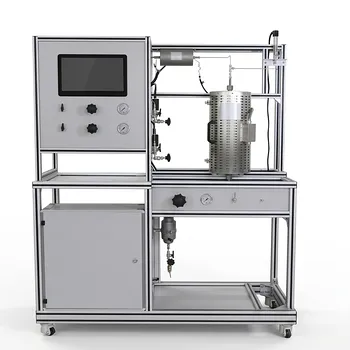
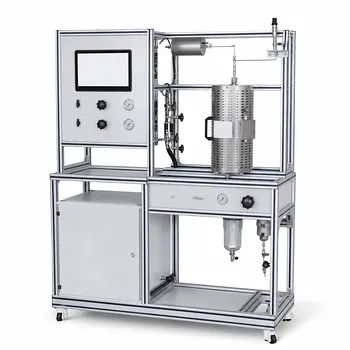
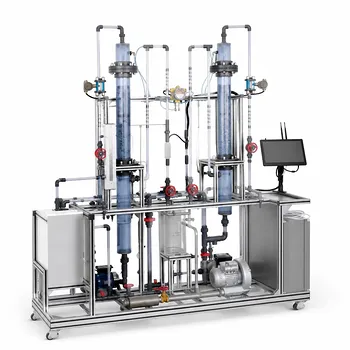
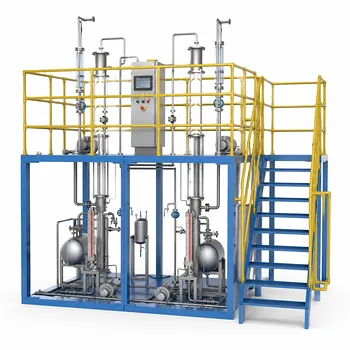
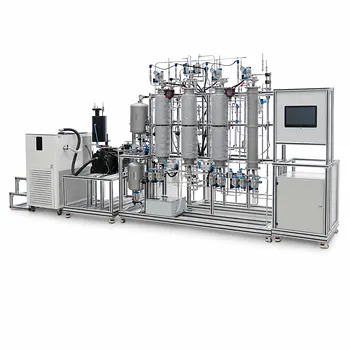
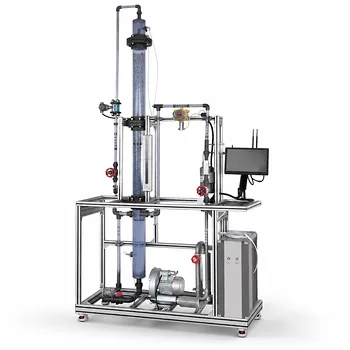
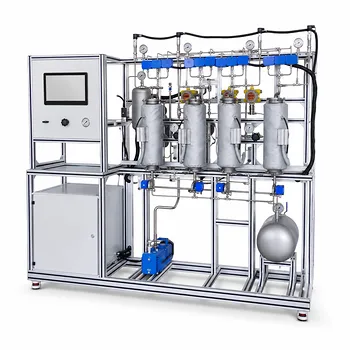
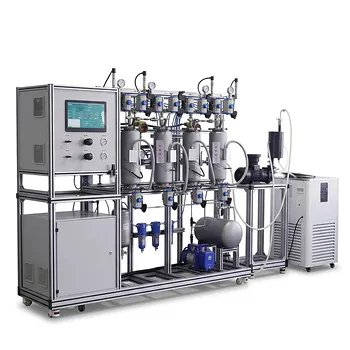
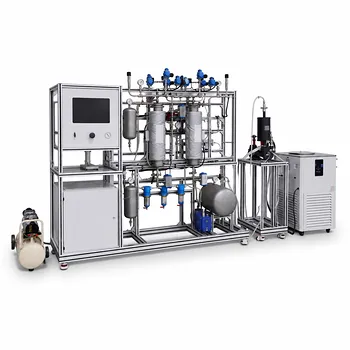
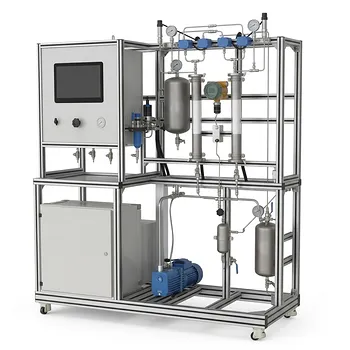
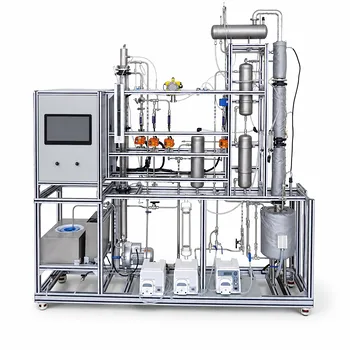
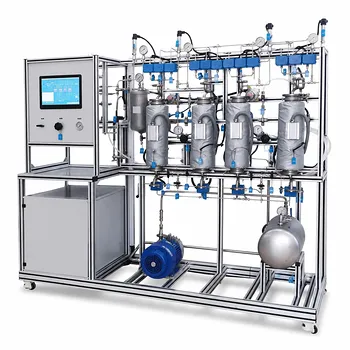
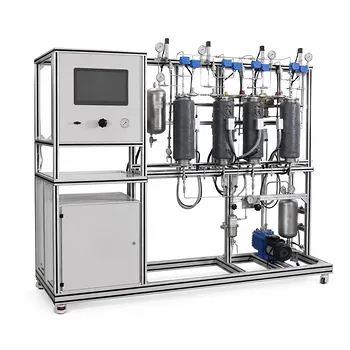
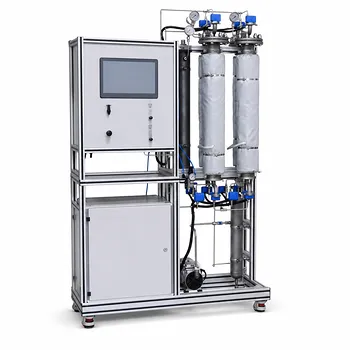
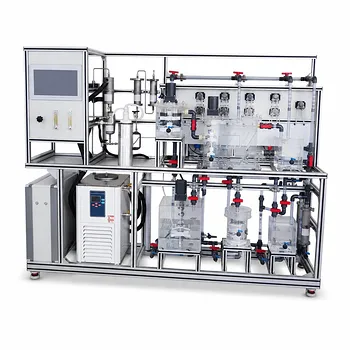
The answer lies in in-situ product removal. In a methanol synthesis pilot plant, coupling reaction with adsorption means placing a solid adsorbent directly inside the reactor. The adsorbent traps methanol as it forms, keeping its gas-phase concentration artificially low. This continuously pulls the equilibrium toward products, allowing the pilot plant to achieve per-pass conversions that visibly exceed the thermodynamic equilibrium limit of a conventional reactor—a direct demonstration of Le Chatelier’s principle in action.
Core Takeaway: A unit operations pilot plant transforms the abstract thermodynamic benefit of “shifted equilibrium” into a measurable, observable reality. By operating a trickle bed reactor packed with both catalyst and adsorbent, you can quantitatively prove higher conversion, lower recycle needs, and reduced energy intensity—while simultaneously measuring the adsorption energetics that make the cycle work.
The Thermodynamic Principle: Shifting Equilibrium with In-Situ Adsorption
Why Methanol Synthesis Needs a Boost
Methanol synthesis from CO/CO₂ and H₂ is equilibrium-limited. As the catalyst bed produces methanol, product accumulation reduces the driving force for the forward reaction. Industrial plants compensate with extensive recycle loops and elongated reactors that suffer from high pressure drops and energy penalties. The core thermodynamic problem is product inhibition.
In-Situ Adsorption as a Chemical “Pump”
Introducing a solid adsorbent into the reactor changes the game. The adsorbent selectively captures methanol molecules, keeping the partial pressure of methanol in the gas phase extremely low. According to Le Chatelier’s principle, the system responds by producing more methanol to restore the equilibrium. This is not a kinetic trick—it is a genuine thermodynamic shift that the pilot plant can make tangible.
How a Pilot Plant Makes the Thermodynamic Benefits Visible
Measuring Conversion Beyond Equilibrium Limits
A properly instrumented pilot plant—configured as a gas–solid–solid trickle bed with separate catalyst and adsorbent sections—allows direct comparison. Run the reactor first without adsorbent at a given temperature and pressure; the exit methanol concentration plateaus at the equilibrium value. Then introduce the adsorbent. The methanol in the outlet stream will drop sharply, while the total methanol produced (including that desorbed later) far exceeds the previous equilibrium amount. This side-by-side experiment transforms the thermodynamic principle into a clear data set.
Quantifying the Energy Savings
The thermodynamic benefit is not just about conversion. A higher per-pass conversion drastically reduces the recycle ratio. In the pilot plant, you can simulate the full loop by measuring the amount of unreacted syngas that must be recompressed and reheated. A lower recycle flow directly translates into lower compression and heating duties—energy savings you can calculate from the pilot plant’s flow, temperature, and pressure sensors. This bridges the gap between a textbook equilibrium shift and the real-world exergy advantage.
Determining Adsorption Thermodynamics
The pilot plant can be operated as an adsorption test unit to measure the very parameters that make the shift possible. By tracking concentration changes at different temperatures, you calculate:
- Gibbs free energy of adsorption (ΔGads) from the equilibrium constant of the adsorption isotherm.
- Adsorption enthalpy (ΔHads) using the van’t Hoff relationship across multiple temperature runs.
- Entropy changes (ΔSads) from the difference.
These numbers reveal whether the adsorbent’s selectivity and heat of adsorption are thermodynamically compatible with the reaction temperature. The pilot plant thus demonstrates not only that the equilibrium shifts, but why—using the language of chemical thermodynamics.
Observing Dynamic Temperature–Concentration Profiles
When the pilot plant is equipped with multiple temperature sensors along the bed, operators can watch the interplay of reaction exothermicity and adsorption heat. Methanol synthesis is exothermic; physical adsorption of methanol is also exothermic. The temperature profile through the bed reveals how the adsorbent acts as a thermal buffer. Such profiles—compared with simulations—show students and researchers how the coupled process can operate closer to isothermal conditions, protecting the catalyst and preventing equilibrium being lost at hot spots.
Understanding the Trade-offs
The Energy Cost of Regeneration
No thermodynamic shift is free. The pilot plant must face adsorbent regeneration. Whether by temperature swing or pressure swing, regeneration consumes energy. The experimental setup allows you to measure the heat or work required to desorb the captured methanol and directly compare it against the energy saved by reduced recycle. This turns the demonstration into a full energy balance exercise, exposing the net thermodynamic advantage.
Pressure Drop and Mass Transfer Constraints
Packing both catalyst and adsorbent into a single vessel increases the bed density and flow path complexity. In the pilot plant, you will measure a higher pressure drop than in a conventional reactor. Mass transfer limitations can also slow the rate of methanol uptake, meaning the “shifted equilibrium” is not instantaneous. The pilot plant teaches that the thermodynamic gain must be weighed against these transport penalties.
Scale-Down Effects and Extrapolation
A pilot-scale unit operates at lower velocities and different heat management profiles than an industrial reactor. The observed conversion enhancement may be amplified at small scale due to better mass transfer. The pilot plant’s value is in teaching the correct methodology: dimensionless groups, residence time distributions, and scaling laws that let you project the thermodynamic benefits to full scale.
Making the Right Choice for Your Pilot Plant Demonstration
Your underlying need is to prove and quantify a thermodynamic concept with a hands‑on system. How you prioritize depends on your main goal.
- If your primary focus is demonstrating the equilibrium shift: Run paired experiments with and without adsorbent, keeping all other conditions identical. The conversion difference immediately visualizes the thermodynamic payoff.
- If your primary focus is energy efficiency: Measure recycle stream flowrates, compressor power, and regeneration energy. Show that the net energy after adsorbent regeneration is still lower than the conventional recycle burden.
- If your primary focus is teaching adsorption thermodynamics: Isolate the adsorbent bed and run isotherm experiments at multiple temperatures, then calculate ΔHads and ΔGads to connect molecular forces to reactor-scale behavior.
- If your primary focus is dynamic process behavior: Use multi‑point temperature sensors and gas analysis to trace how adsorption‑driven concentration profiles evolve over time, linking heat management to the thermodynamic shift.
Coupling reaction and adsorption in a pilot plant turns a theoretical thermodynamic benefit into a reproducible, quantitative lesson—one that connects equilibrium manipulation, energy savings, and practical engineering trade-offs in a single experimental setup.
Summary Table:
| Key Parameter | Measurement Method in Pilot Plant | Engineering Insight/Value |
|---|---|---|
| Equilibrium Shift | Compare reactor outlet concentration with & without adsorbent | Quantitatively proves conversion beyond thermodynamic limits |
| Energy Savings | Monitor recycle flowrates, compressor power, & heating duties | Calculates net energy reduction after adsorbent regeneration |
| Thermodynamic Data | Run isotherms at multiple temperatures to apply van 't Hoff | Determines adsorption enthalpy ($\Delta H_{ads}$) and free energy ($\Delta G_{ads}$) |
| Thermal Management | Track multi-point temperature profiles along the bed | Evaluates adsorbent buffering effects on exothermic reaction hotspots |
Bring Advanced Thermodynamic Concepts to Life with LABPARK
Are you looking to bridge the gap between textbook chemical thermodynamics and real-world process engineering? LABPARK provides state-of-the-art Educational and Vocational Unit Operations Pilot Plants in chemical engineering, bioprocess & biotech, and environmental & water treatment.
Designed specifically for universities, research institutes, and enterprises, our pilot plants deliver the precise instrumentation, automated control, and data acquisition needed to validate novel coupled processes, measure energy efficiencies, and scale up chemical syntheses.
Related Products
- Methanol Synthesis and Catalyst Performance Evaluation Educational Unit Operations Pilot Plant
- Carbon Dioxide Hydrogen Methanol Synthesis Educational Unit Operations Pilot Plant
- Carbon Dioxide Hydrogenation Methanol Synthesis Educational Unit Operations Pilot Plant
- Absorption and Desorption Educational Unit Operations Pilot Plant
- Dual-Mode Gas Absorption and Desorption Unit Operations Training Pilot Plant
People Also Ask
- Why is a purge system necessary when operating a gas recirculation loop in a methanol synthesis pilot plant? (Guide)
- How do temp & pressure affect methanol synthesis pilot plants? Optimize equilibrium and catalyst performance.
- Why do modern methanol pilot plants operate at lower pressures? Catalyst & Feed Requirements Explained
- What are the operational requirements for catalyst activation? Safe Methanol Pilot Plant Operation
- Why Compare Predicted and Experimental Excess Enthalpy? Key to Accurate Pilot Plant Scale-up