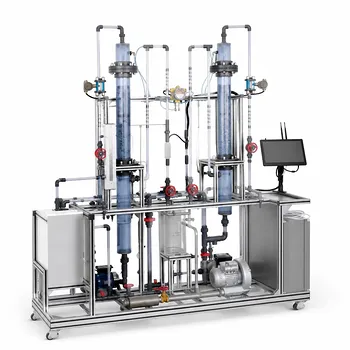
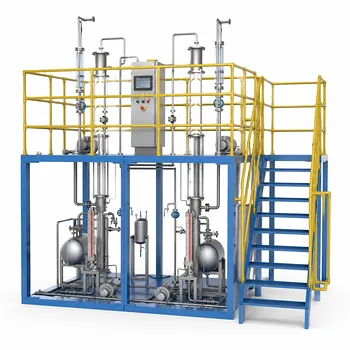
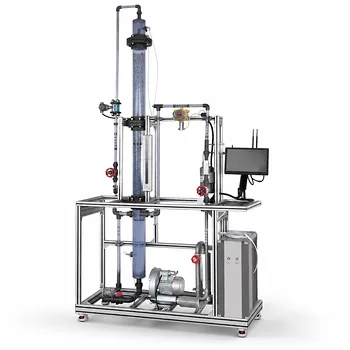
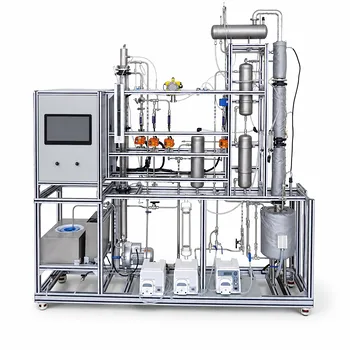
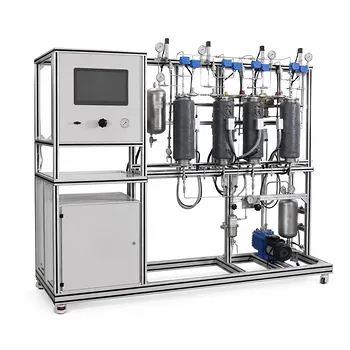
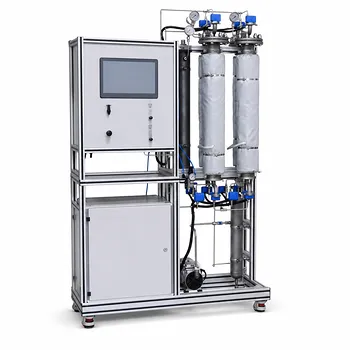
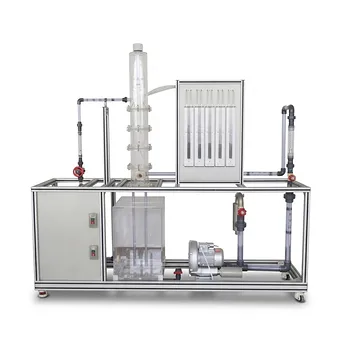
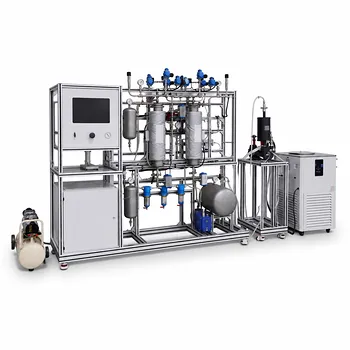
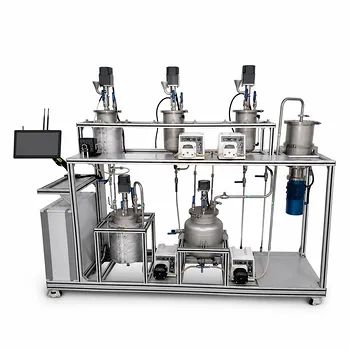
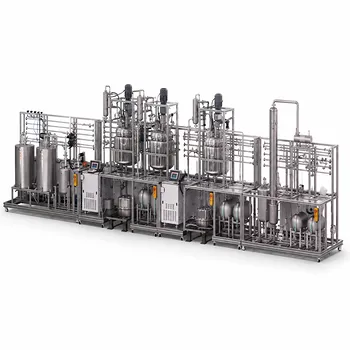
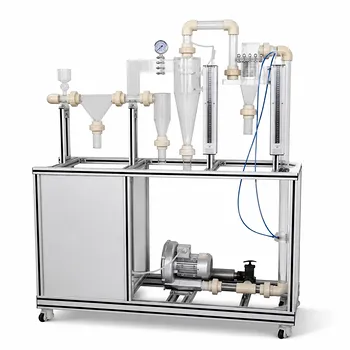
A unit operations pilot plant makes the difference between physical and chemical absorption tangible. By running the same gas through an inert solvent like water (physical) and then through a reactive solvent such as a sodium hydroxide solution (chemical), students can immediately observe stark contrasts in absorption efficiency, column temperature, and mass transfer rates. The pilot plant transforms theoretical principles into measurable, side‑by‑side evidence, anchored in the primary reference’s example of CO₂‑water versus CO₂‑NaOH.
Physical absorption obeys Henry’s Law—solubility alone dictates gas uptake, with nearly no heat effect. Chemical absorption introduces a fast reaction that consumes the dissolved gas, dramatically lowering the equilibrium partial pressure, boosting mass transfer, and generating a measurable temperature rise. Running both systems on the same column turns textbook concepts into teachable, quantitative insights.
Setting Up a Head‑to‑Head Demonstration
Selecting the Right Solvent–Gas Pair
Physical absorption is best shown with a non‑reactive pair, such as carbon dioxide absorbed into water. Here, only physical solubility governs uptake, making it a classic Henry’s Law demonstration. Chemical absorption needs a reactive system, most clearly CO₂ into an aqueous sodium hydroxide (NaOH) solution, where the dissolved gas is rapidly neutralized. For teaching industrial relevance, you can later switch to an amine solution like MEA, which adds reversibility, but the NaOH system gives the most dramatic, immediate effect.
Instrumenting the Column for Comparison
A well‑equipped pilot column includes gas concentration sensors at the inlet and outlet, liquid flow meters, and temperature probes placed along the packing height. For the physical run, the temperature profile remains nearly flat. For the chemical run, you will see a pronounced temperature bulge where the reaction zone sits. Sampling ports for liquid composition allow calculation of mass transfer coefficients and the effective driving force.
What You’ll Observe: Physical vs. Chemical Absorption Side by Side
Solubility and Driving Force
With physical absorption, the equilibrium partial pressure of the solute in the gas phase is fixed by Henry’s Law. As the liquid becomes saturated, the driving force collapses quickly. In chemical absorption, the reaction consumes the dissolved solute in the liquid film, keeping its equilibrium partial pressure near zero. This sustains a large driving force even at very low gas‑phase concentrations, which is why chemical systems can achieve far deeper removal with less solvent.
Temperature Signatures
Physical absorption is effectively isothermal—any heat of solution is too small to notice. Chemical absorption, especially with NaOH, is highly exothermic. The temperature profile along the column becomes a live map of the reaction front, often with a clear peak. This non‑isothermal behavior is a key diagnostic for students, directly linking reaction heat to enhanced mass transfer.
Mass Transfer Coefficients and Column Efficiency
Calculating the overall volumetric mass transfer coefficient (K_Ga) from inlet/outlet concentrations reveals the core insight: chemical absorption yields values often one to two orders of magnitude higher than physical absorption. The reaction effectively eliminates the liquid‑side mass transfer resistance, allowing the column to operate far more efficiently. Students can also compare the height of a transfer unit (HTU) or stage efficiency for each run, quantifying the industrial advantage of reactive solvents.
Beyond the Basics: Extending the Pilot Plant to Real Processes
Reversible Chemical Absorption with Amines
Once the fundamental NaOH contrast is understood, a plant can be configured for amine‑based solvents (MEA, DEA, MDEA). Adding a regeneration loop (hot stripping at ~105 °C) shows how the chemical reaction can be reversed, replicating industrial carbon capture and gas sweetening cycles. The temperature swing between absorber and stripper becomes a teaching tool for energy balance and reaction thermodynamics.
Physical Absorption at High Pressure and Low Temperature
For advanced demonstrations, a pilot plant can mimic Rectisol or Selexol processes. Using physical solvents like methanol at −40 °C and high pressure, the absorption relies purely on solubility. Regeneration happens simply by pressure reduction (flashing), without heat. While more complex, this setup lets students explore the Henry’s Law region where physical absorption becomes economically viable for high‑partial‑pressure acid gases.
Understanding the Trade‑offs and Limitations
Safety and handling mark the first divergence. NaOH solutions are corrosive and the exotherm demands careful temperature control; amine systems add toxicity and degradation concerns. Physical‑only setups with water are inherently safer but yield such weak absorption that a very tall column or gas recycle is needed to see meaningful concentration changes.
Solvent cost and regeneration must be considered. A simple NaOH‑CO₂ demonstration is consumptive—once the hydroxide is spent, you replace it. In contrast, amine loops demonstrate regeneration but require additional heaters and stripper columns, raising capital and operational complexity. For an educational lab, the classic NaOH‑CO₂ pair offers the clearest “before‑and‑after” effect with minimal equipment.
Data interpretation can mislead if not careful. A chemical absorption column is non‑isothermal, so plug‑flow and isothermal assumptions used in simple mass transfer calculations must be corrected. Additionally, high reaction rates can make the liquid‑side resistance negligible, but if mixing is poor, the benefit may be masked by gas‑side resistance.
Applying These Insights to Your Teaching or Research Goal
After a brief introductory sentence, use this exact format for the bullets:
- If your primary focus is teaching fundamental absorption phenomena: Start with CO₂‑water versus CO₂‑NaOH. Let students measure concentration, temperature, and mass transfer coefficients to internalize how a chemical reaction fundamentally changes the driving force.
- If your primary focus is validating kinetic models for carbon capture: Use an amine system with a regeneration loop and collect temperature‑dependent reaction rate data to fit into process simulation models.
- If your primary focus is demonstrating industrial gas sweetening: Configure the pilot plant for a physical solvent at high pressure or an amine system at moderate conditions, highlighting the role of operating cost, regeneration strategy, and solvent selection.
- If your primary focus is rapid, cost‑effective screening of new solvents: A flexible pilot column with modular solvent delivery, precise dosing, and online gas analysis lets you quickly compare physical vs. chemical absorption performance in a controlled environment.
A single pilot plant, with well‑chosen solvent pairs and basic instrumentation, is the definitive bridge between textbook solubility and the engineering reality of industrial separation.
Summary Table:
| Feature | Physical Absorption (e.g., CO2 + Water) | Chemical Absorption (e.g., CO2 + NaOH) |
|---|---|---|
| Governing Law | Henry's Law (solubility limit) | Chemical reaction kinetics + solubility |
| Thermal Effect | Isothermal (negligible heat change) | Highly exothermic (clear temperature bulge) |
| Mass Transfer ($K_{Ga}$) | Baseline rate; limited by saturation | 10 to 100x higher; reaction removes resistance |
| Regeneration | Pressure reduction (flashing) | Heat-induced stripping (e.g., amine loops) |
Bring Mass Transfer Theory to Life with LABPARK
Bridge the gap between textbook concepts and industrial scale. LABPARK provides premium Educational and Vocational Unit Operations Pilot Plants in chemical engineering, bioprocess & biotech, and environmental & water treatment specifically engineered for universities, research institutes, and enterprises.
Our custom-built pilot plants allow students and researchers to perform hands-on runs, measure real-time temperature profiles, and calculate precise mass transfer coefficients safely.
Ready to elevate your engineering curriculum or research capabilities? Contact the LABPARK team today to discuss your laboratory specifications!
Related Products
- Absorption and Desorption Educational Unit Operations Pilot Plant
- Dual-Mode Gas Absorption and Desorption Unit Operations Training Pilot Plant
- Packed Bed Absorption Educational Unit Operations Pilot Plant
- Carbon Dioxide Absorption and Desorption Educational Pilot Plant for Carbon Capture Studies
- Multimodal Absorption and Desorption Pilot Plant for Unit Operations Training
People Also Ask
- How to demonstrate physical vs chemical absorption using a pilot plant? A practical lab guide.
- Why are liquid-phase mass transfer rates in pilot plants comparable to gas-phase rates? Key Insights
- Why is interface composition critical in absorption pilot plants? Bridging Theory & Practice
- How do absorption pilot plants assist students in calculating mass transfer coefficients and sizing column parameters?
- How to Calculate HTU & NTU for Pilot Plant Packing Height: A Complete Guide