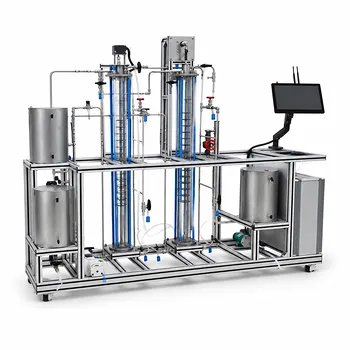
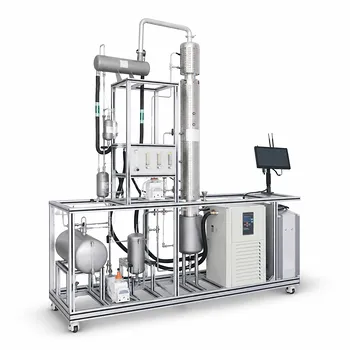
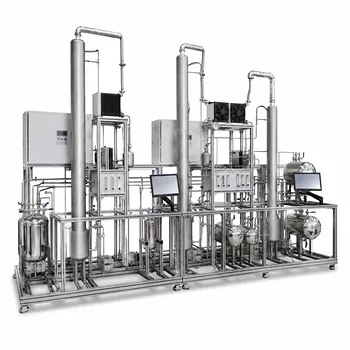
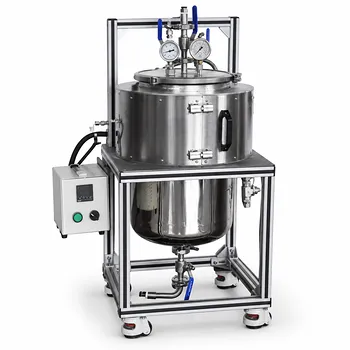
The abstract calculus of Legendre transforms directly translates into the pressure and temperature setpoints on a supercritical fluid extraction pilot plant’s control panel. In practice, these mathematical criteria are used to calculate the exact pressure–temperature coordinates where the extraction mixture becomes a single supercritical phase and where it becomes thermodynamically unstable (the spinodal limit). Operators then deliberately maintain conditions just above the mixture’s critical point to maximize solvent density and mass transfer, while staying well clear of the spinodal boundary to prevent sudden phase separation inside the vessel.
In SFE pilot plant operation, the mathematical criteria of criticality and spinodal limits are not academic exercises—they are the foundation of the operating envelope. By calculating these thermodynamic boundaries, engineers set pressure and temperature targets that keep the fluid in a homogeneous supercritical state, leveraging its optimal solvating power and avoiding process-disrupting phase splits.
The Thermodynamic Foundation: Critical Points and Spinodal Boundaries
Why Stability Conditions Are Expressed Through Legendre Transforms
Legendre transformations recast the internal energy into thermodynamic potentials—like the Gibbs or Helmholtz free energy—that use pressure, temperature, and composition as natural variables. For phase stability, the critical point is defined by the simultaneous vanishing of the first and second derivatives of the chemical potential with respect to composition (or volume). The spinodal surface is the deeper mathematical boundary where only the second derivative goes to zero, marking the limit beyond which a homogeneous phase spontaneously separates.
In the primary reference’s language: the spinodal criterion corresponds to the second derivative of the Legendre transform being zero. This is the precise point where the mixture loses its intrinsic stability and cannot exist as a single phase, even in a metastable form.
From Equations to Envelope: Mapping the Mixture Critical Locus
An equation of state—often Peng–Robinson or Soave–Redlich–Kwong—turns these derivative conditions into a calculable critical locus for a CO₂–solute mixture. Unlike a pure component, the mixture’s critical point shifts with composition as extraction proceeds. Operators calculate the locus over the expected solute concentration range to identify the worst-case (highest) critical pressure and temperature.
These calculations populate the phase envelope that directly informs the pilot plant’s operating window. Without them, you would be running blind to the exact coordinates where supercritical behavior begins.
The Spinodal as a Process Safety “No-Go” Line
Inside the two-phase envelope, the spinodal marks the boundary between metastability and absolute instability. Crossing it does not just cause gentle phase separation—it triggers instantaneous, often violent, phase splits accompanied by pressure surges. In a high-pressure extraction vessel, this can damage equipment and destroy extraction uniformity.
For a pilot plant, the calculated spinodal acts as a hard safety limit. Control logic is often programmed with alarm bands offset from the spinodal by a safety margin, so that normal temperature or pressure fluctuations never drive the fluid into the unstable region.
Practical Implementation in SFE Pilot Plant Operation
Setting the Operation Point: Just Above the Mixture Critical Point
The primary reference stresses that maintaining operation just above calculated critical points ensures optimal solvent density, high solubility, and rapid mass transfer. In a pilot plant, this means the extraction pressure and temperature are set slightly above the mixture’s critical values—typically a few bars and a few degrees Celsius beyond them.
This tight positioning exploits the supercritical fluid’s liquid-like density for strong solvating power while preserving its gas-like diffusivity for fast mass transfer into the solid matrix. For pure CO₂, that would mean running above 31 °C and 73.8 bar, but for a real extract-laden mixture the critical pressure can be significantly higher, so the setpoint is adjusted accordingly.
Real-Time Control: How Thermodynamic Models Run the Pumps and Heaters
The pre-calculated critical and spinodal curves are embedded into the plant’s process control system. High-pressure pumps and heat exchangers are then controlled—often via PID loops—to hold the extraction conditions inside a narrow band just above the critical temperature and pressure.
Near the critical point, fluid density changes dramatically with small perturbations. A fluctuation of only 0.5 °C or 1 bar can alter density by several percent. The spinodal margin tells operators how much control authority they really need; the tighter the margin, the more responsive the control loops must be to avoid dipping into metastable or unstable territory.
Preventing Premature Phase Separation in the Extractor
The overriding practical goal is a single, homogeneous supercritical phase inside the extraction vessel. If conditions stray inside the two-phase dome—even into the metastable region—liquid droplets can form, causing channeling, uneven extraction, and loss of mass transfer efficiency.
The thermodynamic criteria explicitly define the lower boundary of the safe supercritical region. By staying above the mixture’s critical pressure and temperature (and comfortably away from the spinodal), operators guarantee that no phase boundary exists inside the extractor, protecting both product quality and equipment.
Understanding the Trade-offs
The Instability Premium: The Danger of Operating Too Close
Running extremely close to the critical point—where density compressibility is highest—gives powerful tunability. A tiny pressure change delivers a large solubility swing, useful for selective fractionation. But this advantage is a double‑edged sword: the process becomes hypersensitive to any control drift, risk of crossing into the two‑phase region rises, and reproducibility suffers.
Pilot plants designed for teaching often accept a wider safety margin to visually demonstrate the dramatic property changes without jeopardizing equipment. Production‑oriented pilots may inch closer, but only with advanced model‑predictive control to anticipate and correct disturbances in real time.
Model Accuracy and Real Mixtures: The Gap Between Theory and Plant
Real extracts contain dozens of compounds; the true critical locus is a twisted, multi‑dimensional surface, not a single point. Using only pure‑CO₂ critical data can lead to dangerously underestimating the required pressure. The spinodal shifts with solute loading, so an operating point that is safe at the start of extraction may drift into the two‑phase zone as the solute concentration builds in the supercritical phase.
This gap forces operators to validate thermodynamic models offline. They periodically draw samples, measure phase compositions, and feed the data back into the equation‑of‑state to recalibrate the critical and spinodal boundaries—keeping the safety margin honest.
Making the Right Choice for Your SFE Objective
- If your primary focus is maximizing extraction efficiency: Operate just above the mixture’s calculated critical point to exploit high density and gas‑like diffusivity, treating those coordinates as your minimum pressure–temperature setpoint.
- If your primary focus is process stability and safety: Widen the margin from the critical point and the spinodal boundary, ensuring that normal control fluctuations never push the fluid into the metastable or unstable two‑phase region.
- If your primary focus is selectivity through density tuning: Use the proximity of the spinodal as a guide for pressure‑programmed extraction, where small step changes yield sharp solubility cuts, but implement tight cascade control to avoid crossing into instability.
- If your primary focus is scale‑up from pilot data: Validate your equation‑of‑state model against experimental phase envelope measurements and map the critical locus over the full range of feed compositions to define a robust, transferable process window.
The power of Legendre‑transform‑derived stability criteria lies not in the abstract math, but in their ability to transform a high‑pressure extraction vessel from a black box into a precisely controlled, efficient, and inherently safe unit operation.
Summary Table:
| Parameter / Boundary | Thermodynamic Definition | Practical Plant Application |
|---|---|---|
| Critical Point | First and second derivatives of chemical potential vanish | Target operating coordinate; set pressure/temperature just above this to maximize solvent density. |
| Spinodal Limit | Second derivative of Legendre transform equals zero | Hard safety boundary; avoiding this prevents sudden phase separation and pressure surges. |
Ready to bridge thermodynamic theory with hands-on practice? LABPARK provides high-quality Educational and Vocational Unit Operations Pilot Plants in chemical engineering, bioprocess & biotech, and environmental & water treatment. Tailored for universities, research institutes, and enterprises, our systems offer the precise control and safety parameters needed to master complex processes. Contact us today to find the perfect pilot plant solution for your lab!
Related Products
- Multi-Reactor Educational Pilot Plant for Reaction Engineering Unit Operations
- Supercritical High-Gravity Flash Evaporation Educational Unit Operations Pilot Plant
- Comprehensive Liquid-Liquid Extraction Pilot Plant for Engineering Education
- Continuous Sieve-Plate Distillation Pilot Plant for Unit Operations Laboratory Education
- Green Anhydrous Ethanol Purification Extractive Distillation Unit Operations Training Pilot Plant
People Also Ask
- What role do educational pilot plants play in scaling green chemistry? Bridging the Lab-to-Industry Gap
- How do educational pilot plants teach scale-up? Bridge the gap to commercial manufacturing.
- How do educational unit operations pilot plants address safety and waste management when scaling up?
- How do educational unit operations pilot plants bridge theory and design? Bridge the Engineering Gap
- Why Compare Predicted and Experimental Excess Enthalpy? Key to Accurate Pilot Plant Scale-up