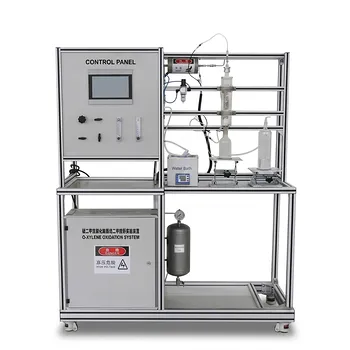
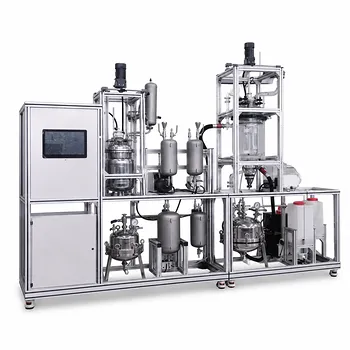
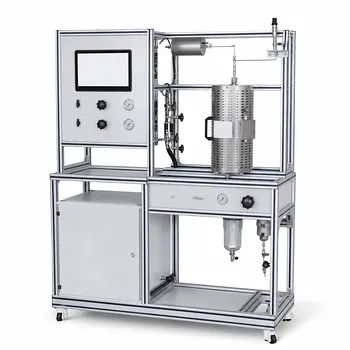
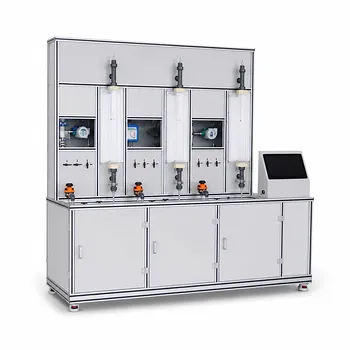
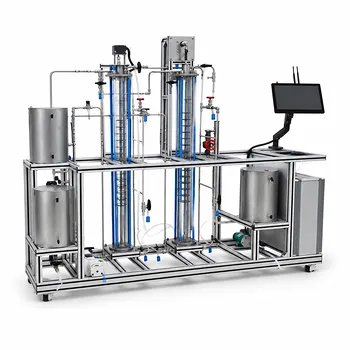
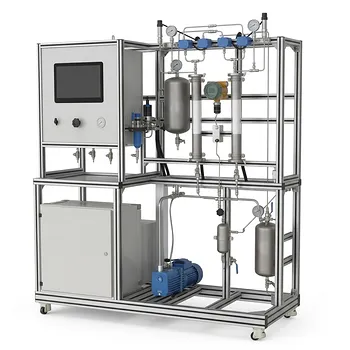
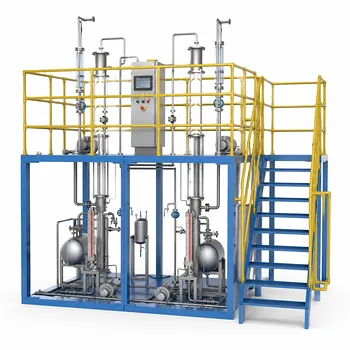
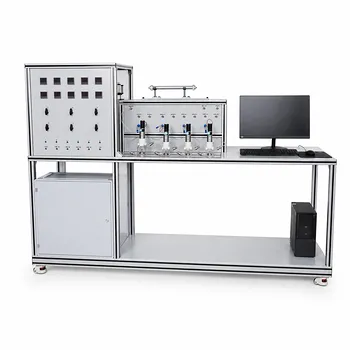
In pilot-scale unit operations simulating p-xylene oxidation, exothermic heat management is achieved by deliberately vaporizing a portion of the acetic acid solvent. This vapor is then condensed in an overhead heat exchanger and refluxed back to the reactor, creating a self-regulating cooling loop that mimics industrial practice. Solvent recovery from the exhaust stream is handled by an integrated off-gas scrubber that captures evaporated acetic acid from the vent gases, ensuring resource efficiency and environmental compliance.
The defining design choice for a p-xylene oxidation pilot plant is using the solvent itself as the heat sink—vaporization, condensation, and reflux work together to control temperature, while a downstream scrubber prevents solvent loss. This approach directly emulates the full-scale AMOCO process, making it indispensable for realistic process development and scale-up studies.
The Chemistry and the Challenge
P-xylene oxidation to terephthalic acid (TPA) is one of the most exothermic liquid-phase reactions practiced at industrial scale. Managing this heat load while handling a volatile, corrosive solvent creates a unit operations puzzle that pilot plants must solve faithfully.
Why P-Xylene Oxidation Generates So Much Heat
The reaction proceeds through multiple free-radical intermediates, with each oxidation step releasing significant energy. A single mole of p-xylene can produce over 1,300 kJ of heat, which in a confined pilot reactor can spike temperatures within minutes without active control.
Temperature excursions destroy selectivity, accelerate solvent burning, and risk thermal runaway. The pilot plant must therefore demonstrate stable, near-isothermal conditions that mirror the industrial temperature profile.
The Role of Acetic Acid as Solvent
Acetic acid dissolves the hydrocarbon feed and the cobalt/manganese/bromine catalyst system. Crucially, its boiling point at typical reactor pressures sits in the range of 110–140°C—almost exactly the target reaction temperature.
This coincidence is not accidental; it is the thermodynamic basis for the heat management strategy. By operating the reactor close to the solvent’s bubble point, the system can use latent heat of vaporization as a massive thermal buffer.
Heat Management Through Strategic Vaporization
Industrial TPA plants do not rely on cooling coils submerged in the slurry. Instead, they turn the solvent into a working fluid that removes heat by phase change. Pilot plants replicate this elegant mechanism directly.
Using the Solvent as a Heat Sink
The reactor is maintained at a pressure that allows controlled boiling of the acetic acid. As the exothermic reaction proceeds, the heat vaporizes a fraction of the solvent. Because evaporation absorbs far more energy than sensible heating, a small amount of vapor removes a disproportionately large heat load.
The pilot plant’s overhead system continuously condenses this vapor, creating a return stream of cool liquid solvent. This liquid rains back into the reactor, providing both reflux and direct contact cooling. The steady-state liquid level remains constant because the vaporization rate matches the condensation rate.
The Overhead Condenser and Reflux Loop
A shell-and-tube or plate heat exchanger mounted above the reactor serves as the primary heat removal device. Cooling water or a tempered thermal fluid on the utility side controls the condensation duty. Adjusting the coolant flow rate fine-tunes the reactor temperature.
Condensed solvent flows by gravity back into the reactor, eliminating the need for a reflux pump. The system naturally self-regulates: a small temperature rise increases the vaporization rate, which increases condensation and reflux, restoring the set point. This passive stability is a key advantage for pilot-scale operation.
Why Not Just Use Jackets or Internal Coils?
Traditional jacketed vessels and cooling coils struggle in TPA service. The reaction forms solid terephthalic acid crystals that rapidly foul heat transfer surfaces and reduce cooling capacity. The vaporization–condensation method avoids this entirely because heat exchange happens in the condenser, not inside the fouling slurry zone.
Moreover, industrial scale-up is validated. When a pilot plant uses the same solvent-boiling approach as the commercial unit, the dimensionless heat transfer and mixing parameters translate directly, avoiding hidden scale-up risks.
Solvent Recovery from Off-Gas Streams
Even with a total condenser, some solvent vapor escapes with the non-condensable gases. An off-gas scrubber unit operation completes the solvent recovery loop, capturing this valuable material before venting.
Composition of the Exhaust Gas
The reactor off-gas is a mixture of nitrogen (from instrument purges or air enrichment), unconsumed oxygen, carbon dioxide from solvent/feed combustion, and acetic acid vapor. Without treatment, this stream represents both an economic loss and an environmental compliance failure.
The Off-Gas Scrubber Unit Operation
The scrubber contacts the vent gas with a countercurrent flow of cool, fresh acetic acid or water. The solvent-laden absorbent then returns to the process or goes to a recovery column. Packed bed or tray column designs are typical, often operated at slightly elevated pressure to improve absorption efficiency.
Instrumentation on the scrubber—temperature, pressure drop, and liquid level—teaches operators how to balance recovery against energy costs. Analytical sampling at the outlet verifies that solvent emissions meet the pilot plant’s environmental permit.
Environmental and Economic Drivers
Acetic acid is a significant operating cost in TPA production. Recovering even 99% of the evaporated solvent directly improves the process economics. Additionally, pilot plants located in research facilities must demonstrate best available control technology for volatile organic compounds, making the scrubber a non-negotiable unit operation for real-world relevance.
Understanding the Trade-offs
No design is perfect. The vaporization–condensation approach has inherent limitations that a well-designed pilot plant must address through careful instrumentation and operational procedures.
Liquid Entrainment and Foaming
Vigorous bubbling can entrain liquid droplets into the overhead vapor line, carrying non-volatile catalyst metals and TPA solids into the condenser. Pilot plants often incorporate a demister pad or knock-out drum upstream of the condenser to protect heat transfer surfaces and avoid product contamination.
Balancing Condenser Load and Reactor Pressure
The reactor pressure directly controls the solvent boiling point. Operating at a higher pressure raises the boiling point and reduces the temperature driving force in the condenser, potentially requiring a larger heat transfer area. Pilot plant designers must match the pressure profile to the available condenser utility and desired simulation fidelity.
When Other Heat Removal Methods Might Be Considered
If the research objective is not TPA process simulation but generic gas-liquid heat transfer studies, a jacketed bubble column with internal coils can offer more direct temperature measurement. Similarly, if the reactor configuration is a packed column—where internal phase change is difficult—an external recirculation loop with a heat exchanger becomes necessary. However, for p-xylene oxidation simulation, such alternatives would misrepresent the real process and lose the valuable scaling insights that only the solvent-boiling method provides.
Making the Right Choice for Your Pilot Plant Design
The unit operations you select must align with your ultimate research or educational goal.
- If your primary focus is reproducing the industrial AMOCO TPA process: Implement solvent vaporization with an overhead condenser and reflux loop, coupled with an off-gas scrubber. This directly mimics the commercial heat management and solvent recovery strategy.
- If your primary focus is studying fundamental exothermic kinetics in a simplified setup: Consider a jacketed, mechanically agitated reactor with internal cooling coils for precise temperature control, accepting that fouling and scale-up fidelity will be compromised.
- If your primary focus is optimizing solvent recovery efficiency: Invest in a high-performance scrubber with instrumentation for real-time liquid-phase analysis, and explore absorbent temperature staging to push recovery above 99.5%.
The key to a successful p-xylene oxidation pilot plant is acknowledging that heat management and solvent recovery are not separate problems—they are two sides of the same thermodynamic coin. Design them together, and you’ll build a unit that not only runs safely but also teaches the core principles that govern multi-billion-dollar chemical processes.
Summary Table:
| Process Step | Core Challenge | Key Strategy | Pilot Plant Mechanism |
|---|---|---|---|
| Heat Management | High exothermicity (>1,300 kJ/mol), fouling risks | Solvent Vaporization | Vaporization, overhead condensation, and gravity reflux |
| Solvent Recovery | Volatile organic compound (VOC) emissions | Off-Gas Scrubbing | Countercurrent absorption of acetic acid in a packed column |
Bring Industrial-Scale Realism to Your Lab with LABPARK
At LABPARK, we design and manufacture premium Educational and Vocational Unit Operations Pilot Plants in chemical engineering, bioprocess & biotech, and environmental & water treatment. Tailored specifically for universities, research institutes, and enterprises, our systems enable you to safely simulate complex chemical processes with precise control.
Ready to elevate your research or training capabilities? Contact our experts today to find the perfect pilot plant solution for your needs!
Related Products
- O-Xylene Oxidation to Phthalic Anhydride Educational Unit Operations Pilot Plant
- Micro-Scale Gas-Solid Catalytic Reaction Educational Pilot Plant
- Methane Cracking Educational Unit Operations Pilot Plant
- Fluidized Bed Gas Solid Catalytic Reaction Educational Pilot Plant
- Gallium and Indium Selective Extraction Educational Pilot Plant
People Also Ask
- What materials fit high-temp oxidation pilot plants? Key Hastelloy & Titanium Requirements
- Under what conditions can axial diffusion be neglected? Reactor Simulation Guide
- What limitations exist in high-temp pilot reactor design? Key Material & Safety Rules
- What pressure parameters ensure pilot plant safety? Analyze reactor profiles & gas evolution.
- How are sensitivity functions applied to parameter estimation in chemical reactor pilot plants? Guide