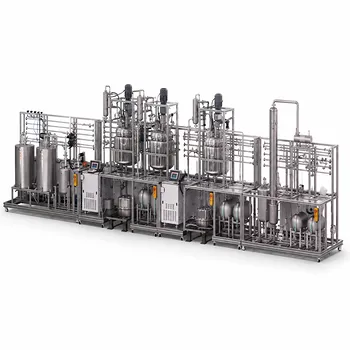
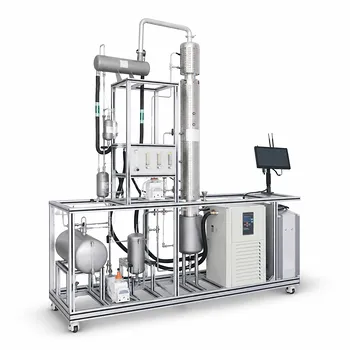
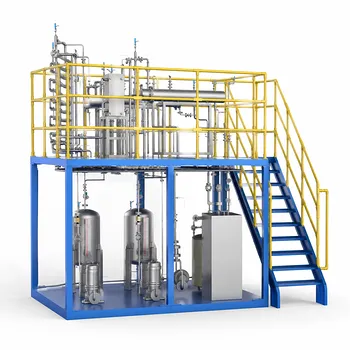
The core engine of an intelligent pilot plant is the seamless integration of computer-based thermochemical databanks and thermodynamic equations. This combination transforms raw, fundamental data into actionable predictions for safe operation and design. It allows you to calculate theoretical reaction yields, predict heating and cooling loads, and determine optimal operating conditions before a single valve is turned, directly linking molecular properties to real-world process control.
While databanks provide the foundational "map" of a molecule's energy, thermodynamic equations are the "engine" that calculates how those molecules behave under real-world pilot plant conditions. This integrated approach bridges the gap between abstract theory and the physical need to predict equilibrium, manage safety, and optimize performance in reactors and separation units.
Translating Data into Pilot Plant Design
The primary role of these integrated computer tools is to de-risk the design and operation of high-temperature reactors and separation systems. The process moves from static data points to dynamic process predictions.
How a Databank Defines a Molecule
A thermochemical databank doesn't store a picture of a molecule; it stores its energetic blueprint. The essential parameters are the standard enthalpy of formation (ΔfH°), standard entropy (S°) at 298.15 K, and a temperature-dependent heat capacity function (often Cp = A + BT + CT² + DT⁻²).
These coefficients aren't just numbers. They are the key to unlocking a substance's behavior as temperature changes during a reaction or phase change.
Predicting Reactor Feasibility and Safety
By integrating databank values with software, you calculate the enthalpy change (H°(T) - H°(298)) and entropy change (S°(T) - S°(298)) at your specific operating temperature. This isn't a trivial calculation; it directly predicts the heat of reaction (ΔHr).
This prediction is the foundation for specifying the heating or cooling system’s duty. Knowing the free energy of reaction (ΔGr) allows you to calculate the equilibrium constant (K) and, consequently, the maximum theoretical yield. This prevents wasting resources on conditions that are thermodynamically impossible.
Bridging Theory and Physical Operations
Once the plant is running, the same equations serve a different master: translating raw sensor data into a picture of the process's true thermodynamic state. This is where abstract concepts like entropy become tangible.
The Magic of Maxwell's Equations
You cannot buy an "entropy sensor" for a pilot plant. Properties like entropy (S) and internal energy (U) are non-measurable. Maxwell's relations solve this by expressing these non-measurable properties as partial derivatives of easily measurable variables: temperature (T), pressure (P), and volume (V).
When a student monitors a compressor or a reactor, the real-time P, V, T data is fed into these equations to compute entropy changes and energy balances that are invisible to the naked eye. This instantly connects a real-time process trend to a fundamental thermodynamic state function.
The "Brain" Behind Vapor-Liquid Equilibrium
In a flash distillation or rectification column, the separation possible is dictated by vapor-liquid equilibrium (VLE). This requires a self-consistent model, achieved through equations of state (EOS). An EOS mathematically links P, V, and T for real substances in both gas and liquid phases.
The software pulls component parameters—critical temperature (Tc), critical pressure (Pc), and acentric factor—from a structured databank. A single, consistent EOS model then predicts the bubble points, dew points, and phase splits that make the physical separation process predictable and controllable.
The Rise of First-Principles Prediction
Modern methods now bypass the need for extensive experimental data. For novel reactions like hydrogenation in a pilot-scale reactor, computational thermodynamic models (like COSMO-RS combined with quantum chemistry) can calculate ΔHr and K from molecular structure alone.
These tools predict the effect of solvent solvation on equilibrium, a critical factor often missed by simpler models. For safe operation, this means predicting not just if a reaction will go, but how the choice of solvent will fundamentally alter the heat generation and equilibrium composition before mixing any chemicals.
Understanding the Trade-offs
This integration is powerful but not without its pitfalls. An expert advisor must highlight where models break down to ensure safe and meaningful operation.
The "Garbage In, Garbage Out" Rule
The strict data format required by software is a critical point of failure. A single misplaced comma, an incorrect acentric factor for a component, or a forgotten 'END' marker will cause an "illegal function call" or, worse, a physically impossible but mathematically "valid" result. The accuracy of the databank parameter is the absolute ceiling of your prediction's accuracy.
The Limits of the Model
Every gas is ideal, and every liquid is a well-behaved mixture—until you run a real pilot plant. The assumptions of an EOS (like Peng-Robinson or Soave-Redlich-Kwong) become the limits of your model. At high pressures or with highly polar, associating molecules (like water or alcohols), a standard cubic EOS may fail to predict the formation of two liquid phases, leading to catastrophic errors in simulating a distillation column or reactor.
The Theory-Practice Gap
A computer will cheerfully calculate an equilibrium yield of 98%. The physical pilot plant may only achieve 70% due to heat losses, non-ideal mixing, and the heat capacity of the reactor vessel itself. The primary value of the pilot plant is to expose and quantify this gap. The theoretical calculation isn't the final answer; it's the baseline against which you measure real-world inefficiency.
Making the Right Choice for Your Goal
The application of these tools must be goal-oriented. A single pilot plant can serve different masters, and the computational approach must align.
- If your primary focus is safe scale-up of a highly exothermic reaction: Prioritize high-accuracy heat of reaction (ΔHr) prediction. Use first-principles quantum chemical models if data is scarce, and always ground-truth the prediction with a small-scale calorimetry experiment to account for non-ideal mixing and heat loss effects the model misses.
- If your primary focus is optimizing a separation sequence like distillation: Rigorously validate your chosen equation of state against binary vapor-liquid equilibrium data. The predictive power of your EOS model, built on pure-component data from the databank, must be confirmed for the specific mixture you are separating to avoid designing a column that cannot achieve the required purity.
- If your primary focus is education and bridging theory with practice: Force the connection between the abstract Maxwell equation and the live sensor data from the compressor. Every data point should be used to compute an un-measurable property like entropy generation, turning the pilot plant from a piece of hardware into a thermodynamic learning laboratory.
Ultimately, these computational tools serve one purpose: to formulate a well-educated guess that makes your expensive and time-sensitive pilot plant experiments radically more efficient and fundamentally safer.
Summary Table:
| Application Area | Thermodynamic Tool | Practical Benefit in Pilot Plants |
|---|---|---|
| Reactor Safety & Yield | Enthalpy & Entropy calculations | Predicts reaction heat duty and max theoretical yield |
| Real-Time Monitoring | Maxwell's Relations | Converts P-V-T data into un-measurable state functions (e.g., entropy) |
| Separation & Distillation | Equations of State (EOS) | Predicts bubble/dew points and phase splits for VLE |
| Solvent Selection | First-Principles (COSMO-RS) | Forecasts equilibrium and heat without prior physical data |
Bring Thermodynamic Theory to Life in Your Lab
At LABPARK, we help universities, research institutes, and enterprises bridge the gap between complex thermodynamic equations and physical plant operations. We provide high-quality Educational and Vocational Unit Operations Pilot Plants in:
- Chemical Engineering
- Bioprocess & Biotech
- Environmental & Water Treatment
Ready to upgrade your training or research capabilities with robust, safe, and highly educational pilot scale systems? Contact LABPARK today to discover how our tailored pilot plants can transform your laboratory experience!
Related Products
- Multi-Reactor Educational Pilot Plant for Reaction Engineering Unit Operations
- Carbon Dioxide Hydrogen Methanol Synthesis Educational Unit Operations Pilot Plant
- Multi Pump Fluid Transport Process Piping Unit Operations Training Pilot Plant
- Ethyl Acetate Synthesis Unit Operations Pilot Plant for Practical Training
- Multi-Modal Distillation Unit Operations Training Pilot Plant
People Also Ask
- How do educational unit operations pilot plants address safety and waste management when scaling up?
- How do educational unit operations pilot plants bridge theory and design? Bridge the Engineering Gap
- Why Compare Predicted and Experimental Excess Enthalpy? Key to Accurate Pilot Plant Scale-up
- How to study gasification in pilot plants? Compare exit gas composition & efficiency
- Why Use PTFE & Hastelloy in Chemical Pilot Plants? Prevent Corrosion & Ensure Safety