Safety and efficiency in chemical engineering pilot plants hinge on one often-overlooked detail: understanding how molecules interact. Without explicitly modeling forces like dipole-dipole and quadrupole-quadrupole interactions, students and future engineers cannot predict how phase envelopes shift, critical lines move, or entirely new three-phase regions emerge when working with polar or non-ideal mixtures. This knowledge is non-negotiable for configuring safe operating pressures, selecting the right thermodynamic models, and designing reliable pressure-relief systems in high-pressure pilot equipment.
The core takeaway: Molecular-scale forces dramatically alter macro-scale phase behavior. In a pilot plant, ignoring these forces can turn a simple distillation into a dangerous pressure excursion or a misjudged relief scenario. Integrating their thermodynamic modeling into the curriculum ensures that operators see beyond ideal textbook assumptions and learn to align equipment parameters with real fluid behavior.
The Hidden Danger of Ignoring Molecular Interactions in Pilot Plants
When a student runs a distillation column on an ideal, textbook mixture, phase boundaries are predictable. The moment a polar solvent like alcohol or a highly asymmetric molecule enters the system, those boundaries become treacherous. The primary cause is the hidden influence of dipole-dipole, quadrupole-quadrupole, and similar electrostatic forces.
How Polar Forces Reshape Phase Diagrams
An increase in a molecule’s dipole moment does more than just change a single property. It systematically shifts the gas-liquid critical lines to higher pressures and temperatures. In a pilot plant, this means the safe operating envelope shrinks or moves into unanticipated regions.
From Class I to Class II: Why a Simple System Gets Complicated
Molecular interactions can push a system from a forgiving Class I phase diagram (continuous gas-liquid critical curve) into a Class II diagram, which introduces a three-phase liquid-liquid-gas (LLG) line. A student who relies only on binary VLE data may never suspect that a second liquid phase will form, leading to column flooding or unexpected pressure spikes. Training must make this transition intuitive, because it turns a routine operation into a complex one.
Bridging the Gap Between Theory and Real-World Operation
A pilot plant’s greatest educational value is its ability to validate or reject theoretical predictions. Integrating molecular-level thermodynamic models directly into the curriculum forces students to confront the gap between simulation output and physical measurement.
Validating Simulations with Physical Data
Simulation software packages come with built-in thermodynamic models, but for highly non-ideal mixtures, different models (Wilson, NRTL, UNIQUAC) can give wildly different flash calculation results. The only definitive way to know which model is correct is to run the physical trial on the pilot plant and compare real temperatures, pressures, and compositions. This comparison teaches students that molecular-level choices (like selecting a liquid-phase activity coefficient model) have direct, measurable consequences on separation efficiency and yield.
Selecting the Right Thermodynamic Model for the Job
Working with polar compounds (alcohols, aldehydes, water) demands a strategic model selection. For the vapor phase, modified cubic equations of state such as the Soave-Redlich-Kwong model handle non-ideality. For the liquid phase, activity coefficient models like Wilson, NRTL, or UNIQUAC become essential. The curriculum must show students how to choose between these models based on the dominant molecular interactions (e.g., preferred Wilson for acetaldehyde-ethanol pairs) and how to estimate missing binary interaction parameters using UNIFAC or chemically similar pairs.
The Safety Imperative: Why Molecular Modeling Prevents Catastrophic Failures
Safety is not an abstract concept in a high-pressure pilot plant; it is the direct result of predicting phase boundaries correctly. Integrating molecular interaction modeling into training is an act of hazard prevention.
Designing Pressure-Relief Systems for Non-Ideal Behavior
Pressure-relief systems are sized based on the worst credible case of vapor generation. If molecular interactions create a sudden LLG three-phase region or shift the critical point to a higher pressure than anticipated, the relief valve may be undersized. Training must demonstrate how dipole-dipole forces can alter pressure profiles, so future engineers can specify relief systems that protect equipment even under non-ideal phase behavior.
Predicting Three-Phase Regions to Avoid Unexpected Liquid-Liquid-Gas Formation
When a pilot plant operator unwittingly crosses into a three-phase L-L-G region, they may encounter severe hydraulic instabilities, foaming, or overpressure. By teaching students to detect these phase diagram transitions—driven by quadrupole-quadrupole and dipole forces—the curriculum equips them to spot dangerous operating windows before they are entered, rather than reacting after an incident.
Understanding the Trade-offs and Common Pitfalls
Even with a strong molecular foundation, training must acknowledge that modeling is not a silver bullet. Over-simplification and over-complication both carry risks.
The Risk of Blind Trust in Ideal Assumptions
The most common pitfall is the ideal-gas/ideal-solution shortcut. In a teaching environment, it is tempting to start with ideal models, but without immediately exposing their failure in the presence of polar forces, students leave with a dangerous overconfidence. They may scale up a design assuming VLE curves that do not exist for their actual chemical system.
The Cost of Overcorrecting with Complex Models Without Validation
On the other hand, a curriculum that pushes highly sophisticated perturbation-theory models without forcing a physical pilot plant validation can produce engineers who trust a simulation over a pressure gauge. The only antidote is the hands-on comparison: running the column, measuring the temperatures, and seeing the deviation. The true skill is knowing when a molecular detail (quadrupole moment) is worth the computational effort and when a well-tuned binary parameter is sufficient.
Making the Right Choice for Your Training Program
The integration of molecular interaction modeling into a pilot plant curriculum must be tailored to the primary safety and educational goals.
- If your primary focus is operational safety in high-pressure equipment: Emphasize how dipole and quadrupole forces shift critical curves and create three-phase regions, and tie every lesson to pressure-relief system sizing and safe operating envelope definition.
- If your primary focus is bridging the gap between simulation and industrial scale-up: Center the curriculum on comparative studies—have students predict phase equilibria with different activity coefficient models, then run the pilot plant to invalidate or confirm the prediction, explicitly linking model choice to separation performance.
- If your primary focus is connecting molecular physics to practical engineering: Use computational tools like COSMO-RS or perturbation theory to calculate thermodynamic properties from first principles, then immediately verify those calculations against pilot plant data for properties like thermal conductivity or reaction equilibrium, showing exactly where molecular-level theory adds value.
A chemical engineering pilot plant is not just a scaled-down factory; it is the laboratory where molecular theory either proves its worth or reveals its limits. Embedding the modeling of dipole-dipole and quadrupole-quadrupole forces into that environment transforms students from simulation-blind operators into engineers who truly control the process at every scale.
Summary Table:
| Aspect | Ideal Assumptions | Molecular-Scale Modeling |
|---|---|---|
| Phase Boundaries | Predicts simple Class I curves | Captures Class II curves & LLG regions |
| Operational Safety | High risk of unexpected flooding/overpressure | Prevents pressure excursions & hazards |
| Relief System Design | Often undersized due to incorrect VLE | Accurately sized for real fluid behavior |
| Simulation Accuracy | Blind trust in textbook shortcuts | Real-world validation of NRTL/UNIQUAC |
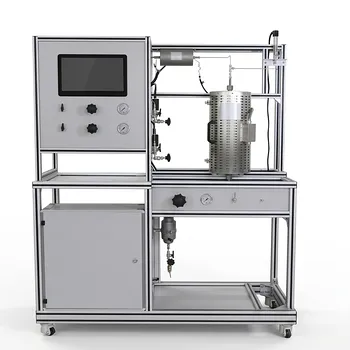
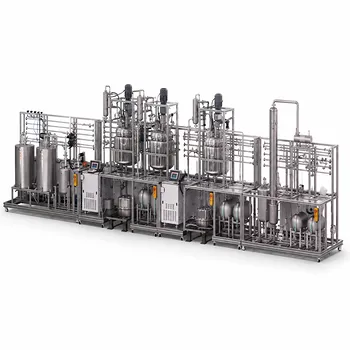
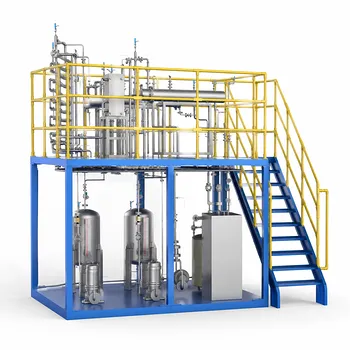
Prepare your students and engineers for real-world chemical complexities with LABPARK. We provide state-of-the-art Educational and Vocational Unit Operations Pilot Plants in chemical engineering, bioprocess & biotech, and environmental & water treatment. Tailored for universities, research institutes, and enterprises, our systems bridge the gap between thermodynamic theory and hands-on operational safety.
Ready to elevate your training curriculum? Contact LABPARK today to discuss your custom pilot plant needs!
Related Products
- Carbon Dioxide Hydrogen Methanol Synthesis Educational Unit Operations Pilot Plant
- Multi Pump Fluid Transport Process Piping Unit Operations Training Pilot Plant
- Natural Product Extraction Unit Operations Training Pilot Plant
- Multi-Modal Distillation Unit Operations Training Pilot Plant
- Multi-Reactor Educational Pilot Plant for Reaction Engineering Unit Operations
People Also Ask
- How do temp & pressure affect methanol synthesis pilot plants? Optimize equilibrium and catalyst performance.
- Why is a purge system necessary when operating a gas recirculation loop in a methanol synthesis pilot plant? (Guide)
- Why do modern methanol pilot plants operate at lower pressures? Catalyst & Feed Requirements Explained
- What are the operational requirements for catalyst activation? Safe Methanol Pilot Plant Operation
- Why is the chemical plant startup schedule crucial? De-risk scale-up with pilot plants.