In nonisothermal pilot reactors, the seemingly minor gap between a catalyst particle and the tube wall governs the entire thermal safety envelope.
The $d_p/d_t$ ratio (particle diameter to tube diameter) must be baked into heat transfer correlations because it directly controls the near-wall void fraction. In small-diameter pilot tubes, this local packing anomaly creates a high-porosity channel that lets fluid race past the bed, severely distorting the radial velocity profile. If you ignore this ratio, your predicted wall heat transfer coefficient becomes dangerously inaccurate—and so does your ability to forecast hotspots or thermal runaway.
While large industrial reactors can often treat the wall as a minor boundary, pilot-scale tubes amplify the $d_p/d_t$ influence to a dominant level. Integrating this ratio into correlations is not a theoretical nicety; it is the only way to faithfully capture radial heat flow, protect catalyst integrity, and scale up a process without hidden thermal risks.
The Physics of the Wall Effect
The Void Fraction Spike at the Wall
When spheres or cylinders are randomly packed inside a tube, they cannot sit flush against the curved wall. This creates a region of elevated void fraction—near 1.0 right at the wall—that decays and oscillates toward the tube center. The supplementary references confirm this packing defect is unavoidable and pins the local porosity to a value much higher than the bulk bed average.
From Void Fraction to Flow Maldistribution
A higher local void fraction means lower resistance to flow. Fluid naturally bypasses the tightly packed central core and streaks along the wall. Measurements show the near-wall velocity can reach twice that of the central axis, turning what should be an even plug of reactants into a lopsided velocity field.
The Direct Link to Heat Transfer
Heat transfer at the wall is a function of the fluid velocity, thermal conductivity, and mixing right at the boundary. When the $d_p/d_t$ ratio is large (i.e., particles are relatively big compared to the tube), the wall channel grows wider, the bypass velocity increases, and the wall heat transfer coefficient shifts significantly. Correlations that omit this term implicitly assume the wall region behaves like the center—a flawed assumption that breaks down in pilot equipment.
Why Pilot Reactors Magnify the Problem
Small Tube Diameters, Outsized Wall Influence
Industrial reactors often have tube diameters hundreds of times larger than the catalyst particle, making the wall effect a thin, negligible skin. In a pilot plant, the tube diameter is intentionally small to limit catalyst volume and reactant use. This drives the $d_t/d_p$ ratio low—sometimes dangerously close to the critical threshold of 10:1. At that scale, the wall distortion no longer skims along the edge; it contaminates the entire cross-sectional flow.
The Peril of Assumed Plug Flow
With a pronounced wall effect, the reactor departs severely from ideal plug flow. Concentration and temperature gradients no longer develop as predicted by simple one-dimensional models. The primary reference underscores that without a $d_p/d_t$ correction, a pilot-scale reactor can hide a cool fluid layer at the wall while the center cooks, or vice versa, making thermocouple readings misleading.
Consequences for Safety and Data Quality
If a researcher or student runs an exothermic reaction without adjusting for the $d_p/d_t$ ratio, the calculated Nusselt number for the wall will be off. This leads to under-predicted hotspot temperatures and an illusion of stable operation. In reality, the catalyst may be sintering or triggering an uncontrolled temperature ramp—failures that only become apparent during scale-up when the wall effect diminishes and the true kinetics emerge.
How Correlations Capture the Ratio
Leva’s Approach: Embedding Geometry into the Coefficient
The primary reference highlights classic correlations, such as those by Leva, that explicitly incorporate the $d_p/d_t$ ratio to adjust the wall heat transfer coefficient ($a_i$). By raising the ratio to a small power, these correlations empirically account for the fact that as particles get bigger relative to the tube, the wall resistance to heat transport changes in a non-linear fashion. They transform a complex two-dimensional packing problem into a usable correction factor for one-dimensional models.
Coupling with Radial Dispersion Models
When the $d_t/d_p$ ratio falls below 10, even corrected one-dimensional correlations may not be enough. The supplementary references indicate that full radial dispersion models—which solve for temperature as a function of both axial and radial position—become necessary. Still, the $d_p/d_t$ ratio remains a critical input because it dictates the radial voidage profile and, consequently, the radial effective thermal conductivity. Without it, the dispersion model loses its physical foundation.
Understanding the Trade-offs and Common Pitfalls
The Limits of Empirical Corrections
Leva-style correlations are powerful, but they are empirical fits to specific beds of spheres or cylinders over a certain range of $d_p/d_t$. Extrapolating them to unusual shapes (like Raschig rings) or extremely low $d_t/d_p$ ratios can introduce fresh errors. The supplementary references mention shape factors ($f_a$) that adjust the Nusselt number for different geometries, reminding us that particle texture matters alongside size. A single $d_p/d_t$ cannot capture all packing nuances.
The Allure of the Simplest Setup
There is a common temptation to pack a very narrow tube with large particles to save material and time. But when $d_t/d_p$ drops below 6–8, the wall effect essentially turns the bed into two parallel reactors with different residence times. At that point, no simple correlation can rescue the data; you are forced into a more expensive, fully two-dimensional analysis. Recognizing this limit early prevents months of wasted experiments.
Misreading Temperature Profiles
A correctly applied $d_p/d_t$ correlation can improve predictions, but operators must still be wary of where they place thermocouples. If a probe sits in the bypass region, the reading will reflect wall-channel conditions, not the bed average. The ratio explains the mismatch—it does not eliminate the need for smart sensor placement.
Making the Right Choice for Your Pilot Reactor
The correct treatment of $d_p/d_t$ depends on your end goal. Below are actionable paths based on different priorities.
- If your primary focus is collecting kinetic data free of transport disguise: Enforce a $d_t/d_p$ ratio greater than 10–12. This pushes wall effects to the periphery and lets you rely on simpler, corrected one-dimensional models without sacrificing intrinsic rate accuracy.
- If your primary focus is teaching or demonstrating non-ideal flow phenomena: Deliberately operate at a low $d_t/d_p$ ratio and require students to apply a $d_p/d_t$-corrected correlation (e.g., Leva’s) side-by-side with a basic plug-flow model. The contrast vividly illustrates why the wall effect cannot be swept under the rug.
- If your primary focus is scaling up a process to an industrial unit: Use the $d_p/d_t$ correlation to decouple the wall effect from the pilot data. This yields a clean kinetic and thermal model that can be confidently transplanted to large tubes where the wall becomes a minor correction, preventing both over-designed heat exchangers and under-estimated hot spots.
The difference between a successful pilot campaign and a thermal runaway often starts just a few particle diameters away from the wall. By giving the $d_p/d_t$ ratio its due place in your heat transfer correlations, you turn a hidden modeling flaw into a well-controlled process variable.
Summary Table:
| Aspect | Impact in Pilot Reactors | Recommendation / Mitigation |
|---|---|---|
| Void Fraction at Wall | Creates high-porosity channel; fluid bypasses bed | Use correlations (e.g., Leva's) to adjust wall heat transfer |
| Velocity Profile | Near-wall velocity can double, distorting plug flow | Implement radial dispersion models for $d_t/d_p < 10$ |
| Thermal Control | Under-predicted hotspots; risk of catalyst sintering | Maintain $d_t/d_p > 10$–12 for kinetic studies; place sensors wisely |
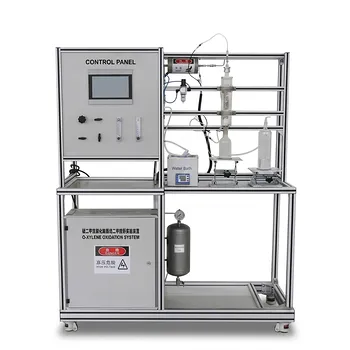
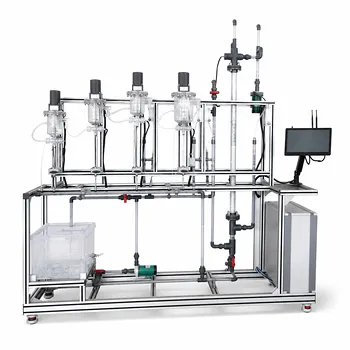
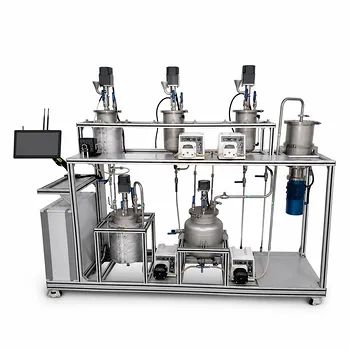
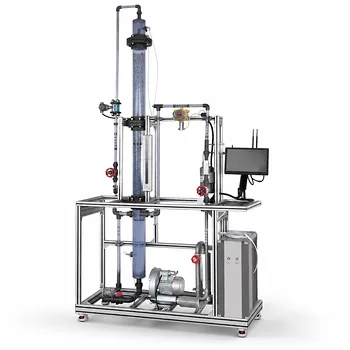
Are you designing or operating pilot-scale reactors for research or education? LABPARK specializes in providing state-of-the-art Educational and Vocational Unit Operations Pilot Plants in chemical engineering, bioprocess & biotech, and environmental & water treatment. We help universities, research institutes, and enterprises bridge the gap between theory and industrial scale-up with precise, safe, and reliable reactor designs.
Ensure your experimental data is scale-ready and free of hidden thermal risks. Contact LABPARK today to explore our pilot plant solutions!
Related Products
- Fixed Bed Gas Solid Catalytic Reaction Educational Pilot Plant
- Fixed-Bed Chemical Reaction and Gas Dust Tar Removal Unit Operations Pilot Plant
- Multi-Reactor Educational Pilot Plant for Reaction Engineering Unit Operations
- Ethylbenzene Dehydrogenation Educational Unit Operations Pilot Plant
- Multi Functional Catalytic Reaction and Reactor Evaluation Educational Unit Operations Pilot Plant
People Also Ask
- How do reactor pilot plants safely study gas-solid reactions? Master kinetics with thermal & flow control.
- How does the Mears criterion evaluate transport resistance? Key Guide to Intrinsic Kinetics
- Fluidized vs. Fixed Bed Reactors: Comparing Heat & Complexity in Pilot Plants
- Why is a multibed configuration necessary for exothermic reactions? Optimize your pilot plant trajectory.
- How is the friction factor determined for fixed-bed pilot plants? Select the best pressure drop correlation.