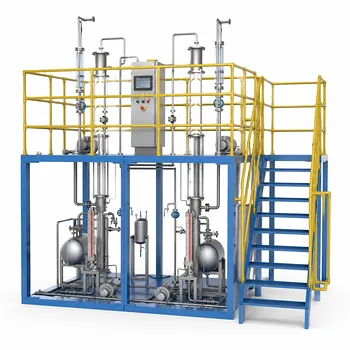
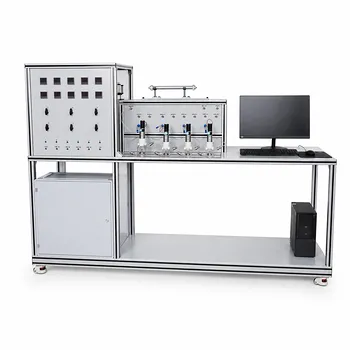
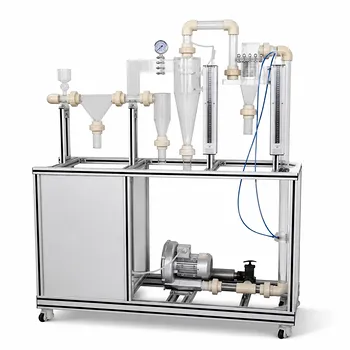
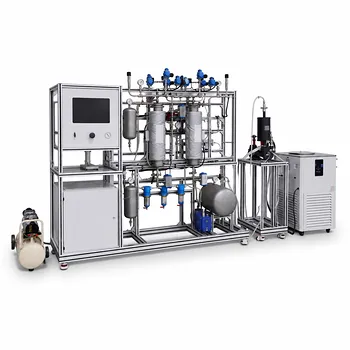
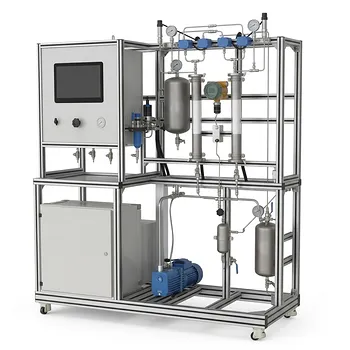
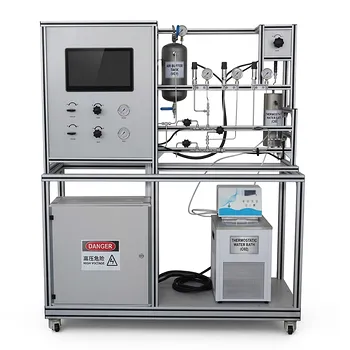
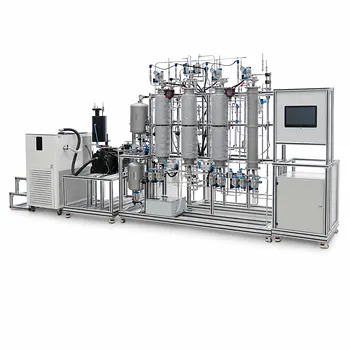
Here’s the core truth: An educational pilot plant for gas-oil stabilization must allow operators to vary temperature, pressure, and gas-to-oil ratio because a single design point simply does not exist in the real world. Production streams fluctuate constantly, and the equipment that handles them is rated for a matrix of operating conditions—not one idealized snapshot. Teaching with a fixed setpoint would conceal the very engineering logic that determines why a first-stage separator is that size, a compressor train is rated that high, and a heat exchanger needs that much duty.
A single, static operating point gives a false sense of simplicity. In reality, the interplay of temperature, pressure, and GOR creates distinct “governing cases” that size each major component differently. An educationally valuable pilot plant mirrors this dynamic, forcing students and researchers to explore the full operating envelope and understand how thermal and pressure variations dictate multi-stage equilibrium and equipment rating.
The Real-World Instability of Gas-Oil Streams
Why a Single Design Point Fails
A gas-oil stabilization train never sees the same inlet conditions for long. Reservoir composition, wellhead pressure, and ambient temperature shift over time, and the gas-to-oil ratio can vary dramatically between wells. Designing equipment around just one combination of temperature, pressure, and GOR would leave the plant dangerously oversized or undersized for the conditions it will actually experience. A pilot plant that cannot vary these inputs trains people on a scenario that is, for practical purposes, fiction.
The Dynamic Triad of Temperature, Pressure, and GOR
These three variables form an interdependent control system for phase behavior. Temperature directly alters the volatility of light hydrocarbons—raise it, and more components flash into the vapor phase. Pressure sets the equilibrium point for separation; drop it, and liquid yields can swing significantly. GOR determines how much vapor-load material enters the system in the first place. Each variable doesn’t act alone; they combine to define the volume and composition of every flash in a multi-stage train. If you can’t change all three, you can’t map the process’s real operating envelope.
How Variable Parameters Define Equipment Sizing
The First-Stage Separator: Sized by Maximum Flash-Off
In a multi-stage stabilization setup, the first-stage separator must handle the highest vapor rate the process will ever produce. That peak gas flash-off does not occur at the “average” operating point—it happens at a specific combination of high inlet temperature, moderate pressure, and high GOR. Only by sweeping through all three variables can you isolate that worst-case condition. If the pilot plant runs at a single design point, the student never sees why the separator’s diameter and internals are sized the way they are.
The Compressor Train: Driven by a Different Peak
The compressors that handle off-gas from later stages face a different governing load. The maximum third-stage flash-off—often the driver for compressor capacity—comes from an entirely different set of T, P, and GOR values than what sizes the first-stage separator. Perhaps a lower temperature plus a specific pressure drop across stages yields a surge of vapor downstream. Without the ability to vary all inputs, the link between this distinct operating scenario and the compressor’s nameplate rating remains hidden.
Heat Exchange and Cooling: A Third Scenario
Thermal loads on preheaters, intercoolers, and aftercoolers are also dictated by a unique condition within the operating matrix. The largest-duty combination might involve a stream with a high GOR at elevated temperature and a specific pressure profile that forces a massive vaporization across a valve. A fixed-point pilot plant can’t reveal why the heat exchanger was designed for that specific duty; it just becomes a black box. Variation turns equipment sizing from a given specification into an active, reasoning-based conclusion.
The Educational Imperative: Learning Through Variation
Teaching Multi-Stage Equilibrium
Oil stabilization is essentially a staged flash calculation problem. Phase equilibrium is highly sensitive to temperature and pressure: as temperature rises, light-ends solubility drops, driving more vapor; as pressure increases, the opposite occurs. When students can deliberately alter these parameters and watch first-, second-, and third-stage gas rates shift, they internalize the underlying thermodynamics. A static rig reduces this to a single-point data entry, robbing the learner of the cause-and-effect insight they need to design or troubleshoot real plants.
Connecting Process Dynamics to Equipment Rating
The core lesson of any unit operations course is that the process dictates the hardware. By varying temperature, pressure, and GOR, students and researchers learn to generate the full matrix of flash-off scenarios, identify the unique “governing case” for each piece of equipment, and then validate why separators, compressors, and heat exchangers have their specific capacities. This hands-on, variable-driven approach transforms abstract design heuristics into concrete, defendable engineering decisions—exactly what a pilot plant is meant to teach.
Understanding the Trade-offs
The Complexity of a Flexible Pilot Plant
Building a pilot plant that safely and accurately varies temperature, pressure, and GOR is not cheap or simple. It requires robust control systems, wider turndown ratios on instruments, and careful metallurgy for a broad thermal range. Operationally, it demands more rigorous procedures and can introduce safety challenges when pushing pressure and temperature boundaries. For a teaching facility, this complexity must be balanced against the educational value.
Why the Investment is Non-Negotiable
Despite the hurdles, a fixed-point rig is fundamentally a misrepresentation of the process. It teaches students to accept an equipment design as an arbitrary input rather than a targeted solution to a variable problem. The trade-off is between simplified operation and genuine understanding; for any program serious about producing competent process engineers, the latter is the only acceptable choice. The supplementary lesson in handling complexity itself—managing control loops, safety limits, and data interpretation across a range—becomes part of the educational benefit.
Making the Right Choice for Your Pilot Plant Curriculum
Ultimately, the degree of variation you build into the pilot plant should match your learning objectives. Here is how to align your focus:
- If your primary focus is fundamental process dynamics: Ensure the pilot plant can independently sweep temperature, pressure, and GOR over a wide range, with real-time data logging so students can trace how each stage’s vapor fraction responds to a change in any single variable.
- If your primary focus is equipment sizing and rating: Design experiments that force students to find the maximum first-stage, second-stage, and third-stage flash-off points, then use that data to justify separator diameters, compressor capacities, and heat exchanger duties—exactly as the original plant designers did.
- If your primary focus is advanced research on oil characterization: Build in the ability to recreate a realistic matrix of field conditions so that you can validate equation-of-state models and probe how varying GOR impacts mid-stage composition, not just bulk gas production.
When a pilot plant supports dynamic variation, it stops being a static demonstration and becomes a true laboratory for the engineering mind.
Summary Table:
| Variable Parameter | Process Impact | Critical Equipment Sized |
|---|---|---|
| Temperature (T) | Alters component volatility & phase equilibrium | Preheaters, Intercoolers & Aftercoolers |
| Pressure (P) | Controls separation stages & equilibrium points | Multistage Compressor Trains |
| Gas-to-Oil Ratio (GOR) | Determines inlet vapor load & flash-off volume | First-Stage Separator |
Elevate Your Process Engineering Curriculum with LABPARK
Static training rigs fail to prepare students for the dynamic realities of industrial processes. LABPARK provides premium Educational and Vocational Unit Operations Pilot Plants in chemical engineering, bioprocess & biotech, and environmental & water treatment.
Designed specifically for universities, research institutes, and enterprises, our pilot plants feature fully adjustable operating envelopes—allowing students and researchers to manipulate temperature, pressure, and flow rates to master real-world equipment sizing and thermodynamics.
Ready to transform your laboratory training? Contact our engineering experts today to build your custom pilot plant solution.
Related Products
- Fixed-Bed Chemical Reaction and Gas Dust Tar Removal Unit Operations Pilot Plant
- Fixed Bed Gas Solid Catalytic Reaction Educational Pilot Plant
- Dual-Mode Gas Absorption and Desorption Unit Operations Training Pilot Plant
- Micro-Scale Gas-Solid Catalytic Reaction Educational Pilot Plant
- Gas Phase Mixing and Residence Time Distribution Determination Educational Unit Operations Pilot Plant
People Also Ask
- When to transition from PID to adaptive control in pilot plants? Key process indicators.
- How do deviations in estimating latent heat impact pilot plant thermal systems? Avoid hardware mis-sizing.
- Why Compare Predicted and Experimental Excess Enthalpy? Key to Accurate Pilot Plant Scale-up
- Why Use PTFE & Hastelloy in Chemical Pilot Plants? Prevent Corrosion & Ensure Safety
- How to study gasification in pilot plants? Compare exit gas composition & efficiency