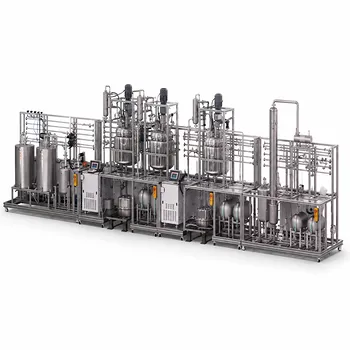
The ideal gas law assumes gas molecules are non-interacting points with zero volume—two assumptions that catastrophically break down under high pressure. In a chemical engineering pilot plant, relying on the ideal gas law for high-pressure gas processes isn't just an approximation; it's a design risk that leads to significant calculation errors.
According to experimental data, using the ideal gas law for a gas like carbon dioxide at high pressure can result in calculation errors exceeding 20% to 27%. The van der Waals equation corrects this by introducing terms for intermolecular attraction (a) and molecular volume (b), slashing the pressure-volume-temperature (PVT) calculation error down to within 1% to 5%. This jump in precision is non-negotiable for accurate mass balance, reactor sizing, and defining safety margins in a pilot unit.
The shift from the ideal gas law to the van der Waals equation in a pilot plant is not purely academic. It's the critical transition from a rough estimate to an engineering calculation precise enough to safely and accurately design, operate, and scale up high-pressure gas processes.
The Fundamental Flaw of the Ideal Gas Law at High Pressure
The ideal gas law (pV = nRT) is foundational because of its simplicity, but its two core assumptions are its fatal flaw.
Why Neglecting Molecular Volume Creates Error
The ideal gas law assumes the physical volume of gas molecules is zero. Under standard conditions, the space between molecules is vast, making this reasonable.
At high pressures, a gas is compressed so much that the molecules' own volume becomes a significant fraction of the total container volume. Ignoring this "excluded volume" means your calculated volume is artificially large, leading to measurable errors in equipment sizing.
Why Ignoring Intermolecular Forces is Dangerous
The second assumption is that there are no attractive or repulsive forces between molecules. In a low-pressure gas, molecules are too far apart for these forces to matter.
Under high pressure, molecules are forced closer together. Attractive forces become significant, causing the gas to be more compressible than the ideal gas law predicts. Your pressure or volume calculations will be dangerously inaccurate if you fail to account for this reality.
How the Van der Waals Equation Corrects These Errors
The van der Waals equation, (p + a/V²)(V - b) = RT, systematically fixes the ideal gas law's core deficiencies through two correction factors. This directly addresses the deep need for reliable pilot plant data.
The b Parameter: Accounting for Molecular Volume
The term b represents the volume excluded by a mole of gas molecules. It’s subtracted from the total molar volume V, providing a corrected, "free" volume in which molecules can actually move. This simple subtraction prevents the overestimation of space that plagues the ideal gas law.
The a Parameter: Correcting for Intermolecular Forces
The term a/V² is an internal pressure correction. It accounts for the attractive forces between molecules that reduce the impact of molecules striking the container wall. Adding this term to the measured pressure p produces a corrected value that reflects the true kinetic energy of the system, which is essential for an accurate state calculation.
The Direct Impact on Pilot Plant Design and Operation
The choice of equation of state (EOS) is not just a calculation preference. It has a direct, physical impact on the pilot plant's hardware and safety protocols.
Vapor-Liquid Equilibria (VLE) Hinge on Accurate EOS
Pilot plants for distillation or gas absorption depend on accurate phase equilibrium predictions. The van der Waals equation and its modern cubic derivatives, like Peng-Robinson (PR) and Soave-Redlich-Kwong (SRK), are applicable to both liquid and vapor phases in a self-consistent manner.
An inaccurate EOS leads to incorrect VLE predictions, which directly causes improperly sized separation columns. This can result in off-spec product, water dropout, or unexpected hydrate formation in gas processing units.
The Compressibility Factor (Z): A Reality Check on Ideality
A gas’s deviation from ideality is quantified by the compressibility factor, Z = PV/RT. For an ideal gas, Z = 1 at all conditions. In a pilot plant operating at high pressure, Z can deviate significantly from 1.
Calculating Z using a real-gas model like the van der Waals equation from experimental PVT data is critical for the correct sizing of compressors, flow meters, and safety relief systems.
Understanding the Trade-offs and Model Limitations
No single model is universally perfect. A key part of a technical advisor's role is to identify the boundaries of a tool.
The Van der Waals Equation is a Stepping Stone, Not a Final Answer
While a huge improvement over the ideal gas law, the van der Waals equation is itself an approximation. Its constants a and b are treated as temperature-independent, which is not strictly true. For the highest precision industrial design, engineers use more sophisticated cubic EOS like SRK and PR, which incorporate more accurate temperature-dependent functions.
The Hierarchy of Model Complexity
The choice between an EOS is a trade-off between accuracy and required data.
- Simple Cubic EOS (van der Waals, Redlich-Kwong): Good accuracy (1-5% error on pressure) with only two substance-specific constants. Excellent for teaching and basic design.
- Advanced Cubic EOS (PR, SRK): Superior accuracy for VLE and liquid densities. Requires critical properties and an acentric factor. The standard for modern process simulation.
- Complex Multi-parameter EOS (Benedict-Webb-Rubin, Bender): Extremely high accuracy over wide density ranges but may require 20+ experimental constants per pure component. Impractical for new or complex mixtures without extensive dedicated experimental campaigns.
Making the Right Choice for Your Pilot Plant
The equation of state you choose must align with your primary objective. A misaligned choice can derail a project, wasting time and introducing risk.
- If your primary focus is teaching fundamental thermodynamic principles: The van der Waals equation is the ideal choice. It’s a powerful analytical tool that vividly demonstrates the impact of molecular size and attraction without the computational complexity of modern cubic equations.
- If your primary focus is designing a high-pressure gas reactor for scale-up: You must use a modern cubic equation like Peng-Robinson or Soave-Redlich-Kwong. The van der Waals equation is a qualitative improvement, but the quantitative accuracy of PR or SRK in predicting VLE is essential for a reliable, safe design that matches real industrial practice.
- If your primary focus is correlating highly precise experimental data from a pilot unit: You may need a complex multi-parameter EOS. Be aware that this requires collecting a large matrix of density, pressure, and temperature data, and the resulting model will likely be highly specific to the fluid system tested.
The moment you move from atmosphere to high pressure, you are no longer working with an ideal gas. The choice of the right real-gas equation of state is what separates a safe, predictable pilot plant from a risky chemistry experiment.
Summary Table:
| Feature / Parameter | Ideal Gas Law ($$pV = nRT$$) | Van der Waals Equation ($$(p + a/V^2)(V - b) = RT$$) |
|---|---|---|
| Molecular Volume | Assumed to be zero (neglected) | Corrected via parameter $$b$$ (excluded volume) |
| Intermolecular Forces | Assumed to be non-existent | Corrected via parameter $$a$$ (intermolecular attraction) |
| Error at High Pressure | High (> 20% to 27%) | Low (1% to 5%) |
| Primary Application | Low-pressure systems & introductory theory | High-pressure processes & teaching real-gas deviations |
Optimize Your Lab’s Thermodynamic Precision with LABPARK
Building reliable high-pressure processes requires both precise thermodynamic modeling and robust physical equipment. LABPARK provides state-of-the-art Educational and Vocational Unit Operations Pilot Plants in chemical engineering, bioprocess & biotech, and environmental & water treatment for universities, research institutes, and enterprises.
Our pilot plants are engineered to bridge the gap between theory and practice safely, ensuring your students and researchers can study real-gas behavior, vapor-liquid equilibria, and process scale-up under precise, controlled conditions.
Ready to elevate your engineering lab's capabilities? Contact our technical experts today to find the perfect pilot plant solution for your institution.
Related Products
- Fixed Bed Gas Solid Catalytic Reaction Educational Pilot Plant
- Natural Product Extraction Unit Operations Training Pilot Plant
- Carbon Dioxide Hydrogen Methanol Synthesis Educational Unit Operations Pilot Plant
- Ethyl Acetate Synthesis Unit Operations Pilot Plant for Practical Training
- Green Anhydrous Ethanol Refining Practical Training Pilot Plant
People Also Ask
- How do reactor pilot plants safely study gas-solid reactions? Master kinetics with thermal & flow control.
- How does the Mears criterion evaluate transport resistance? Key Guide to Intrinsic Kinetics
- Fluidized vs. Fixed Bed Reactors: Comparing Heat & Complexity in Pilot Plants
- Why is a multibed configuration necessary for exothermic reactions? Optimize your pilot plant trajectory.
- How is the friction factor determined for fixed-bed pilot plants? Select the best pressure drop correlation.