Vacuum control and byproduct removal are not just ancillary steps—they are the critical drivers of polymer chain growth in condensation polymerization.
In step‑growth polymerizations like PET or polycarbonate synthesis, the reaction is a reversible equilibrium. To build long chains, the low‑molecular‑weight byproduct—water, phenol, or a glycol—must be continuously stripped from the melt. In a unit operations pilot plant, an engineered vacuum system (often reaching 100 Pa or below) together with efficient vapor separation directly dictates the final polymer’s molecular weight, viscosity, and distribution.
In a condensation polymerization pilot plant, the only way to push an equilibrium‑limited reaction toward high molecular weight is to relentlessly remove the condensation byproduct. Without vacuum‑driven extraction, the polymer stalls at low chain lengths no matter how long you wait or how hot you run.
The Equilibrium Bottleneck in Condensation Polymerization
Why Byproducts Act Like a Brake on Chain Growth
Every esterification or transesterification step that links two monomers also releases a small molecule.
That release is reversible—the byproduct can just as easily attack a chain and chop it back down.
If the byproduct stays in the melt, the forward and reverse rates balance out, locking the polymer at a low degree of polymerization.
Le Chatelier’s Principle in the Melt Phase
Le Chatelier’s principle says a system at equilibrium will shift to relieve a stress.
Removing one product, in this case the small‑molecule byproduct, forces the equilibrium toward more chain‑forming reactions.
The deeper the removal, the stronger the driving force to build ever longer chains.
How Vacuum Control Unlocks High Molecular Weight
Lowering Boiling Points to Extract Byproducts Efficiently
Condensation polymerizations are run at high temperatures—often above 250 °C—to keep the melt fluid and to accelerate kinetics.
At these temperatures, byproducts like water or phenol would normally be vapors, but their partial pressure in the reactor can still be high enough to limit the equilibrium.
Applying a vacuum reduces the absolute pressure, lowering the boiling point of the byproduct far below the reaction temperature. This makes it boil off aggressively, stripping it from the melt and driving the reaction forward.
How Deep Vacuum Overcomes Mass Transfer Limitations
In the later stages of polymerization, the melt becomes extremely viscous.
Diffusion of the tiny byproduct molecules to the liquid‑vapor surface becomes the rate‑limiting step.
A deep vacuum (100 Pa or less) steepens the concentration gradient at the surface, dramatically accelerating mass transfer.
The measurable result: a rapid climb in intrinsic viscosity and number‑average molecular weight that is impossible without adequate vacuum depth.
The Role of Vapor Separation Systems in Pilot Plants
Condensers and Cold Traps: Capturing the Leaving Group
Removing the byproduct vapor is only half the battle; you must also condense and isolate it to prevent back‑diffusion or contamination of the vacuum pump.
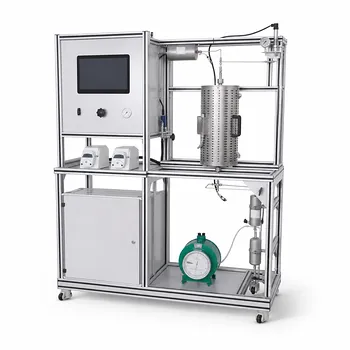
Pilot‑plant setups couple the reactor with staged condensers and cold traps.
These units protect downstream equipment and turn an abstract equilibrium principle into a visible, measurable operation—students see exactly how mass removal correlates with polymer viscosity over time.
The Silent Killer: Non‑Condensable Gases
Even a small leak of air or the evolution of an inert gas can sharply degrade vacuum performance.
Non‑condensable gases accumulate near the cooling surface, forming a gas‑film barrier that chokes heat transfer and impedes further condensation.
In pilot plants, dedicated venting valves are essential to bleed these gases out; otherwise the apparent thermal efficiency collapses, and the vacuum level never reaches the target depth needed for high‑molecular‑weight polymer.
Understanding the Trade‑offs and Common Pitfalls
The Danger of Thermal Side Reactions at High Vacuum
High temperature—necessary for melt processing—also promotes unwanted interchange reactions.
Transesterification and transamidation can randomly split chains and redistribute molecular weight, driving the distribution toward a statistical “most probable” pattern.
Vacuum byproduct removal counteracts the equilibrium‑driven reversibility, but it does not stop these scission and reshuffling side reactions entirely.
Over‑heating while under deep vacuum can accelerate these effects, leading to a polymer with the right average chain length but a broader, less predictable distribution.
When Vacuum Pulls More Than Just Byproduct
Deep vacuum systems can pull out monomer, oligomers, or catalyst residues if not carefully designed.
This loss changes the stoichiometry and starves the chain growth of reactive end groups.
In a pilot plant, the vapor path must be optimized—often with partial condensers—to return the heavier, still‑reactive species while only removing the target byproduct.
Recognizing and Avoiding Pilot‑Plant Equipment Stress
Maintaining sub‑atmospheric pressure places a physical load on every vessel and line.
Pilot‑plant storage tanks, condensate receivers, and even the reactor itself can implode if they are not vented properly during pump‑down or if a vacuum breaker fails.
Installing vacuum breakers and training operators to never isolate a hot vessel under vacuum are non‑negotiable safety lessons that a well‑run pilot plant teaches firsthand.
Making Vacuum Control Deliver the Polymer You Need
Each pilot‑plant run is an opportunity to link fundamental thermodynamics with tangible product quality.
- If your primary focus is achieving maximum molecular weight: Pursue the deepest vacuum practically attainable (below 100 Pa), and optimize the vapor pathway—short, wide‑bore lines and efficient condensers—to minimize pressure drop.
- If your primary focus is delivering a narrow molecular weight distribution: Pair precise vacuum control with equally precise temperature control to suppress interchange reactions, and use a partial condenser to selectively return oligomers to the melt.
- If your primary focus is process reliability and safety: Engineer the system with redundant vacuum breakers, continuous non‑condensable gas venting, and cold‑trap monitoring to protect the pump and prevent unexpected pressure spikes.
- If your primary focus is educational and scale‑up insight: Run intentional “failure” experiments—a slight leak, a partially closed vent—to show students how a 10% loss in vacuum can halve the final melt viscosity, cementing the lesson that mass transfer governs polymer quality.
When you control the vacuum, you control the equilibrium, the kinetics, and ultimately the entire architecture of the polymer chain—there is no more powerful lever in a condensation polymerization pilot plant.
Summary Table:
| Key Factor | Technical Role | Impact on Process & Polymer |
|---|---|---|
| Equilibrium Shift | Strips small-molecule byproducts (water, glycol) | Drives chain growth by preventing reverse reactions |
| Vacuum Depth | Lowers boiling points & steepens diffusion gradient | Overcomes mass transfer limitations in viscous melts |
| Vapor Separation | Employs condensers, cold traps & venting | Protects pumps and removes non-condensable gases |
| Process Safety | Monitors system pressure and temperature | Prevents vessel implosion and thermal chain scission |
Scale Up Your Chemical Engineering Education with LABPARK
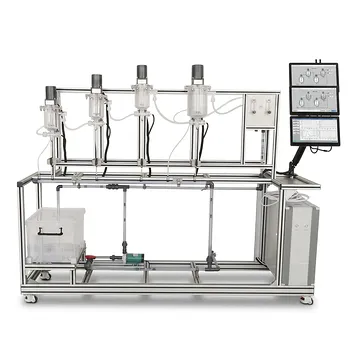
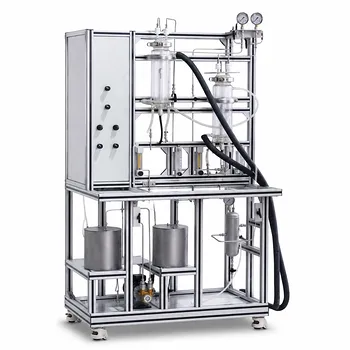
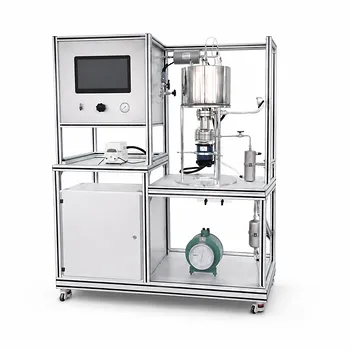
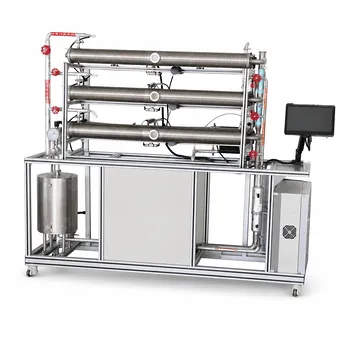
Achieving precise reaction control is crucial for both industrial production and academic research. LABPARK provides premium Educational and Vocational Unit Operations Pilot Plants in chemical engineering, bioprocess & biotech, and environmental & water treatment designed specifically for universities, research institutes, and enterprises.
Our pilot plants deliver the advanced vacuum control, heating precision, and vapor separation systems required to teach and study complex unit operations safely and effectively.
Empower your students and researchers today—contact us to discuss your laboratory requirements!
Related Products
- Polymerization Granulation and Pellet Processing Educational Unit Operations Pilot Plant
- Multi-Stage Stirred Tanks in Series Residence Time Distribution and Mixing Performance Determination Educational Pilot Plant
- Photocatalytic Membrane Separation and Degradation Unit Operations Pilot Plant
- Residence Time Distribution and Reactor Flow Characteristics Determination Educational Pilot Plant
- Carbon Dioxide Hydrogenation Methanol Synthesis Educational Unit Operations Pilot Plant
People Also Ask
- How do educational unit operations pilot plants bridge theory and design? Bridge the Engineering Gap
- How do educational unit operations pilot plants address safety and waste management when scaling up?
- Why Compare Predicted and Experimental Excess Enthalpy? Key to Accurate Pilot Plant Scale-up
- When to transition from PID to adaptive control in pilot plants? Key process indicators.
- Why is the chemical plant startup schedule crucial? De-risk scale-up with pilot plants.