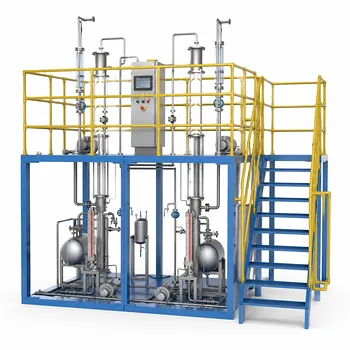
The line between a clean separation and a useless mixture is drawn by vapor pressure. In a distillation pilot plant, knowing exactly how temperature drives vapor pressure is not academic theory—it is the pragmatic skill that determines whether you produce a pure fraction, flood a column, or waste energy. It lets you set the correct column pressure, size the reboiler, predict bubble points, and avoid destroying heat-sensitive compounds.
Pilot-plant distillation relies entirely on the exponential sensitivity of vapor pressure to temperature. Without quantifying this relationship—through Clausius-Clapeyron calculations and bubble-point analysis—you cannot select a safe operating pressure, supply the right thermal energy, or maintain a stable vapor-liquid equilibrium. Every operational decision, from startup heating to condenser sizing, flows from this one thermodynamic link.
The Thermodynamic Imperative: Why Temperature Governs Separation
Separation in a distillation column is a competition of volatilities. A component’s vapor pressure at a given temperature directly determines how much of it escapes the liquid. Understanding this link gives you control over that competition.
The Exponential Lever of the Clausius-Clapeyron Equation
The Clausius-Clapeyron relationship reveals that the logarithm of saturated vapor pressure is inversely proportional to the absolute temperature. This means a small increase in temperature can cause a large, exponential jump in vapor pressure.
For an operator, this is both a tool and a warning. A gentle heating adjustment can dramatically shift component distributions on every tray. If you fail to account for that nonlinearity, you can easily overshoot your target separation or push the column into a flooded, unstable state.
From Molecular Forces to Macroscopic Behavior
The same vapor-pressure curve defines the vapor-liquid equilibrium (VLE) across the column. Phase equilibrium is reached only when the chemical potential of each component is identical in the liquid and vapor phases.
By applying thermodynamic models that incorporate the acentric factor (ω) and non-ideal activity coefficients, you gain insight into molecular-level interactions—hydrogen bonding, van der Waals forces, and structural misfit—that distort simple ideal behavior. In a pilot plant, comparing model predictions with real column data exposes where simplified assumptions break down.
How This Relationship Drives Every Operational Decision
Translating theory into practice means using the temperature–vapor pressure link to make concrete engineering choices during a pilot run.
Setting Column Pressure and Reboiler Duty
Volatility is a function of both temperature and pressure. The Clausius-Clapeyron equation lets you calculate the exact operating pressure needed to achieve a desired separation at a safe temperature. That pressure, in turn, dictates the thermal energy required in the reboiler—calculated from the molar heat of vaporization (ΔH_vap)—to generate the required vapor traffic.
At moderate pressures (below 400 psig, typical of most pilot-plant distillation units), mixtures often behave close to ideality. This allows you to use the simplified equilibrium ratio K = Y/X to model stage compositions quickly, making real-time operational adjustments feasible.
Avoiding Column Flooding and Thermal Damage
Bubble point calculations are a direct application of the temperature–vapor pressure relationship. Knowing the bubble point pressure or temperature for a liquid mixture tells you exactly when the first bubble of vapor will form.
This is indispensable for safe reboiler startup: heat too fast and you risk local overheating and product degradation; heat too slowly and you get insufficient vapor flow. The bubble point also sets an upper pressure limit to prevent overpressurization and column flooding, keeping the pilot plant within its mechanical design limits.
Sizing Condensers and Vacuum Systems
When distilling heat-sensitive materials, the exponential pressure‑temperature curve forces you into vacuum operation. Using the same Clausius-Clapeyron logic, you reverse the process: for a fixed, low temperature (to protect the product), you calculate the necessary vacuum level.
This determines the design and capacity of your vacuum system and condenser. A wrong estimate based on a linear guess—rather than the true exponential trend—leads to undersized equipment, poor condensation, and loss of volatile compounds to the vacuum pump.
The Educational Value: Connecting Theory to Real Equipment
In a teaching or research pilot plant, the temperature‑vapor pressure relationship is the thread that ties thermodynamics textbooks to industrial hardware.
Validating Vapor-Liquid Equilibrium Models
Pilot plants allow students to measure vapor pressures experimentally at multiple temperatures. These data points are then compared with equations of state that incorporate the acentric factor—defined at a reduced temperature of 0.700 to capture structural sensitivity away from the critical point.
The comparison exposes both the power and the limitations of classical models. Students see firsthand how non-ideal behavior emerges from specific molecular interactions, building the intuition to select the correct thermodynamic model for a given chemical mixture.
Measuring Deviations from Ideality
By analyzing real column data, operators and students evaluate how deviations from ideal behavior—quantified by activity coefficients—affect tray efficiency and product purity. This closes the loop between abstract chemical potential concepts and the physical observation of concentration profiles along the column.
Understanding the Trade-offs and Operational Pitfalls
Ignoring the exponential temperature‑dependence of vapor pressure leads directly to three common failures.
The Vacuum Distillation Conundrum
Lowering column pressure via vacuum reduces the boiling point and protects heat-sensitive compounds. But it also increases the vapor volume, requiring larger column diameters and more robust vacuum systems.
The trade-off is clear: lower thermal risk versus higher capital and operational complexity. Only a quantitative grasp of vapor pressure curves allows you to balance these factors.
The Hidden Risk of Thermal Sensitivity
A material that appears thermally safe at its normal boiling point can degrade rapidly if the reboiler temperature overshoots by just a few degrees. That exponential vapor-pressure curve means a small temperature rise might boil the mixture, but it can simultaneously trigger unwanted decomposition or polymerization.
Operators who trust a linear mental model learn this lesson through spoiled batches and damaged equipment.
Over-Reliance on Ideal Behavior
In the moderate-pressure range, the convenient K = Y/X simplification works well for many refinery-like mixtures. However, highly polar or hydrogen-bonding mixtures violate ideal assumptions.
Assuming ideality without verification can lead to significant errors in stage counts and reflux ratios. The pilot plant’s purpose is to detect these deviations before they cost money at full scale.
Making the Right Choice for Your Pilot Plant Goal
Your specific objective dictates how you must use the temperature‑vapor pressure knowledge.
- If your primary focus is protecting heat‑sensitive compounds: Let the vapor‑pressure curve dictat e your vacuum level. Identify the maximum safe temperature, then calculate the corresponding pressure—and design your column and condenser around that vacuum specification.
- If your primary focus is achieving a sharp separation at minimal energy cost: Use bubble-point and dew-point calculations to find the lowest reboiler duty that still maintains a stable vapor traffic. Small temperature tweaks near the optimum can deliver large efficiency gains.
- If your primary focus is education or model validation: Measure vapor pressures experimentally at several temperatures, compute the acentric factor, and compare the results against multiple equations of state. This builds the skill to diagnose non-ideal behavior and choose the right thermodynamic tool for any mixture.
- If your primary focus is scaling up to production: Document the exact pressure‑temperature‑composition relationship observed in the pilot plant. These data become the non-negotiable basis for sizing the full-scale reboiler, condenser, and column diameter.
The temperature‑vapor pressure relationship is not a footnote in a textbook—it is the operating system of your distillation pilot plant. Master it, and you transform from someone who runs experiments into someone who engineers separations with precision.
Summary Table:
| Operational Area | Temperature-Vapor Pressure Link | Practical Impact |
|---|---|---|
| Column Pressure | Clausius-Clapeyron calculation | Determines correct operating pressure and reboiler duty |
| VLE Control | Non-linear vapor-liquid equilibrium | Optimizes stage compositions and product purity |
| Safe Startup | Bubble point analysis | Prevents column flooding and thermal degradation |
| Vacuum Operation | Reduced pressure-temperature curves | Sizes condensers and protects heat-sensitive compounds |
Optimize Your Chemical Engineering Lab with LABPARK
Bridge the gap between thermodynamic theory and practical operation. LABPARK provides state-of-the-art Educational and Vocational Unit Operations Pilot Plants in chemical engineering, bioprocess & biotech, and environmental & water treatment. Designed specifically for universities, research institutes, and enterprises, our pilot plants enable hands-on mastery of vapor-liquid equilibrium (VLE), column control, and safe distillation scaling.
Ready to elevate your research and training capabilities? Contact LABPARK today to find the perfect pilot plant system for your facility!
Related Products
- Continuous Sieve-Plate Distillation Pilot Plant for Unit Operations Laboratory Education
- Multi-Modal Distillation Unit Operations Training Pilot Plant
- Green Anhydrous Ethanol Purification Extractive Distillation Unit Operations Training Pilot Plant
- Dual-Mode Rectification Pilot Plant for Practical Training Unit Operations
- Ethyl Acetate Synthesis Unit Operations Pilot Plant for Practical Training
People Also Ask
- What are the primary reflux ratio control strategies? Master Distillation Unit Operations
- Why is vacuum operation capability an essential feature for a distillation unit operations pilot plant? Unlock Efficiency
- How to select the right activity coefficient model (Wilson, NRTL, UNIQUAC) for distillation pilot plants?
- How can real-time carbon number prediction improve distillation pilot plants? Optimize control.
- How does catalyst water concentration affect distillation pilot plant design? Key separation train choices.