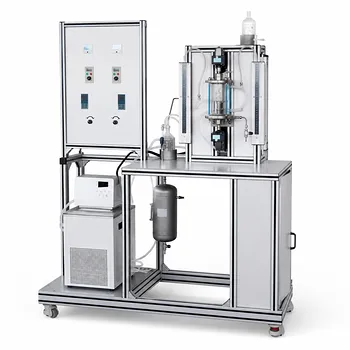
Understanding the overall mass transfer coefficient (K) is the single most important step to bridging the gap between an idealized textbook model and a real-world, scalable industrial process. It serves as the practical, measurable "lumped" rate parameter that directly quantifies how fast a chemical species moves from one phase to another, given a measurable driving force. Without it, pilot plant data is just a collection of temperatures and flow rates with no predictive power for larger systems.
Many novice engineers obsess over individual film coefficients, only to find it's an academic dead-end because interfacial concentrations are impossible to measure in a running column. The true value of K is its practicality: it grounds the mass transfer rate in easily measurable bulk concentrations, converting raw pilot plant data into a reliable tool for identifying which phase (gas or liquid) limits the process and for calculating the column height required at an industrial scale.
Why Traditional Theory Fails Without Empirical "K" Measurement
Textbook correlations for mass transfer often fall apart when confronted with real chemical mixtures. You cannot design a commercial plant solely on theoretical predictions because reality introduces complexities that models ignore.
The Problem with "Clean" Systems
Theoretical correlations, like those used to predict the volumetric coefficient kLa, are usually derived for pure fluids. Industrial and even pilot-scale mixtures often contain trace impurities, surfactants, or anti-foaming agents.
These contaminants accumulate at the gas-liquid interface, creating a physical barrier. They drastically alter the interfacial area and increase the resistance to mass transfer in ways that purely theoretical models cannot predict.
Therefore, pilot plants become measurement stations. You run them not just to prove the reaction works, but to specifically measure the actual K under your process’s unique fluid chemistry, ensuring your design isn't based on an idealized, incorrect assumption.
The Hidden Danger of Consecutive Reactions
In complex reaction networks, like chlorination or hydrogenation, ignoring K doesn't just slow things down—it destroys your product. If a desired intermediate product continues to react, selectivity depends entirely on transport speed.
If the mass transfer rate is too slow, the reactant starves the liquid phase. The desired intermediate remains near the reactive interface too long, forming unwanted byproducts and crashing yield. Pilot plant studies allow you to observe this "hunger strike" and tune K (via agitation or gas flow) to maximize the profitable product before scaling up.
Decoding Process Limits: Gas vs. Liquid Resistance
A critical insight from pilot plant operations is that the overall coefficient K is a passport to identifying the rate-limiting step. It teaches you where to apply engineering effort for the greatest return.
The Power of the Resistance-in-Series Model
The relationship 1/K ≈ 1/kg + 1/kl is the diagnostic toolkit. By measuring K experimentally and, if possible, calculating or estimating kg and kl, you can determine which term dominates the equation.
If 1/kl is much larger than 1/kg, the liquid film controls the mass transfer. Conversely, if the gas film represents the majority of the resistance, you know to focus on gas-phase turbulence. This distribution directly dictates whether money should be spent on a higher-pressure blower or a more sophisticated liquid distributor.
Mastering Hydrodynamics and Flow Regimes
The value of K is not a fixed property; it is a slave to the flow regime. Whether your column operates in a trickle, bubbly, pulse, or spray regime fundamentally alters the effective interfacial area and the film renewal rate.
Crucially, many standard semi-empirical design equations are mathematically invalid in certain regimes, such as trickle flow. By mapping how K changes as you manipulate gas and liquid velocities in the pilot plant, you ensure you are applying the correct mathematical model, preventing gross errors in scaling up the final design.
Understanding the Trade-offs
While K is indispensable, treating it as a universal constant is a catastrophic mistake. You must recognize its limitations to avoid creating an unscalable design.
The Liability of "Lumped" Parameters
The primary danger is that K conflates two independent phenomena: the intrinsic kinetic constant (k) and the specific interfacial area (a). A high K might stem from fast chemistry or simply from a massive contact area created by a specific sparger design.
If you scale up a reactor by simply holding K constant, you might preserve the chemistry but inadvertently specify an impossible gas distribution system. A successful scale-up strategy requires stripping away the "per volume" nature of the measured value to forecast the physical hardware needed.
When Bulk Concentrations Deceive
Using K with a bulk concentration driving force solves measurement problems but can introduce thermodynamic blind spots. In systems with significant heat effects or non-ideal mixing, the bulk liquid concentration at the top of a column might not represent the true local equilibrium with the outlet gas.
This can lead to an artificially low driving force calculation, making the pilot plant data appear more efficient than it is. Always cross-validate K measurements with a global material balance to ensure internal consistency before trusting the data for scale-up.
Making the Right Choice for Your Goal
How you leverage K data depends on the outcome you need. Calibrate your pilot plant experiments with one of these specific objectives in mind.
- If your primary focus is isolated equipment design (e.g., sizing an absorber): Use overall
Kvalues based on easily accessible bulk concentrations to directly calculate the required column height. This simplifies data collection to inlet/outlet sampling, aligning with standard industrial design equations like those for packed towers. - If your primary focus is troubleshooting a failed scale-up: De-couple the resistance model
1/K = 1/kg + 1/H*klto determine which phase is controlling. If the pilot plant had short liquid residence times but the production reactor is tall, the controlling step may have shifted, explaining the performance gap. - If your primary focus is optimizing bioreactor yields: Focus on the volumetric coefficient (
K_La). Systematically vary the impeller power input and aeration rate in the pilot unit to find the minimum energy cost required to keep dissolved oxygen above the critical threshold, avoiding metabolic failure. - If your primary focus is maximizing reaction selectivity: Characterize
K_Lrelative to the kinetic rate constant. You must operate the pilot plant to verify the "kinetic regime"—a delicate balance where the reaction is just fast enough for productivity, but not starved of mass transfer to the point where side reactions dominate.
Using K as a diagnostic probe, rather than just a number to plug into a formula, transforms your pilot plant from a validation step into a true discovery instrument that de-risks the entire scaled-up enterprise.
Summary Table:
| Focus Area | Role of Overall Mass Transfer Coefficient (K) | Practical Engineering Impact |
|---|---|---|
| Scale-Up Accuracy | Accounts for trace impurities and fluid chemistry | Prevents design failures caused by idealized assumptions |
| Rate-Limiting Steps | Identifies gas vs. liquid phase resistance ($1/K \approx 1/k_g + 1/k_l$) | Optimizes equipment spend (e.g., blower vs. distributor) |
| Flow Hydrodynamics | Maps $K$ fluctuations across different flow regimes | Ensures correct mathematical modeling for column heights |
| Reaction Selectivity | Relates transport speed to chemical kinetic rates | Minimizes byproduct formation and maximizes yield |
De-Risk Your Scale-Up with LABPARK Pilot Plants
Bridging the gap between theoretical models and real-world industrial performance requires reliable data. LABPARK provides premium Educational and Vocational Unit Operations Pilot Plants in chemical engineering, bioprocess & biotech, and environmental & water treatment.
Designed specifically for universities, research institutes, and enterprises, our pilot plants enable you to accurately measure mass transfer coefficients, optimize hydrodynamics, and train the next generation of engineers on industry-grade equipment.
Ready to elevate your research and training capabilities? Contact LABPARK today to discuss your customized pilot plant requirements!
Related Products
- Dual-Drive Stirred Gas-Liquid Mass Transfer Coefficient Determination Pilot Plant
- Liquid-Liquid Mass Transfer Coefficient Determination Educational Pilot Plant
- Absorption and Desorption Educational Unit Operations Pilot Plant
- Comprehensive Heat Transfer Coefficient Determination Educational Unit Operations Pilot Plant
- Solid Spherical Heat Transfer Coefficient Determination Educational Chemical Engineering Pilot Plant
People Also Ask
- How does temperature affect mass transfer rates in chemical engineering educational pilot plants?
- How do pilot plants study gas solubility in polymer melts at high pressures? Key Mass Transfer Insights
- How does column packing affect absorption intensification, and how is it evaluated experimentally?
- Why Compare Membrane-Reservoir Models with Pilot Plant Data? Ensure Successful Process Scale-Up
- How does k_La affect hydrogenation scale-up? Critical insights for pilot reactors.