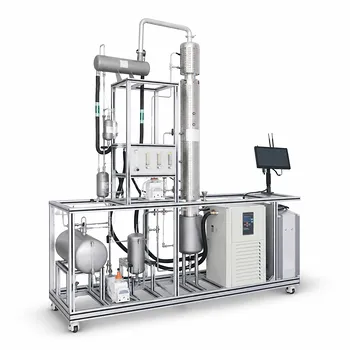
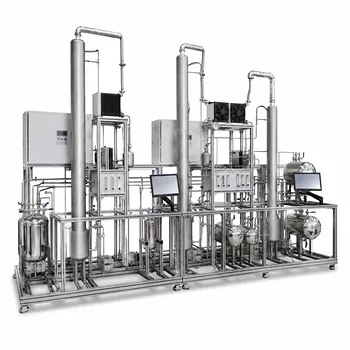
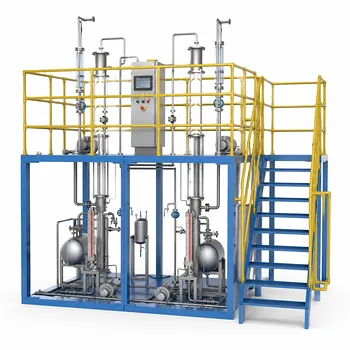
The definitive purpose of the total reflux state is to serve as the column’s “zero-point calibration” before production begins. In a distillation unit operations pilot plant, total reflux is the critical startup condition where all condensed vapor is returned to the column with zero product withdrawal. This state rapidly forces the unit into stable vapor-liquid equilibrium, allowing operators to establish a steady thermal and composition profile. The minimum number of theoretical stages (N_min) required for the separation is then calculated using the Fenske equation, which relies on the high-purity samples generated at this exact condition to establish the column's ultimate separation capability.
While total reflux yields zero actual production, it is the most powerful diagnostic tool available in a pilot plant. It provides the only true baseline of a column’s maximum separating power by decoupling the variables of feed rate and product withdrawal. This state allows you to measure the theoretical minimum stage requirement and calculate real-world tray efficiency before committing to an operating reflux ratio.
Laying the Groundwork: The Startup Imperative
Starting a distillation column is inherently chaotic. The composition, temperature, and hydraulic gradients are non-existent immediately after the heat is applied. Rushing to introduce feed or draw product during this transient state will lock in severe fractionation inefficiencies.
The Delicate Path to Equilibrium
The primary goal of startup is not to make product, but to build a thermal and composition profile from the reboiler to the condenser.
A cold column starting up sees erratic boiling and irregular pressure drops. If you withdraw distillate too early, you remove the light components from the top before they can establish a enriched pooling effect.
This leaves the upper section starved of the necessary volatile material, making it impossible to achieve high overhead purity later. You must allow the lights to accumulate at the top of the column.
How Total Reflux Forces Stability
Total reflux is the fastest route to a steady state because it creates a closed-loop mass balance. Every gram of vapor condensed returns as liquid, ensuring zero net loss of components from the column.
This internal cycling quickly builds the required concentration gradients on each tray. The rising vapor meets a counter-current flow of liquid, facilitating repeated heat and mass transfer.
With no disturbances from feed entry or product draws, the column hydraulics—weir loading, downcomer clearance, vapor velocity—stabilize predictably. This stability is vital in a pilot plant where sensitive instruments are being calibrated.
Unpacking the Calculation: Minimum Theoretical Stages
Once total reflux is achieved and the overhead and bottoms compositions have plateaued, you have reached the column’s thermodynamic limit. This condition allows you to calculate the minimum number of theoretical stages (N_min) —an absolute benchmark that cannot be violated.
The Foundation: The McCabe-Thiele Visualization
Under normal operation, the operating lines for the rectifying and stripping sections are distinct. Under total reflux conditions (R = infinity), these operating lines collapse precisely onto the diagonal of the McCabe-Thiele diagram (the y = x line).
This represents the maximum possible driving force for mass transfer because, at any point, the vapor composition (y) and liquid composition (x) are as far apart as physically possible from the equilibrium curve. Stepping off stages between the operating line and curve here results in the smallest, most efficient number of steps.
The Math: Applying the Fenske Equation
Graphical methods are subject to drawing error, so we use a rigorous analytical method: the Fenske equation. This equation directly calculates N_min from the purity data you collected during total reflux.
The equation is: N_min = log[ (x_D / (1 - x_D)) * ((1 - x_W) / x_W) ] / log(α_avg)
Let’s define the terms in a practical lab context:
- x_D: Mole fraction of the light key component in the distillate sample taken from the condenser.
- x_W: Mole fraction of the light key component in the bottoms sample taken from the reboiler.
- α_avg: The average relative volatility between the light and heavy key components, calculated as the geometric mean of α at the top and bottom temperatures.
A crucial note: the referenced standard equation often presents the result as N_min + 1. The "+1" accounts for the theoretical stage contributed by the reboiler itself. In rigorous pilot plant analysis, N_min usually refers strictly to the number of theoretical trays inside the column shell, excluding the reboiler. Always report which convention you are using.
Understanding the Trade-offs and A Common Pitfall
Total reflux is a powerful educational and diagnostic tool, but mistaking its purpose for an operating strategy is a critical error. Its benefits come with specific caveats that define pilot plant methodology.
The Zero-Throughput Reality
The most obvious limitation is that operating at total reflux generates zero production. You are consuming energy in the reboiler and cooling water in the condenser without creating a single drop of usable product.
It is strictly a temporary state. Prolonged operation at total reflux is only useful for column testing or academic exercises where mass balance closure is prioritized over output.
The Trap of Misinterpreting "Minimum"
The Fenske equation calculates the theoretical minimum. A physical column with exactly that many trays would need an infinite height to reach equilibrium, which is physically impossible.
This is why N_min is a baseline metric, not a design target. You compare the calculated N_min to the actual number of trays to find the overall column efficiency. If N_min = 8 and your column has 10 physical trays, your overall efficiency is 80%.
Distinguishing It from the Minimum Reflux Ratio
A common conceptual pitfall is confusing N_min (total reflux) with the minimum reflux ratio (R_min) . They represent opposite ends of the spectrum.
Total reflux (R = ∞) requires minimum stages (N_min). At this point, capital cost is theoretically lowest, but operating cost is infinite. Minimum reflux (R = R_min) requires an infinite number of stages. Here, energy consumption is at its absolute theoretical minimum, but the capital cost to build a column that tall is infinite.
Understanding both boundaries is what allows students to use a pilot plant to identify the optimal economic trade-off, typically operating at 1.1 to 2.0 times R_min.
Making the Right Choice for Your Pilot Plant Goal
Once total reflux startup is complete and your column is stable, your path forward depends on the specific educational or research objective of the session.
- If your primary focus is measuring column hardware efficiency: Run the column at total reflux until steady state is absolute. Use the Fenske equation to find N_min and compare it to the number of physical trays to derive efficiency.
- If your primary focus is optimizing an energy-efficient separation: After stabilizing at total reflux, transition to a partial reflux condition. Calculate the minimum reflux ratio (R_min) using an appropriate method, then progressively adjust the reflux ratio upward from the pinch point to find the optimal purity-vs-cost balance.
- If your primary focus is a reactive distillation study: Recognize that total reflux startup is still vital for wetting the catalyst and establishing thermal stability, but the Fenske equation may not apply due to kinetic constraints. Focus instead on the column’s response to reflux ratio changes to find the non-linear optimum for reaction conversion.
Mastering the total reflux startup phase transforms the pilot column from a simple piece of hardware into a calibrated, predictable instrument—a prerequisite for any meaningful scientific or engineering conclusion.
Summary Table:
| Concept | Definition / Formula | Role in Pilot Plant Startup & Analysis |
|---|---|---|
| Total Reflux | Closed-loop state (R = ∞) where all condensed vapor returns as liquid. | Acts as a "zero-point calibration" to rapidly stabilize column hydraulics and concentration profiles. |
| Minimum Stages (N_min) | Logarithmic ratio of distillate/bottoms purity divided by relative volatility. | Establishes the ultimate thermodynamic separating power and baseline efficiency of the column. |
| Fenske Equation | N_min = log[ (x_D / (1 - x_D)) * ((1 - x_W) / x_W) ] / log(α_avg) | Calculates theoretical N_min, allowing comparison with physical tray count to find column efficiency. |
| Minimum Reflux (R_min) | The reflux ratio requiring an infinite number of stages. | Serves as the opposite economic boundary limit used to optimize operating costs vs. capital costs. |
Elevate Your Chemical Engineering Lab with LABPARK
Hands-on experience is critical for mastering complex distillation and unit operations. LABPARK designs and manufactures high-quality Educational and Vocational Unit Operations Pilot Plants tailored for chemical engineering, bioprocess & biotech, and environmental & water treatment applications.
Whether you are a university seeking to enrich engineering curricula, a research institute investigating advanced process separation, or an enterprise training the next generation of technical staff, our pilot plants provide the industry-grade reliability and precision you need.
Maximize your laboratory's potential—contact us today to find the perfect pilot plant solution!
Related Products
- Continuous Sieve-Plate Distillation Pilot Plant for Unit Operations Laboratory Education
- Multi-Modal Distillation Unit Operations Training Pilot Plant
- Green Anhydrous Ethanol Purification Extractive Distillation Unit Operations Training Pilot Plant
- Dual-Mode Rectification Pilot Plant for Practical Training Unit Operations
- Ethyl Acetate Synthesis Unit Operations Pilot Plant for Practical Training
People Also Ask
- How can real-time carbon number prediction improve distillation pilot plants? Optimize control.
- How to select the right activity coefficient model (Wilson, NRTL, UNIQUAC) for distillation pilot plants?
- Why is vacuum operation capability an essential feature for a distillation unit operations pilot plant? Unlock Efficiency
- What are the primary reflux ratio control strategies? Master Distillation Unit Operations
- How does catalyst water concentration affect distillation pilot plant design? Key separation train choices.