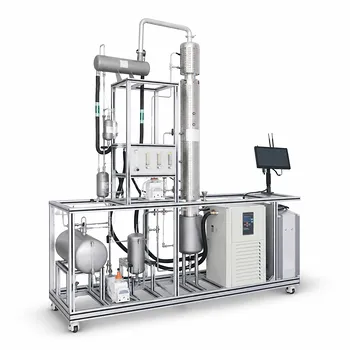
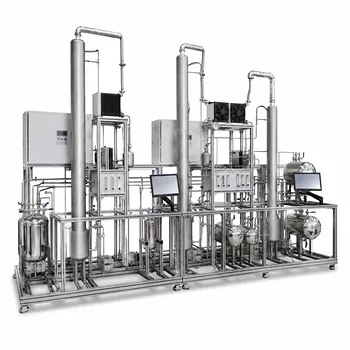
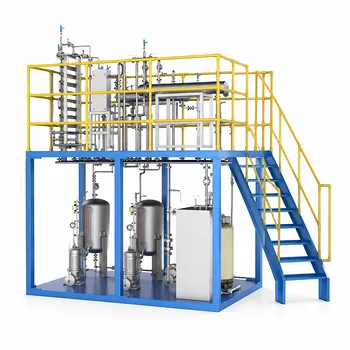
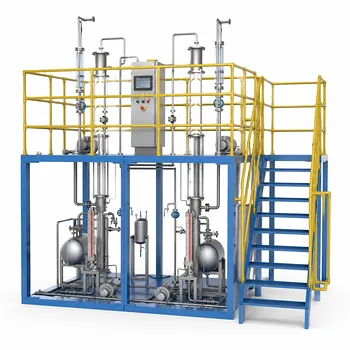
Chemical potential is the true thermodynamic compass of your distillation column. It represents the “escaping tendency” of a component from a phase. In a distillation pilot plant, separation occurs only because a component's chemical potential differs between liquid and vapor; mass transfer continues until those potentials equalize, establishing equilibrium and defining the theoretical limit of your separation. Without grasping this concept, operating the column becomes a recipe-following exercise rather than a genuine engineering investigation.
The core insight: Components move from a phase of higher chemical potential to one of lower potential. When potentials are identical across phases, the net driving force for separation vanishes. Chemical potential is therefore the thermodynamic condition for vapor-liquid equilibrium, and understanding it is the key to analyzing column performance, tray efficiency, and the gap between theory and reality.
The Fundamental Driver of Separation
What Chemical Potential Truly Represents
Chemical potential is the partial molar Gibbs free energy—it quantifies how a system’s energy changes when you add or remove a particle of a given component. In distillation, you are forcing components to redistribute between liquid and vapor phases. That redistribution will only happen if the chemical potential is unequal.
When you heat the reboiler, you create a vapor phase where light components can have a lower chemical potential than in the liquid. They “escape.” Meanwhile, heavier components find a lower potential in the liquid. The column trays then provide a cascade of contacting stages, each bringing vapor and liquid closer to the equilibrium equal-potential condition.
Why Equality Defines the Ultimate Separation Limit
At each theoretical stage, mass transfer stops when the chemical potential of every component is the same in both liquid and vapor. That is the equilibrium state. Real trays approach but never fully reach this, which is why we define tray efficiency. The concept of chemical potential therefore gives you the thermodynamic ceiling—the maximum purity you could ever achieve under given pressure and temperature. Every operational decision (reflux ratio, heat duty, pressure) is an attempt to shift those equilibrium compositions to meet your separation target.
Connecting Chemical Potential to Practical Distillation Parameters
The K‑Value Is a Direct Expression of Chemical Potential Equality
Equality of chemical potentials in liquid and vapor leads to a relationship between fugacities. Simplified for low-to-moderate pressures, this yields the familiar K‑value: $K_i = y_i/x_i = \gamma_i P_i^{\text{sat}} / P$. Here, the activity coefficient $\gamma_i$ corrects for non‑ideal liquid-phase interactions, and $P_i^{\text{sat}}$ captures the pure-component escape tendency at temperature. The chemical potential is embedded in both $\gamma_i$ and the vapor-pressure term.
When students measure $y_i$ and $x_i$ from the pilot column and calculate experimental K‑values, they are indirectly probing the chemical potential balance. A K‑value > 1 means the component’s chemical potential is lower in the vapor, so it concentrates upward. A K‑value < 1 signals the opposite. Understanding this link prevents the K‑value from being just a memorized number—it becomes the operational fingerprint of the underlying thermodynamic driving force.
Vapor Pressure and Temperature: Manipulating the Potentials
The Clausius‑Clapeyron equation shows how vapor pressure changes with temperature, which in turn alters $P_i^{\text{sat}}$ and the component’s tendency to vaporize. By controlling column pressure and heat input, you are directly shifting the temperature profile and thus the chemical potentials. For instance, reducing pressure lowers boiling points and often increases relative volatility because the chemical potential difference between components becomes more favorable. Students who see the column as a device for engineering chemical potential landscapes can purposefully adjust these levers rather than guess.
Understanding the Trade-offs: Ideal Equilibrium vs. Real Operations
The Equilibrium Assumption Is a Starting Point, Not the Finish Line
While chemical potential equality defines the ideal stage, real trays operate with finite mass‑transfer rates. Vapor and liquid are in contact for only seconds. The system strives toward equilibrium but never fully reaches it, which is why we need an efficiency factor. The gap between actual separation and the equilibrium limit is the practical problem that engineers solve with tray design and column hydraulics.
Non‑Ideality and the Complexity of Chemical Potential Calculations
For ideal mixtures, chemical potential models are simple (Raoult’s law). But in educational labs, mixtures often exhibit hydrogen bonding or other non‑idealities. Then you need activity coefficient models (Wilson, NRTL, UNIFAC) to compute $\gamma_i$, which corrects the liquid‑phase chemical potential. The crucial lesson is that ignoring non‑ideality will make your theoretical predictions diverge wildly from pilot‑plant data. Students who recognize this can critically evaluate when a model applies and when it fails—a core engineering skill.
Over‑Reliance on a Single Thermodynamic Variable
Vapor-liquid equilibrium is also described by temperature, pressure, and composition. You might be tempted to skip chemical potential entirely and just use K‑values or phase diagrams. But those are consequences, not causes. Without the underlying understanding of chemical potential, you’ll struggle to troubleshoot why a column suddenly loses separation efficiency when feed composition changes. The driver—the equality of potentials—explains why everything else moves.
Applying Chemical Potential Insight in the Educational Lab
From Molecular Interactions to Column‑Scale Behavior
Chemical potential bridges quantum‑level interactions (hydrogen bonding, van der Waals forces) and macro‑scale unit operations. When students compare computational predictions of activity coefficients with actual distillate compositions, they see how molecular misfits translate into tray‑by‑tray composition profiles. This connection turns the pilot plant from a steel assembly into a living demonstration of thermodynamic theory.
Diagnosing Operational Problems Through a Chemical‑Potential Lens
If the column fails to reach steady state or delivers lower purity than expected, the chemical‑potential viewpoint offers a structured diagnostic:
- Has the stage temperature changed, shifting the vapor‑pressure component of the potential?
- Is there improper liquid‑vapor contacting, so mass transfer cannot equalize potentials?
- Has the feed composition changed, altering activity coefficients and thus the equilibrium curve?
Training students to ask these questions develops an intuition that serves them in any industrial separation process.
Making the Right Choice for Your Educational Goal
How you emphasize chemical potential depend on your lab’s learning objectives:
- If your primary focus is column operation fidelity: Use chemical potential to explain why steady‑state requires temperature, pressure, and flow stability—because they hold the equilibrium composition fixed. Emphasize the link between energy input and the creation of a chemical‑potential gradient.
- If your primary focus is modeling and simulation: Centered on the equality of fugacities, derive K‑values from chemical potential expressions. Have students calculate phase envelopes and compare them with pilot‑plant data, then discuss deviations in terms of activity coefficients and mass‑transfer limitations.
- If your primary focus is troubleshooting and efficiency analysis: Frame tray efficiency as the fractional approach to chemical‑potential equilibrium. Use the Murphree efficiency directly as a measure of how close the actual vapor composition came to the equilibrium value dictated by potential equality.
Understanding chemical potential transforms a distillation pilot plant from a confusing set of knobs and gauges into a coherent physical system, where every action you take is a deliberate attempt to manipulate molecular escaping tendencies toward a desired separation.
Summary Table:
| Key Concept | Thermodynamic Role in Distillation | Practical Lab Impact |
|---|---|---|
| Driving Force | Drives component redistribution between phases | Determines separation direction and K-value calculations |
| Equilibrium Limit | Equalizes chemical potentials across phases | Establishes the thermodynamic ceiling for tray efficiency |
| Non-Ideality | Models liquid-phase deviations (e.g., activity coefficients) | Prevents divergence between theoretical models and real pilot data |
Bring Thermodynamic Theory to Life in Your Lab
Bridge the gap between molecular chemistry and column-scale operations. LABPARK provides high-quality Educational and Vocational Unit Operations Pilot Plants in chemical engineering, bioprocess & biotech, and environmental & water treatment for universities, research institutes, and enterprises. Empower your students to master vapor-liquid equilibrium and column diagnostics with robust, hands-on learning systems.
Contact LABPARK today to customize your distillation pilot plant!
Related Products
- Continuous Sieve-Plate Distillation Pilot Plant for Unit Operations Laboratory Education
- Multi-Modal Distillation Unit Operations Training Pilot Plant
- Green Anhydrous Ethanol Purification Extractive Distillation Unit Operations Training Pilot Plant
- Dual-Mode Rectification Pilot Plant for Practical Training Unit Operations
- Ethyl Acetate Synthesis Unit Operations Pilot Plant for Practical Training
People Also Ask
- What are the primary reflux ratio control strategies? Master Distillation Unit Operations
- How to select the right activity coefficient model (Wilson, NRTL, UNIQUAC) for distillation pilot plants?
- Why is vacuum operation capability an essential feature for a distillation unit operations pilot plant? Unlock Efficiency
- How does catalyst water concentration affect distillation pilot plant design? Key separation train choices.
- How can real-time carbon number prediction improve distillation pilot plants? Optimize control.