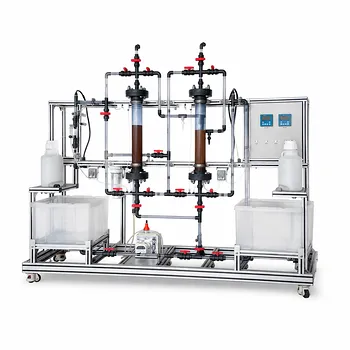
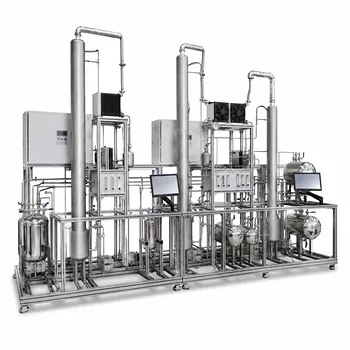
The unflinching reality of process scale-up is that an API’s molecular behavior in a beaker becomes its biggest manufacturing risk in a reactor. A pilot-scale study of crystallization and filtration is not a mere checkbox; it is the only definitive method to translate the compound’s complex, solvent-dependent solubility and pH sensitivity into a reliable, scalable isolation step. Without this physical interrogation, you are flying blind, unable to predict how cooling rates, mixing geometry, and time will conspire to either derail your purity or crash your filter cloth.
Addressing the surface question of "why this matters" reveals a deeper truth: Crystallization and filtration are not sequential steps but a single, inseparable system. Pilot studies bridge the gap between molecular thermodynamics and industrial fluid dynamics, forcing an honest reconciliation of crystal purity with the physics of solid-liquid separation to ensure the final medicine is both bioavailable and manufacturable.
The Thermodynamic Control Panel: Engineering the Crystal
At the heart of a complex API’s behavior is its sensitivity to the local chemical environment. Laboratory solubility screens provide data, but only a dynamic pilot plant reveals how to exploit that data under true processing conditions.
Mastering the Supersaturation Tightrope
A compound that dissolves freely in methanol at low pH but crashes out instantly upon neutralization presents a massive control challenge. The primary role of the pilot plant is to translate this property into a kinetic map. You must determine the exact cooling and anti-solvent addition rates that generate supersaturation slowly enough to avoid uncontrolled nucleation.
Without this data, you risk generating a bimodal slurry of fines and agglomerates. Such inconsistency directly violates the critical quality attributes required for a consistent drug product. The pilot plant lets you pinpoint the metastable zone width under realistic shear and volume, defining the safe operating window where growth dominates over nucleation.
The Hidden Cost of Mixing on Polymorph Stability
Complex molecules carry the risk of conformational polymorphism, where a solvent stabilizes a specific molecular shape that dictates the final crystal lattice. A solvent screening in a vial is blind to the mixing inefficiencies of a 2000-liter reactor. In antisolvent crystallization, the point of addition creates a localized storm of extreme supersaturation.
A pilot study is essential to visualize and mitigate this. It allows you to test injector geometry relative to the impeller to ensure the antisolvent plume is dissipated in milliseconds, not seconds. This is vital because poor mixing not only creates fines but can selectively nucleate a metastable polymorph that later transforms into a brick-like hydrate in your slurry, destroying filterability months after the batch is made.
The Unbreakable Link: Why a Crystal's Size Dictates Production Speed
An engineer’s most expensive blind spot is treating crystal size distribution (CSD) as a purely product-quality metric. Your downstream filtration rate is hardwired to your upstream crystallization kinetics.
The Solids-Liquid Trap
Herein lies the core engineering trade-off: rapid cooling to save cycle time produces a shower of microscopic needles that pack into an impermeable, high-resistance filter cake. Conversely, growing large, beautifully filterable rhombohedrons requires slow cooling that chokes the production schedule. A pilot plant allows you to conduct a controlled experiment on this feedback loop.
You can measure the cake resistance (alpha) and fluid kinematic viscosity under varying agitation speeds. This quantitative relationship between the crystallizer’s residence time and the filter’s throughput is the master equation for calculating the true cost of "quality." The pilot plant ensures you don’t solve a purity challenge by creating a filtration bottleneck that turns a 2-hour plateau into a 24-hour nightmare due to a blinding 100-micron cake.
Avoiding the Plugged Flow Nightmare
Complex solubility profiles often require working in high-solid-density slurries to maximize yield. The pitfall is crossing the critical solid-liquid balance where the slurry loses fluidity. Pilot-scale circulation loops—exposed to real-world heat exchanger fouling and pump shear—are the only way to prove you can keep crystals suspended without shattering them. Any calculation on paper must be validated here to prevent a total plant shutdown caused by a single blocked transfer line.
Understanding the Trade-offs
Objective evaluation demands acknowledging that pilot-scale crystallization is an exercise in managing conflicting priorities. The perfect crystal is useless if it cannot be isolated economically.
Purity vs. Yield
Washing a filter cake to remove entrained mother liquor rich in impurities is effective, but if you’ve grown massive, fast-filtering crystals, the wash liquor can channel through the cake without mass transfer. You sacrifice purity. Pilot filtration trials under various pressure drops and wash ratios reconcile this purity-yield conflict, proving exactly how much you must dissolve back to hit specifications.
The Solvent Selection Dilemma
A solvent that yields 99.9% pure conformational polymorph with high thermodynamic stability might also generate a crystal habit that filters at half the speed. The pilot plant provides the stark business case: is the regulatory certainty of the stable polymorph worth the capital expenditure of doubling your filter area? This is a decision distilled from data, not speculation.
Making the Right Choice for Your Development Strategy
Harnessing pilot-scale crystallization infrastructure is about de-risking capital and safeguarding the patient. Your focus determines how you leverage the data.
- If your primary focus is defining a robust control strategy: Prioritize experiments that map the impact of cooling rate and agitation on nucleation to define the proven acceptable range for your Critical Process Parameters (CPPs).
- If your primary focus is preventing polymorphic transformation during storage: Use the pilot plant to generate material via a controlled solvent-mediated transformation, then stress-test the isolated product to ensure it’s the thermodynamic sanctuary, not a kinetically trapped ghost.
- If your primary focus is debottlenecking the manufacturing line: Directly correlate the crystallization holding time with filter cake permeability to calculate the true economic optimum for batch cycle time and eliminate the filtration step as the rate-limiting factor.
The transition from lab-scale chemistry to pilot-scale engineering is where data silos collapse; it is the only proving ground where a molecule’s chemical identity must reconcile with the physical laws of unit operations.
Summary Table:
| Focus Area | Scale-Up Challenge & Risk | Pilot-Scale Solution |
|---|---|---|
| Supersaturation | Uncontrolled nucleation & bimodal slurry | Map metastable zone width under realistic shear |
| Mixing & Polymorphs | Localized supersaturation & unstable polymorphs | Optimize injector/impeller geometry & feed rate |
| Filtration Rate | High cake resistance from needle-like crystals | Correlate cooling rates with cake permeability |
| Slurry Fluidity | Pipeline blockage & crystal attrition | Validate circulation loops under real pump shear |
Optimize Your Process Scale-Up with LABPARK
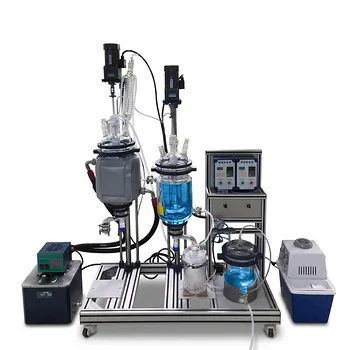
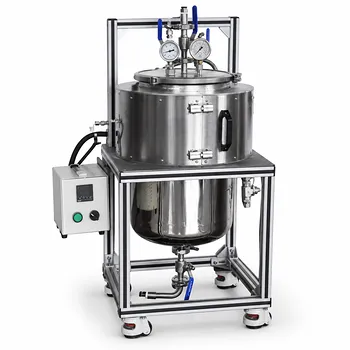
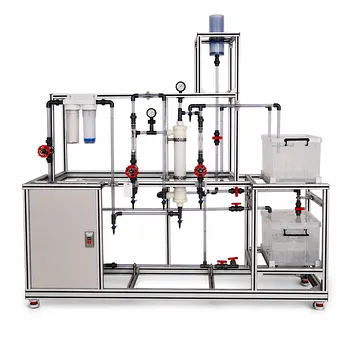
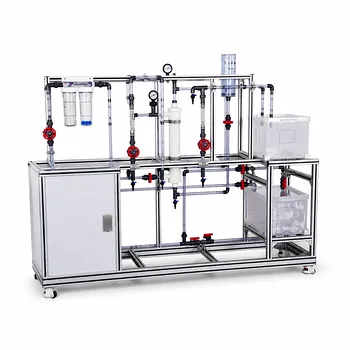
Bridging the gap between laboratory chemistry and industrial manufacturing requires reliable, precise, and scalable equipment. LABPARK provides premium Educational and Vocational Unit Operations Pilot Plants in chemical engineering, bioprocess & biotech, and environmental & water treatment tailored for universities, research institutes, and enterprises.
Our advanced pilot systems empower you to:
- Accurately map crystallization kinetics and thermodynamic behavior.
- Eliminate filtration bottlenecks and optimize cake wash ratios.
- Train future engineers and researchers on industry-standard pilot equipment.
Ready to de-risk your scale-up processes and secure predictable API manufacturing? Contact LABPARK today to explore our custom pilot plant solutions.
Related Products
- Multi Functional Membrane Crystallization Educational Unit Operations Pilot Plant
- Potassium Salt Thermal Dissolution and Crystallization Separation Educational Unit Operations Pilot Plant
- Hot Filtration Educational Unit Operations Pilot Plant Laboratory System
- Constant Pressure Filtration Educational Unit Operations Pilot Plant
- Multifunctional Membrane Separation Educational Pilot Plant with Ultrafiltration, Nanofiltration, Reverse Osmosis
People Also Ask
- Why is precise temperature control critical in crystallization pilot plants? Key to Scale-Up Success
- Control Crystallization Pilot Plant Secondary Nucleation: 4 Key Adjustments
- What key factors should be considered when configuring a crystallization unit operations pilot plant?
- What are the benefits of integrating online PAT tools like ATR-FTIR into crystallization unit operations pilot plants?
- How to use crystallization pilot plant agitation speed to identify diffusion vs reaction growth?