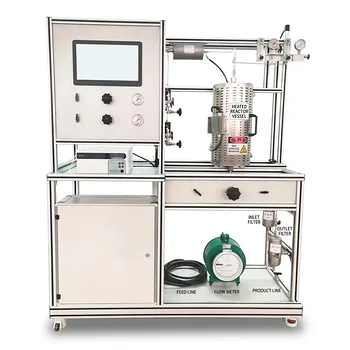
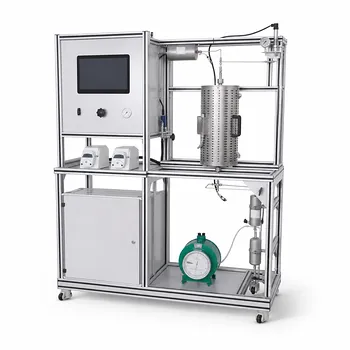
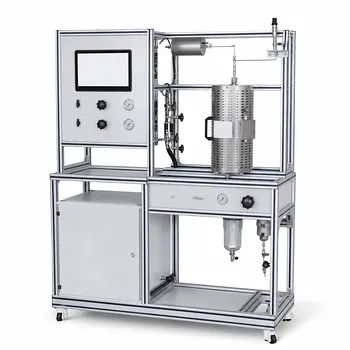
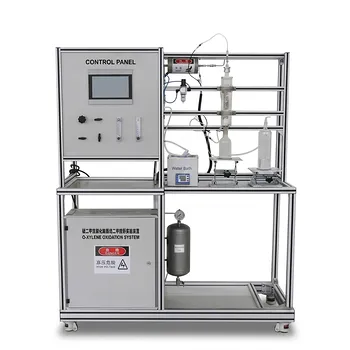
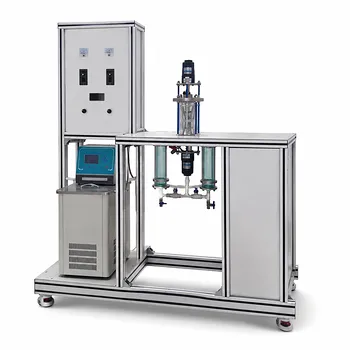
Without measuring effective radial thermal conductivity and the wall heat transfer coefficient, a pilot-scale fixed-bed reactor is just a black box — not a training tool. These two parameters quantify how heat escapes from the catalyst bed to the cooling wall, directly determining whether an exothermic reaction runs safely or spirals into thermal runaway. In educational pilot plants, students use radial and axial thermocouple arrays to calculate these values, map thermal gradients, and learn the heat-transfer principles that underpin every industrial reactor design.
In a fixed-bed catalytic reactor, the battle against temperature gradients is won or lost at the pellet-to-wall level. Measuring effective radial thermal conductivity (λ_er) and the bed-to-wall heat transfer coefficient (α_i) transforms a pilot plant from a simple reaction vessel into a predictive tool for safe scale‑up, catalyst protection, and process intensification.
Why Heat Transfer Governs Reactor Performance
The Danger of Uncontrolled Temperature Gradients
Exothermic reactions release heat faster than the bed can dissipate it if radial transport is poor. Hot spots form, accelerating reaction rates locally in a runaway feedback loop. The result can be thermal runaway, complete catalyst deactivation, or even mechanical failure of the reactor tube.
Conversely, endothermic reactions can quench near the cold wall, killing conversion. Measuring λ_er and α_i reveals whether the bed conducts enough heat laterally and whether the wall can accept it. Without these numbers, a pilot plant yields only outlet data — not the internal safety margins that define industrial viability.
The Two Critical Parameters for Thermal Analysis
A fixed‑bed reactor’s radial heat transfer is described by two lumped parameters. Effective radial thermal conductivity (λ_er) captures all mechanisms that move heat from the hot center toward the wall. It is not the simple conductivity of the solid catalyst; it combines a static contribution (particle‑to‑particle conduction, radiation across gas voids) and a dynamic contribution that grows with flow rate, often captured by the Peclet number.
The bed‑to‑wall heat transfer coefficient (α_i) quantifies the thermal resistance at the thin layer where the packed particles contact the tube wall. Even if the bed conducts heat perfectly, a poor wall coefficient — due to a stagnant gas film or particle‑wall contact resistance — will trap heat inside. Both λ_er and α_i are strongly influenced by the ratio of particle diameter to tube inner diameter (d_p/d_t), making them sensitive to the very geometric choices a process engineer controls.
How Pilot‑Scale Systems Enable Hands‑On Measurement
Training reactors are deliberately instrumented with multiple thermocouples along the radius and axis. By triggering a known exothermic reaction and recording the steady‑state temperature field, students can back‑calculate λ_er and α_i through a two‑dimensional heat balance.
For example, the radial temperature profile’s curvature at a given axial position is directly proportional to λ_er, while the sharp drop near the wall yields α_i. This concrete exercise connects textbook transport theory to a physical system, showing that a 1°C measurement error can shift the predicted hotspot temperature by tens of degrees at industrial scale.
Bridging Theory to Industrial Scale‑Up
From Lab Data to Reliable Design
An industrial reactor of the same length but ten times the diameter will not behave like the pilot unit if radial heat transfer is ignored. The pilot‑scale measurements of λ_er and α_i feed into two‑dimensional reactor models that predict whether the full‑scale bed will require segmented cooling, a different tube diameter, or a larger pellet size.
When a scale‑up fails, the root cause is often thermal. A well‑trained researcher who has mapped gradients on a pilot rig knows that doubling tube diameter can quadruple the time heat takes to reach the wall — and will demand the pilot data to validate the model before construction begins.
Teaching Transport Phenomena Through Experimentation
Beyond scale‑up, the educational value is immense. A student can change the catalyst particle size in the pilot plant and immediately see λ_er rise or fall. Adjusting the coolant flow rate alters α_i, visibly flattening or steepening the radial profile. These experiments embed core chemical engineering concepts — Reynolds‑number dependency, static vs. dynamic conduction, near‑wall flow maldistribution — in a way no lecture can replicate.
Such hands‑on learning trains an intuition for when a reactor is kinetically limited versus when it becomes heat‑transfer limited, a judgment that separates competent engineers from outstanding ones.
Common Pitfalls and Real‑World Limitations
The Measurement Challenge: Sensor Placement and Accuracy
Obtaining reliable values is harder than the theory suggests. Thermocouples disturb the packing, creating local bypass or artificial contact points. The wall temperature itself is often inferred from probe readings in the metal wall, introducing errors if the probe‑to‑wall contact is poor or if scale is present.
Even a tiny misalignment of the radial probe can place it in a void between pellets, capturing gas‑phase temperature rather than the solid‑phase temperature that drives λ_er. Students must learn that a beautifully smooth model curve often hides a shaky experimental foundation, and that sensitivity analysis is part of the training.
When Neglected Parameters Lead to Disguised Failure
A less obvious pitfall parallels the boiler‑scale problem: fouling at the tube wall creates a very low thermal conductivity layer — calcium‑based deposits can have conductivities 50 times lower than the steel tube. In a pilot plant, such scale acts as an extreme thermal insulator, artificially depressing α_i and masking the true performance of a clean‑wall design.
A researcher who does not distinguish between a foul‑limited α_i and the intrinsic packed‑bed coefficient risks scaling up to a clean industrial reactor that under‑removes heat, creating an entirely unexpected hotspot. Thus, measuring α_i critically includes learning to recognize and prevent wall fouling — or to account for it in the model.
Making the Right Choice for Your Training or Scale‑Up Goal
Your approach to these measurements should match your ultimate objective. Use the following guide to prioritize:
- If your primary focus is safe process scale‑up: Obtain λ_er and α_i under the exact flow conditions and d_p/d_t ratio of the target reactor, and validate the temperature predictions against at least two pilot‑scale axial positions.
- If your primary focus is deep educational learning: Deliberately vary particle size, tube diameter, and flow rate so students can measure how both parameters shift — this builds a lifelong intuition for heat‑transfer limitations.
- If your primary focus is process optimization and troubleshooting: Map the full radial temperature profile at multiple axial heights to locate incipient hot spots; monitor α_i over time to detect early wall fouling before it corrupts your data or your catalyst.
In every case, remember that the numbers you extract are not just homework — they are the single most reliable bridge between a gram‑scale catalyst test and a ton‑scale production reactor.
Summary Table:
| Parameter | Definition | Key Influencing Factors | Impact on Scale-Up & Safety |
|---|---|---|---|
| Effective Radial Thermal Conductivity ($\lambda_{er}$) | Combines static (radiation, conduction) and dynamic (flow-induced) lateral heat transport inside the bed. | Particle-to-tube diameter ratio ($d_p/d_t$), gas flow velocity (Peclet number). | Prevents localized hot spots and thermal runaway within the catalyst bed. |
| Bed-to-Wall Heat Transfer Coefficient ($\alpha_i$) | Quantifies thermal resistance at the boundary layer where catalyst particles contact the reactor wall. | Wall fouling, coolant flow rate, near-wall flow maldistribution. | Determines how effectively heat transfers out of the reactor to the cooling jacket. |
Optimize Your Chemical Engineering & Process Training with LABPARK
Bridge the gap between transport theory and industrial practice with precision-engineered equipment. LABPARK provides state-of-the-art Educational and Vocational Unit Operations Pilot Plants in chemical engineering, bioprocess & biotech, and environmental & water treatment.
Designed specifically for universities, research institutes, and enterprises, our pilot plants empower your students and researchers to:
- Conduct Accurate Heat Transfer Analysis: Measure radial thermal conductivity and bed-to-wall coefficients using high-accuracy thermocouple arrays.
- Prevent Scale-Up Failures: Validate 2D reactor models with reliable pilot data to ensure safe scale-up.
- Enhance Hands-On Learning: Help students visualize transport phenomena, fluid dynamics, and thermodynamics in real time.
Ready to elevate your laboratory’s training and research capabilities? Contact LABPARK today to request a quote or custom configuration!
Related Products
- Fixed Bed Gas Solid Catalytic Reaction Educational Pilot Plant
- Ethylbenzene Dehydrogenation Educational Unit Operations Pilot Plant
- Fixed-Bed Chemical Reaction and Gas Dust Tar Removal Unit Operations Pilot Plant
- Carbon Dioxide Hydrogenation Methanol Synthesis Educational Unit Operations Pilot Plant
- Multi-Reactor Educational Pilot Plant for Reaction Engineering Unit Operations
People Also Ask
- How do reactor pilot plants safely study gas-solid reactions? Master kinetics with thermal & flow control.
- How does the Mears criterion evaluate transport resistance? Key Guide to Intrinsic Kinetics
- Fluidized vs. Fixed Bed Reactors: Comparing Heat & Complexity in Pilot Plants
- Why is a multibed configuration necessary for exothermic reactions? Optimize your pilot plant trajectory.
- How is the friction factor determined for fixed-bed pilot plants? Select the best pressure drop correlation.