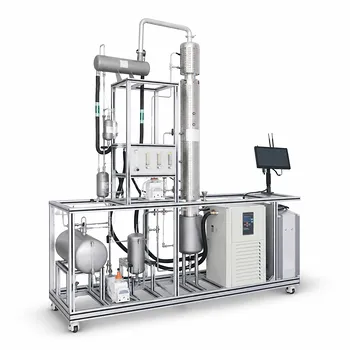
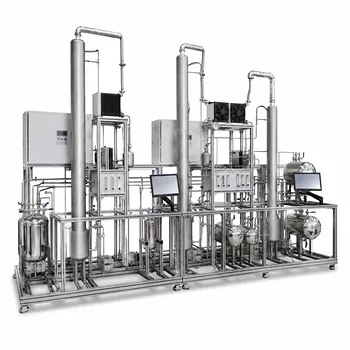
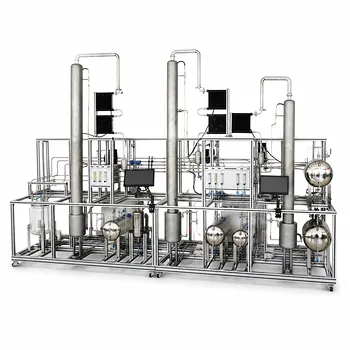
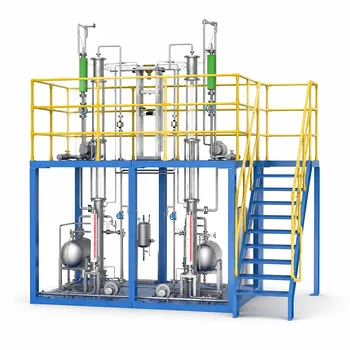
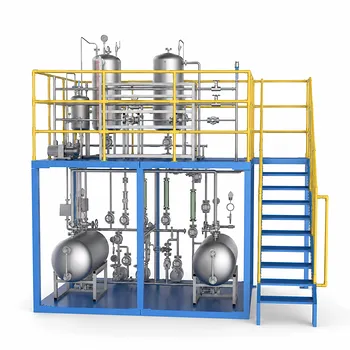
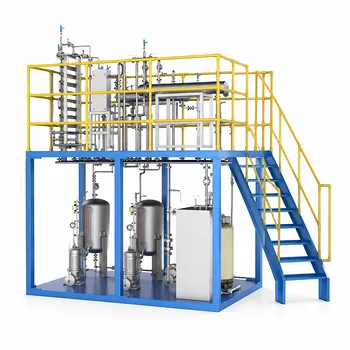
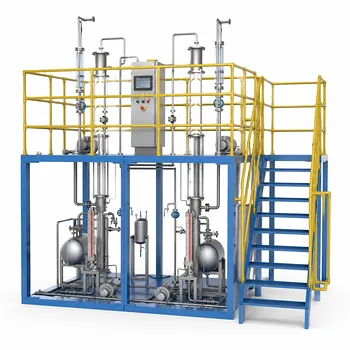
Your pilot plant distillation column is a black box without these measurements. Without monitoring a mixture's bubble point, dew point, and component vapor pressures, an operator is effectively flying blind, relying on guesswork rather than thermodynamic reality to achieve separation. These three properties are the fundamental targets that define the precise temperature and pressure boundaries required to create and sustain the two distinct phases—liquid and vapor—whose intimate contact makes distillation possible.
While often treated as abstract textbook concepts, bubble point, dew point, and vapor pressure are the immediate, practical control parameters for a pilot plant. They provide the definitive thermal and pressure targets needed to start a column safely, maintain stable mass transfer, and guarantee the product purity the pilot run was designed to demonstrate.
The Thermodynamic Foundation of Separation
Distillation is a phase-change operation. Its core mechanics depend on strategically manipulating temperature and pressure to force a liquid mixture into partial vaporization and then selectively condense that vapor.
The Critical Phase Boundaries
The process is bounded by two critical thermodynamic states. The bubble point is the exact condition—usually a temperature at a given pressure—where the first bubble of vapor forms from a liquid. This is the birthplace of the rising vapor phase that will carry more volatile components up the column. The dew point is its mirror image: the condition where the first drop of liquid condenses from a vapor. This marks the creation of the descending liquid reflux that washes down the less volatile components.
Vapor Pressure as the Driving Force
The driving force for every interaction between these phases is vapor pressure. This is the measure of a pure component's tendency to escape into the vapor phase at a given temperature. The difference in vapor pressure between components is their relative volatility, the physical property that makes separation possible. Controlling column conditions to exploit differences in vapor pressure is the very definition of distillation.
The Operational Imperative: From Theory to Control
In a pilot plant, you are not running a simulation. You have a physical system that can flood, degrade heat-sensitive products, or fail to separate chemicals. These thermodynamic measurements translate directly into control room decisions that determine the success or failure of a high-value experimental run.
1. Determining the Correct Energy Input in the Reboiler
The reboiler provides the energy for vaporization. To operate efficiently, you must know the bubble point temperature of the liquid bottom product at the column's base pressure. This calculation gives you the minimum startup temperature for the reboiler heating medium. Supplying insufficient energy fails to generate the necessary vapor flow. Supplying too much risks thermal degradation of the product or entering a dangerous transient state that can lead to premature flooding.
2. Setting a Stable Column Pressure Profile
The column's operating pressure is not an arbitrary setpoint; it is a strategic choice derived from component vapor pressures. For a given desired separation temperature, the bubble point pressure calculation defines the system pressure needed to initiate boiling. Conversely, if pressure is fixed, the vapor pressures dictate the temperature profile from bottom to top. Accurately calculating this relationship allows an operator to set a steady pressure profile, preventing the instability that leads to severe cycling, tray weeping, or entrainment flooding.
3. Guaranteeing the Overhead Condenser's Performance
The overhead vapor is the product of the separation. Its dew point calculation tells you the exact temperature at which you must operate the condenser to create an effective liquid seal and reflux. Set the condenser temperature too high, and you get incomplete condensation, losing valuable product out the vent. Set it too low, and you risk over-cooling, which can cause problematic subcooling of the reflux and shock the upper column stages. The dew point is the literal target for balancing product recovery and column stability.
4. Controlling the Feed Stage's Thermal Condition
The thermodynamic state of the feed—whether it's a subcooled liquid, a saturated liquid at its bubble point, or a two-phase mixture—disrupts the internal vapor and liquid traffic on the column tray where it enters. Measuring the bubble point of the feed at the column's pressure allows for precise control of the pre-heater. This ensures the feed enters in the exact thermal condition assumed in the column's design, preserving the established mass transfer equilibrium and preventing an operational upset.
Safety and Equipment Integrity: Avoiding Catastrophic Failure
The criticality of these measurements extends beyond product purity into fundamental process safety in a laboratory or pilot environment.
Preventing Overpressurization
Pilot plant columns are designed with specific pressure limits. The relationship between a boiling liquid and its vapor pressure is exponential with temperature. A loss of cooling in the condenser or an uncontrolled heating ramp in the reboiler can quickly lead to a pressure surge. By continuously referencing bubble point and vapor pressure data, operators can set hard safety limits on heating duties and define the maximum safe operating temperature for a cooling failure scenario, preventing a rupture disk failure or a vessel overpressure event.
Defining the Limits of Separation
Vapor-liquid equilibrium has a critical endpoint. Certain high-pressure separations must operate well below the mixture's critical point. If operators push the system into a supercritical region without this knowledge, the phase boundary disappears entirely. There is no longer a distinction between liquid and vapor, all mass transfer ceases, and the column becomes a pressurized mixer rather than a separator. Measuring and understanding vapor pressure trends is the only way to map and avoid this operational dead zone.
Understanding the Trade-offs and Pitfalls
A reliance on theoretical calculations without empirical verification introduces a separate set of risks that a skilled pilot plant operator must navigate.
The Ideal Solution Assumption Trap
Many streamlined calculations assume ideal liquid and vapor behavior, where component interactions are negligible. While common low-pressure hydrocarbon separations may mimic ideal solutions well, many pilot plants are built precisely because the mixture’s behavior is unknown or highly non-ideal. Blindly trusting an ideal bubble point calculation for a system with strong hydrogen bonding can yield a startup temperature that is dangerously wrong, leading to a failure to vaporize or a sudden and violent geyser of vapor upon heating. Direct measurement is the only check against this error.
Sensor Location vs. True Composition
A measurement is only as good as its context. A bottom-temperature probe can read exactly the calculated bubble point for the pure bottoms product, but this reading is meaningless if the sample port is in a stagnant zone. The operator must always ask if the physical measurement location reflects the true stage composition. The art of pilot plant operation lies in using thermodynamic targets to interrogate the physical reality, correlating the calculated bubble point with the observed tray temperature to diagnose a deviation before it ruins the campaign.
Making the Right Choice for Your Pilot Plant Goal
Your focus dictates where to place your greatest analytical rigor. These are not uniform priorities; they shift with the objective of your pilot run.
- If your primary focus is scaling up a process: Prioritize direct measurement of dew point and composition at the top of the column. This data confirms you can produce a specification-grade overhead product, which is the most critical proof point for process licensors and the key economic validation for scale-up.
- If your primary focus is process safety and thermal limits: Prioritize the relationship between bubble point and vapor pressure for the bottom mixture. This defines the minimum safe operating pressure and the maximum allowable reboiler temperature to avoid initiating a decomposition reaction with an unknown runaway pressure potential.
- If your primary focus is validating a thermodynamic model: Force deviations between measurement and prediction. Operate the pilot plant at conditions where the calculated ideal bubble point and the measured incipient boiling temperature diverge, and then use this divergence data to fine-tune the activity coefficient parameters in a non-ideal property model.
- If your primary focus is training operators: Insist that every startup step references a target bubble or dew point condition. The lesson is not in hitting the number, but in learning to use these phase-boundary concepts as the fundamental language to diagnose why a column that was running perfectly just began to flood without warning.
A distillation pilot plant is an instrument for asking thermodynamic questions. The measurement of bubble point, dew point, and vapor pressure is how you read the answers.
Summary Table:
| Property | Thermodynamic Definition | Operational Role in Pilot Plants |
|---|---|---|
| Bubble Point | Temp/pressure where first vapor bubble forms | Sets reboiler startup temp & feed pre-heater control |
| Dew Point | Temp/pressure where first liquid drop condenses | Dictates overhead condenser temp to prevent subcooling |
| Vapor Pressure | Measure of pure component's volatility | Defines pressure profile & prevents supercritical operation |
Elevate Your Chemical Engineering Lab with LABPARK
Achieving precise separation in distillation columns requires highly accurate thermodynamic control. LABPARK offers premium Educational and Vocational Unit Operations Pilot Plants tailored for chemical engineering, bioprocess & biotech, and environmental & water treatment. We empower universities, research institutes, and enterprises with robust, safe, and industry-aligned training systems.
Take the guesswork out of your unit operations—contact us today to find the perfect pilot plant solution for your institution!
Related Products
- Continuous Sieve-Plate Distillation Pilot Plant for Unit Operations Laboratory Education
- Multi-Modal Distillation Unit Operations Training Pilot Plant
- Green Anhydrous Ethanol Purification Extractive Distillation Unit Operations Training Pilot Plant
- Dual-Mode Rectification Pilot Plant for Practical Training Unit Operations
- Ethyl Acetate Synthesis Unit Operations Pilot Plant for Practical Training
People Also Ask
- Why is vacuum operation capability an essential feature for a distillation unit operations pilot plant? Unlock Efficiency
- What are the primary reflux ratio control strategies? Master Distillation Unit Operations
- How does catalyst water concentration affect distillation pilot plant design? Key separation train choices.
- How can real-time carbon number prediction improve distillation pilot plants? Optimize control.
- How to select the right activity coefficient model (Wilson, NRTL, UNIQUAC) for distillation pilot plants?