Knowledge Chemical Engineering Education Why Integrate Separation in Microfluidic Synthesis? Achieve Continuous Success
Author avatar

Tech Team · LABPARK

Updated 1 month ago

Why Integrate Separation in Microfluidic Synthesis? Achieve Continuous Success


Executing a chemical reaction in a microreactor is a solved engineering challenge; executing three in a row without intermediate purification is a recipe for failure. The integration of separation unit operations is not merely an optional accessory but a fundamental prerequisite for advancing multi-step continuous synthesis. Without such integration, unreacted starting materials, catalysts, and side products from an initial step freely cascade into the next, where they quench reactivity, poison catalysts, and render the final yield negligible.

The advancement of laboratory-scale continuous synthesis is less a problem of mixing and more a problem of purification. The core challenge lies in seamlessly bridging the gap between discrete reaction stages. Integrating micro-scale separation is the only viable path to transform a series of efficient single reactions into a genuinely telescoped process capable of producing a pure target molecule without manual intervention.

The Fundamental Bottleneck of Multi-Step Microfluidic Synthesis

The physical constraints of a microreactor fundamentally punish the lack of purification. While batch chemists can perform manual work-ups between steps, a continuous system collapses without automated, inline separation to manage the evolving complexity of the reaction mixture.

The Unseen Menace of Side Products and Quenching

When the effluent from a first step directly mixes with the reagent for a second step, unquenched catalysts or reactive byproducts can trigger instantaneous decomposition. They destroy the downstream reagents before the desired transformation even has a chance to occur. This creates a cascade of decomposition rather than a cascade of synthesis, generating useless tar instead of the target intermediate.

Catalyst Poisoning and Clogging Risks

Many synthetic routes rely on precious metal catalysts that are exceptionally sensitive to poisoning. Ligands or coordinating solvents from an upstream reaction can permanently deactivate a downstream packed-bed catalyst, halting the chemical process entirely. Moreover, insoluble salts or oligomeric byproducts generated early in the sequence will nucleate and aggregate in the microchannels, causing catastrophic clogging that is nearly impossible to clear from the confined geometry.

The Microfluidic Toolkit for Continuous Purification

To solve these bottlenecks, researchers exploit the unique physical laws that dominate at the micro-scale. This relies on surfaces and interfaces rather than gravity, allowing for the miniaturization of classic separation unit operations.

Exploiting Capillary Forces for Gas-Liquid Separation

Microreactors possess extremely high surface-area-to-volume ratios, causing surface forces to dominate over body forces. Engineers can exploit these capillary forces to separate gas bubbles from liquid streams passively, without needing bulky gravity settlers. This allows for the continuous removal of gaseous byproducts like nitrogen or carbon dioxide generated in a previous step, which would otherwise compress, disrupt flow stability, and alter precise residence times in downstream reactors.

Membrane-Based Separation for Reactive Shifting

The integration of selective solid membranes—such as microfabricated palladium—enables product removal at the point of generation. This concept, vital to process intensification research, allows you to continuously pull a product like hydrogen from a reaction stream, shifting equilibrium-limited reactions to near-complete conversion without raising temperature or pressure. This modularity allows for a "plug-and-play" architecture where a purification membrane is physically sandwiched between two reaction stages, mimicking the logic of a full-scale chemical plant.

Understanding the Trade-offs

While integration is crucial, it introduces a new layer of complexity that must be managed objectively. The physical act of connecting purification units is not without significant engineering costs.

The Complexity Tax and Residence Time Mismatch

Introducing separation units adds fluidic complexity, leak points, and dead volumes to the system. A high-yield extraction step might require a residence time of 5 minutes, while an adjacent reaction step completes in 30 seconds. This creates a massive flow bottleneck that can completely negate the inherent speed advantage of the microreactor unless the flow paths are carefully balanced.

Material Compatibility and Fouling Challenges

Microfluidic separation techniques often rely on specific membrane polymers or channel surface treatments. Aggressive organic solvents or highly reactive intermediates can swell these membranes or strip away surface coatings, leading to chemical incompatibility and mechanical failure. Furthermore, systems that mitigate clogging through controlled precipitation are difficult to maintain long-term, as micron-scale fouling demands absolute precision over nucleation kinetics.

Making the Right Choice for Your Goal

The necessity of integration is universal, but the execution strategy must align perfectly with your primary objective. The decision to use a membrane, an extraction chip, or a passive capillary separator dictates the success of the entire synthesis.

  • If your primary focus is exploratory synthesis discovery: Prioritize reconfigurability and speed. Use robust, solvent-resistant liquid-liquid extraction chips that you can quickly swap between steps, accepting a slightly impure intermediate stream if it means testing more conditions per hour without clogging.
  • If your primary focus is maximizing yield for a specific high-value target: Invest in the bespoke design of a membrane separator. You must tolerate a higher complexity tax and slower flow rates to remove the thermodynamic or inhibitory bottleneck with absolute precision, enabling total conversion.
  • If your primary focus is scaling up to pilot production: Design your separation unit to operate at higher flow rates and Reynolds numbers. Ensure your chosen technology does not rely solely on weak capillary forces that vanish as channel dimensions increase; pivot toward robust, density-driven or membrane-based systems that scale predictably.

Integrating separation is not just an improvement to the microreactor—it is the definitive evolutionary step that elevates it from a simple reaction chip to a truly continuous chemical manufacturing plant.

Summary Table:

Separation Technique Key Mechanism Primary Application Benefit
Capillary Separator Exploits high surface-area-to-volume ratio Continuous, passive gas-liquid removal
Membrane Separator Selective solid-state permeation Shifts reaction equilibrium and prevents poisoning
Extraction Chip Liquid-liquid phase extraction Flexible, reconfigurable setup for reaction discovery

Elevate Your Chemical Engineering Programs with LABPARK

To master complex processes like continuous synthesis and micro-scale separations, hands-on training is essential. LABPARK provides premium Educational and Vocational Unit Operations Pilot Plants in chemical engineering, bioprocess & biotech, and environmental & water treatment.

Tailored for universities, research institutes, and enterprises, our advanced pilot plants help students and researchers transition from theory to real-world industrial application.

Ready to upgrade your laboratory capabilities? Contact us today to discuss your equipment needs and receive a tailored solution!

Related Products

People Also Ask

Related Products

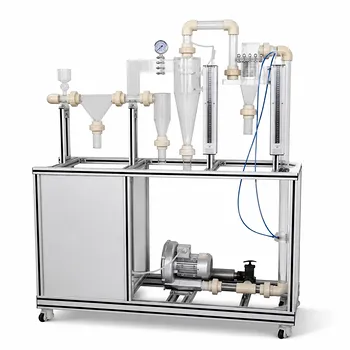
Gas-Solid Heterogeneous Separation Demonstration Educational Unit Operations Pilot Plant

Gas-Solid Heterogeneous Separation Demonstration Educational Unit Operations Pilot Plant

Comprehensive visual transparent gas-solid separation pilot plant for chemical engineering labs. Demonstrates gravity settling inertial settling cyclone and bag filter technologies. Enables real-time analysis of fluid-particle mechanics pressure drop and collection efficiency. Ideal for undergraduate unit operations courses.

Photocatalytic Membrane Separation and Degradation Unit Operations Pilot Plant

Photocatalytic Membrane Separation and Degradation Unit Operations Pilot Plant

Bench-scale pilot plant integrating photocatalytic degradation with membrane separation for engineering education. Study advanced oxidation, microfiltration, and hybrid processes using industrial sensors. Features safety light-blocking curtain, low-noise compressor, and durable stainless-steel construction.

Multi-Functional Membrane Separation Educational Pilot Plant for Unit Operations Lab

Multi-Functional Membrane Separation Educational Pilot Plant for Unit Operations Lab

The Multi-functional Membrane Separation Educational Unit Operations Pilot Plant is an integrated bench-scale laboratory system designed for teaching undergraduate engineering education. It features Ultrafiltration, Nanofiltration, and Reverse Osmosis modules in a compact, mobile unit for practical hands-on learning.

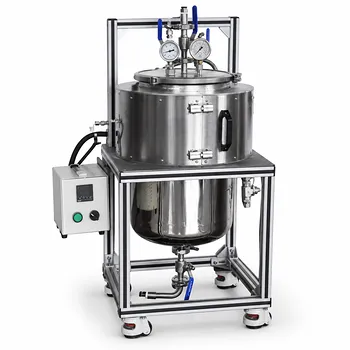
Hot Filtration Educational Unit Operations Pilot Plant Laboratory System

Hot Filtration Educational Unit Operations Pilot Plant Laboratory System

This integrated laboratory bench-scale hot filtration pilot plant enables students to study solid-liquid separation under thermal conditions, featuring a stainless steel vessel, removable heating jacket, and multi-layer filter plates for unit operations education, ideal for chemical engineering laboratory curriculum.

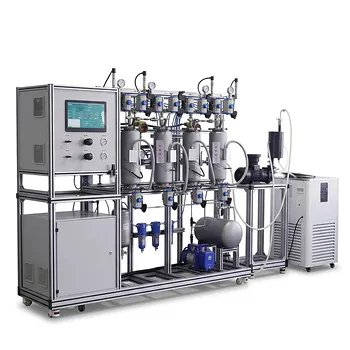
Multi-Component Gas Pressure Swing Adsorption Pilot Plant for Unit Operations Education

Multi-Component Gas Pressure Swing Adsorption Pilot Plant for Unit Operations Education

Multi-component gas pressure swing adsorption pilot plant designed for unit operations education. Features four-tower configuration, IoT touchscreen control, dual regeneration, and real-time breakthrough curve analysis for engineering training with safety interlocks and mobile frame simulates industrial PSA processes.

Bio-fermentation Ethanol Production Practical Training Unit Operations Pilot Plant

Bio-fermentation Ethanol Production Practical Training Unit Operations Pilot Plant

Bio-fermentation ethanol production pilot plant for hands-on training in unit operations: fermentation, solid-liquid filtration, membrane separation, and distillation. Bridges theory with industrial practice using industrial-grade components, customizable for university labs. Hybrid automated and manual control for comprehensive learning.

Bench Scale Dual Column Gas Separation and Capture Educational Pilot Plant

Bench Scale Dual Column Gas Separation and Capture Educational Pilot Plant

This dual-column educational pilot plant provides hands-on teaching of gas adsorption, separation, and capture processes. It features stainless steel columns, regeneration up to 400°C, and a 15.6-inch touchscreen PLC for TSA and PSA studies in chemical engineering curricula, process simulation.

Multifunctional Membrane Separation Educational Pilot Plant with Ultrafiltration, Nanofiltration, Reverse Osmosis

Multifunctional Membrane Separation Educational Pilot Plant with Ultrafiltration, Nanofiltration, Reverse Osmosis

An integrated laboratory bench-scale membrane separation system for higher education engineering labs combining Ultrafiltration, Nanofiltration, and Reverse Osmosis processes. Features industrial PLC control with touch-screen HMI, transparent piping, and academic assessment software. Ideal for chemical and environmental engineering curricula.

Carbon Material Thermal Pretreatment Multiphase Separation Educational Pilot Plant

Carbon Material Thermal Pretreatment Multiphase Separation Educational Pilot Plant

Educational pilot plant for carbon material thermal pretreatment and multiphase separation. Features jacketed agitated reactor, separation column, and modern controls for hands-on unit operations training in heat transfer, fluid flow, and process safety with industrial-grade materials and wireless data acquisition.

Ultrafiltration Membrane Separation Educational Pilot Plant

Ultrafiltration Membrane Separation Educational Pilot Plant

This ultrafiltration membrane separation educational pilot plant enables undergraduate students to process PVA solutions, study hollow fiber membrane dynamics, and perform quantitative analysis with spectrophotometry for hands-on learning of unit operations and industrial maintenance and membrane cleaning protocols.

Dual-Mode Gas Absorption and Desorption Unit Operations Training Pilot Plant

Dual-Mode Gas Absorption and Desorption Unit Operations Training Pilot Plant

Industrial-scale pilot plant for gas absorption and desorption training in chemical engineering. Features dual-mode operation with real and simulated materials, transparent columns for flow visualization, and customizable design. Supports independent or combined loops for hands-on unit operations experiments.

Continuous Sieve-Plate Distillation Pilot Plant for Unit Operations Laboratory Education

Continuous Sieve-Plate Distillation Pilot Plant for Unit Operations Laboratory Education

Integrated pilot-scale teaching system for continuous sieve-plate distillation studies. Visual demonstration of tray hydraulics, flexible feed positions, and automatic reflux control for hands-on unit operations education in engineering labs. Designed for higher education engineering laboratories.

Multi-Modal Distillation Unit Operations Training Pilot Plant

Multi-Modal Distillation Unit Operations Training Pilot Plant

Multi-modal distillation pilot plant for practical unit operations training in chemical engineering education. Features real, analog, and semi-physical simulation modes, industrial construction, customizable for university labs. Hands-on fractionation columns, SCADA control, safety systems. Includes sight glasses, sampling ports, closed-loop recycling.

Natural Product Extraction Unit Operations Training Pilot Plant

Natural Product Extraction Unit Operations Training Pilot Plant

Integrated natural product extraction pilot plant for chemical engineering training bridges theory and industrial practice with modular extraction and evaporation/concentration units, hybrid touchscreen and manual control, realistic process simulation, and self-contained softened water and vacuum utilities.

Supercritical High-Gravity Flash Evaporation Educational Unit Operations Pilot Plant

Supercritical High-Gravity Flash Evaporation Educational Unit Operations Pilot Plant

Bench-scale integrated teaching system for advanced separation and mass transfer, combining supercritical high-gravity flash evaporation with heating, chemical reaction, and material collection, featuring modular design, Stainless Steel 316L construction, transparent visualization, touchscreen control, and safety systems for chemical engineering education.

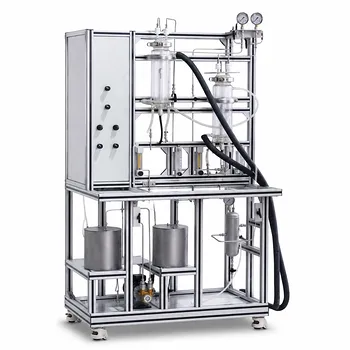
Solid Waste Pyrolysis and Refining Educational Pilot Plant for Unit Operations

Solid Waste Pyrolysis and Refining Educational Pilot Plant for Unit Operations

This pilot plant for solid waste pyrolysis and refining integrates pyrolysis, separation, distillation, and catalytic hydrogenation into one educational unit. It provides visual process observation, smart data logging, and industrial safety for hands-on learning of engineering unit operations.

Constant Pressure Filtration Educational Unit Operations Pilot Plant

Constant Pressure Filtration Educational Unit Operations Pilot Plant

Hands-on educational pilot plant for constant pressure filtration. Classic plate and frame filter press allows students to study kinetics, determine specific cake resistance, perform cake washing and evaluate washing rates. Ideal for chemical engineering curriculum. Mobile, customizable, safety-compliant design.

Multi-Reactor Educational Pilot Plant for Reaction Engineering Unit Operations

Multi-Reactor Educational Pilot Plant for Reaction Engineering Unit Operations

Integrated bench-scale educational pilot plant for chemical engineering teaching featuring fixed bed fluidized bed and stirred tank reactors with web-based digital twin controls and safety interlocks for hands-on unit operations and reaction engineering comparative studies in one compact system.

Rising and Falling Film Evaporation Educational Unit Operations Pilot Plant

Rising and Falling Film Evaporation Educational Unit Operations Pilot Plant

Hands-on educational pilot plant for studying rising and falling film evaporation, flow regimes, and heat transfer. Customizable for university labs with industrial instrumentation and data acquisition. Enables comparative evaluation of evaporation modes and energy efficiency.

Two-Dimensional Fluidization Hydrodynamics Educational Pilot Plant for Unit Operations Training

Two-Dimensional Fluidization Hydrodynamics Educational Pilot Plant for Unit Operations Training

Explore gas-solid and liquid-solid fluidization hydrodynamics with our transparent 2D educational pilot plant. Ideal for chemical engineering unit operations labs, it demonstrates fixed to fluidized bed regimes, measures pressure drop, and integrates QR-code digital learning for enhanced student training.


Leave Your Message