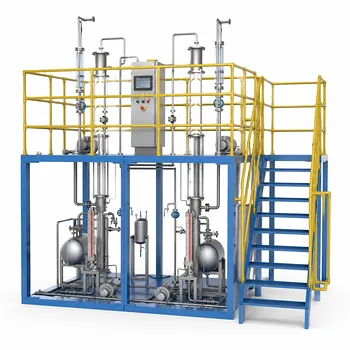
In the shift toward Industry 4.0, sensor-driven automation and real-time monitoring turn a membrane filtration pilot plant from a static piece of equipment into an intelligent, responsive system. These technologies are critical because they provide instantaneous feedback on parameters like transmembrane pressure and permeate flux, enabling the plant to automatically adjust backwashing intervals, cross-flow velocity, and other operational setpoints to maintain peak performance. Without this integration, users rely on delayed manual sampling and can neither replicate modern smart manufacturing nor truly understand the dynamic fouling and separation behaviors that define real industrial processes.
The true value of sensor-driven automation is that it closes the gap between academic theory and industrial practice. It transforms membrane pilot plants into platforms that not only teach core separation principles but also embed the real-time data acquisition, process control logic, and energy conservation strategies demanded by today’s bioprocess and chemical industries.
From Manual Observation to Intelligent Process Control
Why Traditional Monitoring Falls Short
Membrane filtration is a dynamic process where feed quality, flow rate, and fouling conditions change constantly. Relying on periodic grab samples and off-line analysis (like HPLC) creates measurement delays that prevent immediate intervention.
By the time data is available, the membrane may have already experienced a significant flux decline or irreversible fouling layer. This lag makes it impossible to practice the rapid decision-making required in continuous, high-efficiency industrial operations.
The Sensor-Driven Advantage: A Real-Time Control Loop
Integrating in-line sensors for temperature, pressure, flow, and even turbidity creates a digital feedback loop. The system reads these signals continuously and, through a PLC or SCADA platform, can instantaneously adjust operating parameters.
For example, if transmembrane pressure rises sharply due to fouling, the automation can automatically trigger a backwash or increase cross-flow velocity to scrub the membrane surface. This proactive response prevents damage, sustains permeate quality, and minimizes energy consumption—exactly what modern “smart” factories demand.
Training the Next-Generation Workforce for Digital Operations
Hands-On with Industry-Grade SCADA and PLC
Automated pilot plants introduce students and researchers to the same digital control systems used in full-scale plants. They practice converting raw sensor signals (mA, V) into engineering units (kPa, m³/h), configuring alarms, and developing control logic.
This experience is vital for troubleshooting process deviations, performing accurate mass and energy balances, and managing data in a structured, auditable way. It builds the digital fluency that employers need in chemical, biopharmaceutical, and water treatment industries.
Data Acquisition and Process Optimization
Real-time data logging allows for deep, evidence-based learning. Users can visualize how flux declines over time, correlate it with transmembrane pressure trends, and then test the impact of different cleaning protocols or membrane materials immediately.
The ability to capture and analyze high-resolution data transforms a simple separation exercise into a rigorous investigation of process intensification, selectivity, and long-term operational cost. This is the foundation for scaling up processes with confidence.
Cutting Waste and Preventing Catastrophic Failure
Dynamic Adjustment of Backwashing and Cross-Flow
Membrane fouling is not a linear event; it accelerates if left unchecked. Sensor-driven automation detects the early signs of pore blocking and adjusts backwashing frequency or duration precisely when needed, rather than on a fixed timer.
Simultaneously, it can modulate cross-flow velocity to balance shear rate and energy consumption. This keeps the operation near its most efficient point, reducing both chemical cleaning frequency and water usage—key sustainability goals for any modern process.
Preventing Irreversible Membrane Damage
Polymers membranes are sensitive to pressure spikes, excessive temperature, and extreme pH. Real-time monitoring acts as a safeguard: if a pump cavitates or a valve fails, the system can detect the abnormal pressure or flow condition and immediately initiate a safe shutdown or bypass.
This protects expensive membrane modules from mechanical damage or chemical attack, dramatically extending their lifespan in a pilot environment where modules are often reused for multiple experimental runs.
Navigating the True Complexities: Trade-offs and Hidden Challenges
The Limitations That Automation Cannot Erase
Even the most advanced sensor network must work within the physical constraints of the membrane material. Polymeric membranes, for instance, still swell or degrade when exposed to strong organic solvents or harsh cleaning agents, regardless of how quickly a system detects it.
Automation can alert you to a chemical compatibility issue, but it cannot change the inherent resistance of the material. For applications involving aromatic or alicyclic separations, you still need to select alternative membranes like ceramic or metal ones.
The Fouling Prediction Gap and Sensor Drift
Sensors themselves are imperfect. Flow meters can drift, pressure transducers can lose calibration, and fouling is a complex, multi-mechanism process that is hard to predict solely from bulk parameters like transmembrane pressure. A sudden spike in pressure might be due to a true fouling event or a temporary air lock.
Relying blindly on automation without understanding sensor validation and fault detection can lead to false triggers—wasting backwash water or, worse, ignoring a real problem. True proficiency means teaching the logic behind the automation, not just pushing buttons.
The Cost of Intelligence and Complexity
Integrating full-scale PLC/SCADA systems, flow transmitters, and turbidity sensors into a pilot plant increases capital cost and maintenance burden. A clogged sensor or a loose signal cable can halt a training session.
However, this mirrors real plant reality. The educational and research payoff—in terms of workforce readiness and insightful, high-resolution data—far outweighs the initial complexity, provided the curriculum includes sensor troubleshooting and basic maintenance.
Making the Right Choice for Your Pilot Plant Goal
Your decision to integrate sensor-driven automation should be guided by what you need the pilot plant to teach or prove. Use the following goals to calibrate your setup.
- If your primary focus is education and workforce development: Prioritize a full PLC/SCADA interface with industrial-grade sensors for pressure, flow, and temperature. The learning objective is to master real-time process control, data logging, and troubleshooting in a realistic plant environment.
- If your primary focus is research into fouling and membrane longevity: Invest in high-accuracy, research-grade sensors (e.g., zeta potential or optical fouling monitors) and data acquisition capable of capturing rapid transients. The automation should allow you to run precisely repeatable cleaning protocols to isolate material science variables.
- If your primary focus is process intensification and sustainability: Select a system that allows you to measure and dynamically control energy consumption and waste streams. Real-time monitoring of permeate flow vs. energy input lets you directly demonstrate how advanced membranes and smart controls create a smaller environmental footprint.
Sensor-driven automation is not an upgrade—it is the only way to build a membrane pilot plant that is intellectually honest, industrially relevant, and truly capable of solving tomorrow’s separation challenges.
Summary Table:
| Feature | Traditional Manual Monitoring | Sensor-Driven Automation |
|---|---|---|
| Data Frequency | Periodic grab samples (delayed) | Continuous, high-resolution real-time logging |
| Control Loop | Manual adjustments (reactive) | Automated PLC/SCADA control loop (proactive) |
| Fouling Mitigation | Late detection, fixed-timer cleaning | Early detection, dynamic auto-backwash adjustment |
| Equipment Safety | High risk of membrane damage from spikes | Automatic shutdown and bypass safety trips |
Elevate Your Training & Research with LABPARK Smart Pilot Plants
Bridge the gap between academic theory and smart industrial practice. LABPARK provides state-of-the-art Educational and Vocational Unit Operations Pilot Plants in chemical engineering, bioprocess & biotech, and environmental & water treatment for universities, research institutes, and enterprises.
Equipped with advanced sensor-driven automation and industrial-grade SCADA/PLC interfaces, our systems prepare students and researchers for modern, digitized industrial workflows.
Contact LABPARK today to discover how we can customize a pilot plant solution to fit your exact educational or research goals!
Related Products
- Ultrafiltration Membrane Separation Educational Pilot Plant
- Multi-Functional Membrane Separation Educational Pilot Plant for Unit Operations Lab
- Multifunctional Membrane Separation Educational Pilot Plant with Ultrafiltration, Nanofiltration, Reverse Osmosis
- Hollow Fiber Ultrafiltration Membrane Separation Educational Pilot Plant
- Multi Functional Membrane Crystallization Educational Unit Operations Pilot Plant
People Also Ask
- Pervaporation vs. Vapor Permeation: Handling Suspended Solids in Membrane Pilot Plants
- How do PEI, PVDF, and PSU membranes compare in pilot plants? Find the best fit.
- How do membrane pilot plants demonstrate synthetic vs biological membrane advantages?
- Why Use a Membrane Separation Pilot Plant vs. Lab Testing? Avoid Costly Scale-Up Failures
- Isotropic vs. Anisotropic Membranes: How to Choose the Best Pilot Plant Modules