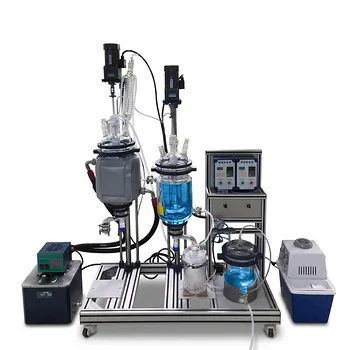
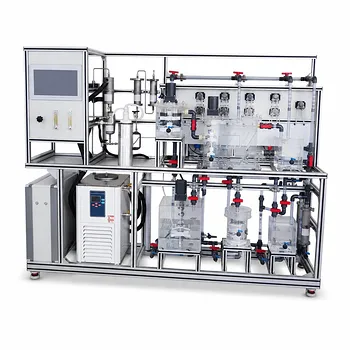
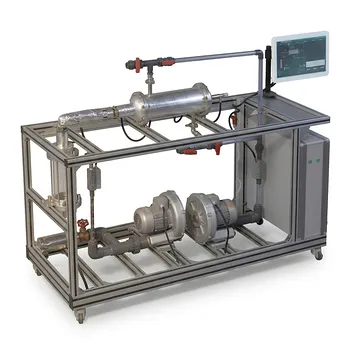
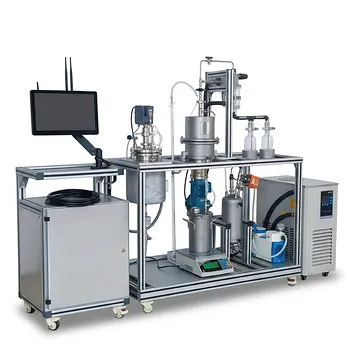
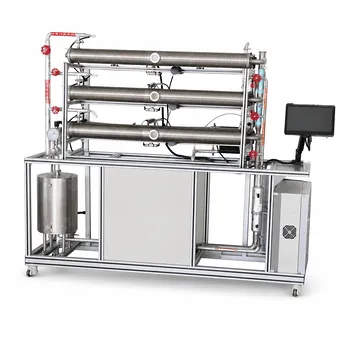
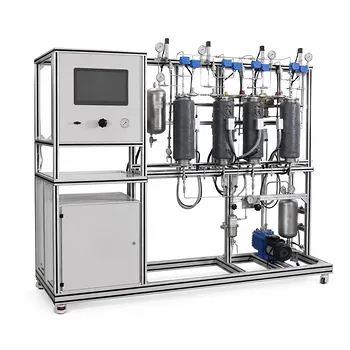
The cooling jacket is a non-negotiable component for teaching non-isothermal reactor behavior—it is the physical embodiment of the heat removal term in the energy balance, turning abstract differential equations into a tangible, measurable process. Without it, students would only see temperature and reaction rates climb uncontrollably toward thermal runaway, missing the entire purpose of studying dynamic stability and safe operation. In an educational CSTR pilot plant, the jacket directly links the mathematical model’s UA·ΔT term to a real piece of equipment, letting users manipulate coolant flow, observe the immediate thermal response, and connect theory to the industrial reality of heat management in continuous reactors.
At its core, the integration of a cooling jacket solves two intertwined problems in training: it demonstrates how heat removal prevents runaway in exothermic CSTRs, and it makes the modeling of temperature control—via the overall heat transfer coefficient, thermal capacitance, and dynamic energy balance—directly observable and experimentally testable. It transforms the perfectly mixed cooling jacket assumption from a textbook equation into a live, tunable system.
The Fundamental Need for Temperature Control in Exothermic Reactors
Exothermic reactions release energy, and in a continuous stirred tank without cooling, that energy accumulates rapidly. The reactor’s temperature and enthalpy soar unless heat is removed at a rate matching the heat generation. This leads learners directly to the core of process safety.
Why Uncontrolled Temperature Compromises Safety and Learning
Runaway is not just a theoretical concern. In a pilot plant, an unjacketed reactor would quickly demonstrate how kinetics (governed by the Arrhenius equation) amplify themselves: higher temperature accelerates the reaction, which produces more heat, which further raises the temperature. This feedback loop erases any possibility of studying steady-state conversion or control loop tuning because the system no longer has a stable operating point. The cooling jacket is what breaks that loop, creating the heat sink necessary for multiple steady states and dynamic experiments.
Temperature Sensitivity and Reaction Rate Accuracy
Reaction rate constants depend exponentially on temperature. Even small fluctuations drastically alter measured rates, making it impossible to extract accurate kinetic parameters like the activation energy. For educational setups—such as acid-catalyzed hydrolysis experiments—the jacket’s thermal stability ensures that students calculate rate constants under known, constant conditions, not under drifting temperature profiles that would render the data meaningless.
The Cooling Jacket as an Educational Tool for Dynamic Analysis
Beyond just preventing runaway, the jacket provides the primary sensorimotor feedback for learning non-isothermal reactor dynamics. Students don’t just read about a heat transfer equation; they see water flow, feel the temperature difference, and record the resulting reactor trajectory.
Bridging the Perfectly Mixed Assumption and Real Behavior
The mathematical model often treats the cooling jacket as perfectly mixed, assuming a uniform jacket temperature (Tⱼ). In a pilot plant, students can test this idealization by measuring the jacket’s inlet and outlet temperatures and comparing them to the assumed homogenous value. The hands-on discrepancy teaches thermal inertia, spatial gradients, and the limits of simplified modeling better than any simulation.
Linking the Energy Balance Term to a Physical Component
Every transient energy balance for a non-isothermal CSTR includes a term:
heat removed = U·A·(T − Tⱼ)
where U is the overall heat transfer coefficient and A is the heat transfer area. The cooling jacket is that term made physical. By adjusting coolant flow, students directly modify U (via the convective boundary layer) and observe the resulting change in reactor temperature. This turns a lumped parameter into an intuitive, tunable knob.
How the Jacket Integrates into Temperature Control Modeling
Understanding the jacket’s role requires dissecting how it fits into the differential equations that govern the reactor. The educational value lies in being able to validate those equations with real-time data.
The Heat Transfer Equation in Practice
The fundamental relationship Q = U·A·(T − Tⱼ) is the cornerstone of jacket modeling. In a pilot plant, students can measure temperatures, vary the cooling water flow rate, and calculate the effective U value under different operating conditions. This exercise directly validates the assumption that the cooling jacket behaves as a controllable heat sink, with U reflecting resistances from fouling, fluid velocity, and material conductivity.
Thermal Capacitance and System Stability
The liquid-filled jacket adds significant thermal capacitance to the system—water sitting in the annulus stores and releases energy, increasing the overall heat capacity of the reactor assembly. This shifts the dimensionless Lewis number (ratio of thermal to mass capacitance) to higher values. A higher Lewis number is known to stabilize exothermic reactors, suppressing oscillatory behavior and Hopf bifurcations. In an educational setting, students can remove the jacket water, reduce the thermal capacitance, and witness the system transition from a stable steady state into sustained temperature oscillations—a dramatic demonstration of how thermal inertia affects stability margins.
Distinguishing Idealized Models from Industrial Reality
Mathematically, assuming a perfectly mixed jacket simplifies the energy balance to a single lumped temperature. A pilot plant reveals that real jackets exhibit thermal lag, imperfect mixing, and heat losses to the environment. Students learn that the model’s UA term, while useful for control design, must be interpreted as a fitted parameter that encapsulates all these non-idealities. This prepares them for the gap they’ll encounter in industrial reactors, where rigorous modeling requires partitioned jacket zones or spatially distributed parameters.
Understanding the Trade-offs and Limits of Jacketed Cooling
The cooling jacket is not a silver bullet. Pointing out its limitations builds credibility and equips learners with a complete picture of reactor cooling strategies.
When a Single Jacket Isn’t Enough
In highly exothermic pilot reactions, a single jacket may struggle to remove heat fast enough, leading to hotspots or a drifting temperature profile. Alternative methods—like internal cooling coils, external liquid recirculation through heat exchangers, or evaporative cooling via reflux condensers—become necessary. Evaporative cooling, for example, uses the latent heat of vaporization to achieve near-isothermal conditions at the boiling point, offering more uniform temperature control than sensible heat transfer through a jacket alone. Exposing students to these trade-offs using a pilot plant that can switch between cooling methods deepens their understanding of process intensification and safety design.
The Perfectly Mixed Jacket Assumption Simplicity Trap
While convenient for teaching, the perfectly mixed assumption can mislead students about achievable control performance. Real jackets exhibit dead zones and temperature gradients that cause the measured outlet temperature to differ from the effective mixed temperature. Without explicitly testing this assumption, learners might over-trust model predictions, creating hazards when scaling up. The pilot plant allows that controlled disillusionment in a safe environment.
Making the Right Choice for Your Educational Goal
How you integrate the cooling jacket into a CSTR pilot plant exercise depends on what you aim to teach. Use the following guidelines to shape your curriculum.
- If your primary focus is understanding reactor stability and dynamics: Fill the jacket with water to increase thermal capacitance, run the reactor near an instability boundary, and let students observe how the higher Lewis number suppresses oscillations. Then drain the jacket and repeat to demonstrate the bifurcation.
- If your primary focus is process safety and thermal runaway prevention: Vary the coolant flow rate in steps and have students calculate the instantaneous heat removal using Q = U·A·(T − Tⱼ), plotting it against the heat generated by the reaction. Show them where the balance breaks and runaway begins.
- If your primary focus is modeling and control loop design: Use the jacket to deduce the overall heat transfer coefficient under different flow conditions, then compare experimental dynamic responses to those predicted by the perfectly mixed jacket model. Highlight the discrepancies to introduce advanced modeling concepts.
- If your primary focus is bridging theory and industrial practice: Connect the pilot plant jacket to discussions of commercial reactor cooling options—coils, reflux condensers—and explain when a jacket alone suffices and when a more complex system is justified.
The cooling jacket’s true value in education is not simply that it cools; it is that it makes the invisible dynamics of heat transfer visible, measurable, and experimentally accessible. Use it to move students from abstract energy balances to the confident, practical intuition they need to design and operate real chemical reactors safely.
Summary Table:
| Educational Focus | Jacket Operation | Key Learning Outcome |
|---|---|---|
| Reactor Stability | Adjust water volume / capacitance | Observe thermal inertia and stability margins (suppressing oscillations) |
| Runaway Prevention | Step-change coolant flow rate | Balance heat generation vs. removal ($Q = UA\Delta T$) to prevent runaway |
| Control Modeling | Measure dynamic thermal response | Validate idealized models against real-world thermal lags and losses |
Bring textbook equations to life in your laboratory. LABPARK provides high-quality Educational and Vocational Unit Operations Pilot Plants in chemical engineering, bioprocess & biotech, and environmental & water treatment.
Designed specifically for universities, research institutes, and enterprises, our pilot plants feature robust jacketed CSTR configurations with precise temperature control modeling capabilities. Help your students master thermal dynamics and process safety with hands-on training equipment.
Contact LABPARK today to customize your pilot plant solution!
Related Products
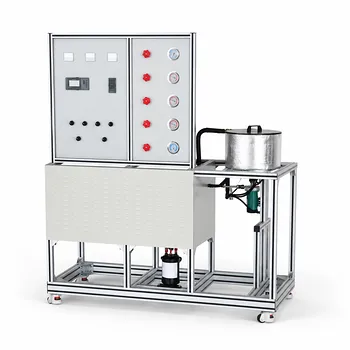
- Educational Compression Refrigeration Performance Determination Unit Operations Pilot Plant
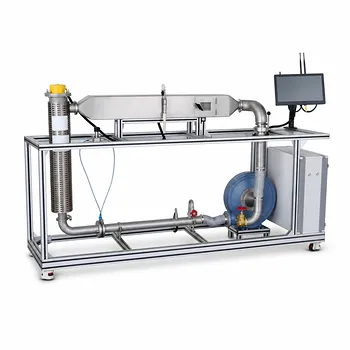
- Circulating Wind Tunnel Drying and Convective Heat Transfer Coefficient Determination Educational Pilot Plant
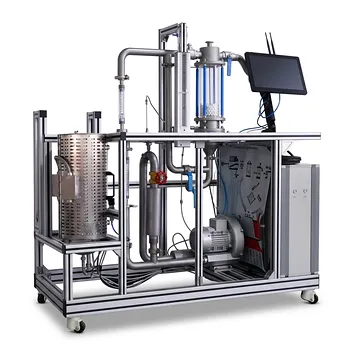
- Carbon Material Thermal Pretreatment Multiphase Separation Educational Pilot Plant
- Multi-Stage Stirred Tanks in Series Residence Time Distribution and Mixing Performance Determination Educational Pilot Plant
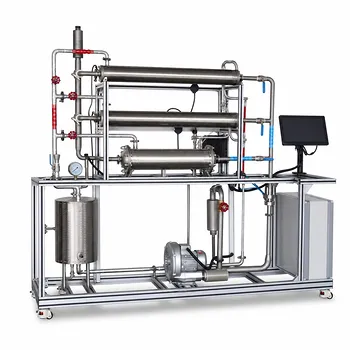
- Comprehensive Heat Transfer Coefficient Determination Educational Unit Operations Pilot Plant
People Also Ask
- Why Switch Unit Operations Flow Configurations? Impact on Experimental Measurements
- Why is distinguishing between elastic and plastic deformation critical? Prevent tablet capping.
- How is unsteady-state flow analyzed & taught? Master Transient Systems in Unit Ops
- What are the differences between set-point, servo, and program control? Master unit operations training.
- How to use pilot plants to estimate gas compression costs? Master scale-up economics.