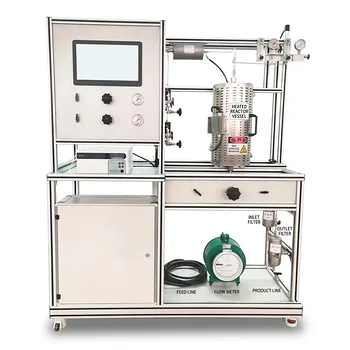
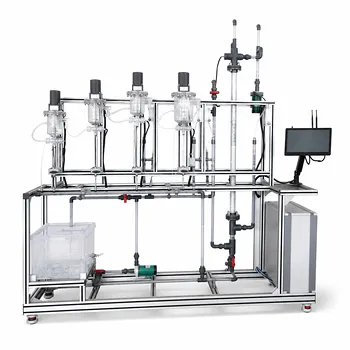
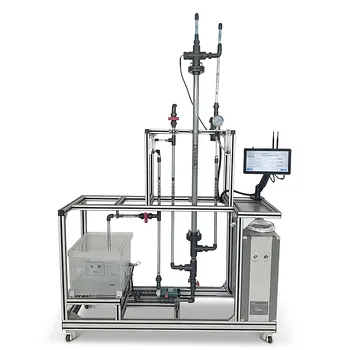
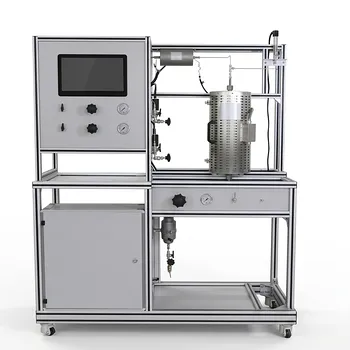
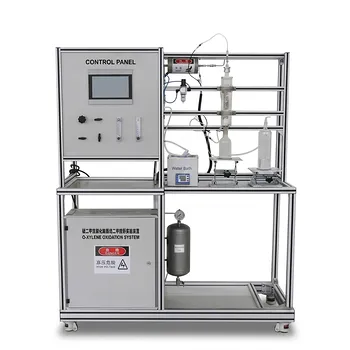
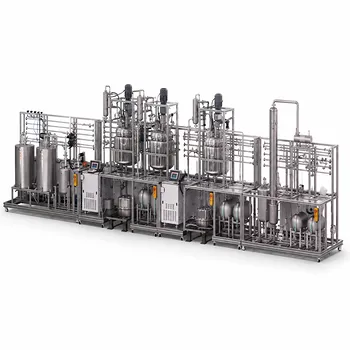
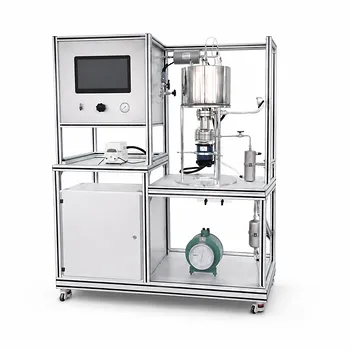
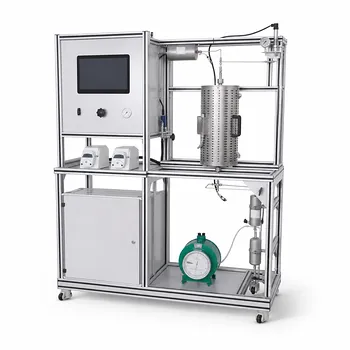
The short answer is that it’s the only direct lever you have to control local concentrations, and in a parallel reaction, the ratio of those concentrations dictates which product pathway wins.
Feeding methods like semi-batch addition or side-stream injection are the physical knobs that let a pilot plant operator impose a favorable concentration environment on the chemistry. By choosing how and when a reagent enters the reactor, you can deliberately starve a reaction that leads to waste and feed the one that creates value.
The core problem is that parallel reactions are a kinetic competition. A pilot plant’s flexible feeding strategy is not just a convenience—it’s the primary tool to demonstrate that high selectivity is achievable outside a textbook, by actively maintaining concentration conditions that favor the desired reaction over the undesired one.
The Fundamental Link Between Feeding and Selectivity
Understanding this link starts by viewing selectivity as a rate race.
The Arithmetic of Reaction Order
In a parallel system, Reactant A transforms into your desired product, R, and an undesired waste product, S. If the reaction to S has a higher order dependence on A (for example, if the waste reaction is second-order in A, while the desired reaction is first-order), the waste pathway will accelerate dramatically faster than the desired pathway as the concentration of A increases.
A pilot plant demonstrates this brutally. A single batch reactor, where all A is charged upfront, naturally creates an environment with a high initial concentration of A. This inherently selects for the higher-order waste reaction, tanking your yield. The feeding mechanism exists to override this natural tendency.
Concentration as a Selectivity Switch
By shifting to a semi-batch strategy, you change the game. Adding A slowly means its instantaneous concentration in the reactor remains near zero. The desired, first-order-in-A reaction can still proceed, but the second-order-in-A waste reaction is suppressed because it needs a high frequency of A-A collisions that no longer exists.
This is the deep need of your question: to prove that selectivity is not just a chemical property but a consequence of a dynamic environmental condition you can engineer.
Translating Theory into Pilot Plant Operations
The pilot plant's value is in showing how to physically create these ideal concentration gradients.
Starving a Reactant with Semi-Batch Operation
The primary reference highlights the most intuitive case: keeping a low concentration of A to maximize selectivity. In a stirred pilot vessel, this means configuring the system as a semi-batch reactor where a primary reactant B is already in the vessel, and A is fed gradually.
This direct manipulation demonstrates that yield is not a fixed outcome but a variable you can control by shifting the feeding schedule. The visual of the feed pump’s speed directly correlating with the product distribution curve is the experiment’s ultimate takeaway.
Spatial Gradients with Side-Stream Feeding
A Plug Flow Reactor (PFR) achieves the same goal through space rather than time. Using segmented side-stream feeding inlets along the reactor's length transforms a simple pipe into a surgical tool for concentration control.
Instead of overwhelming the reactor entrance with a slug of Reactant A, you divide it into multiple injections. This keeps the local concentration of A low at every point along the reactor’s axis, systematically suppressing the higher-order waste reaction across the entire reaction profile. This configuration proves the concept for continuous, large-scale manufacturing.
The Critical "How": Injection Point Design
Simply dripping a reagent into a vessel fails the demonstration. The supplementary references provide a crucial operational detail that separates a successful experiment from a misleading one. If you add a reactant by letting it run down the wall or pool on the liquid surface, you create a localized "hot spot" of high concentration.
In that micro-environment, the waste reaction runs away before the agitator can dilute the feed. The correct configuration is to inject the reagent via a delivery or dip tube directly into the high-shear zone of the impeller. This instantly blasts the fresh feed into a fine dispersion, achieving the ideal "zero local concentration" state on a molecular level and guaranteeing the measured selectivity is genuine.
Understanding the Trade-offs in Reactor Selection
An objective advisor must also highlight when these feeding strategies become insufficient or create new problems.
The Backmixing Trap in Semi-Batch
A continuous stirred-tank, even if semi-batch during startup, often leads to a continuous mode with high backmixing. This is disastrous not necessarily for parallel reactions, but for series reactions ($A \rightarrow R \rightarrow S$). If your desired product R is an intermediate, backmixing ensures some of it re-enters the reaction zone, has a long residence time, and reacts away to waste, S.
Therefore, demonstrating high selectivity for an intermediate demands a configuration that defeats backmixing, like a spray tower or a PFR with precise side-feeding, rather than a generic semi-batch stirred tank.
Practical Limitations of Excess Feeding
While pilot feeding systems let you demonstrate the effect of a stoichiometric excess of a reactant, this strategy has a clear production penalty. Feeding excess, unreacted raw material to push selectivity must be balanced against the energy and capital cost of separating and recycling that material downstream. The pilot plant teaches that the highest selectivity does not always equal the most economical process.
Making the Right Choice for Your Goal
Your specific demonstration goal dictates the feeding configuration you should select.
- If your primary focus is maximizing selectivity when the product is the end point: Prioritize a semi-batch stirred tank with precise dip-tube injection into the impeller’s shear zone to starve the side reaction kinetically.
- If your primary focus is achieving high selectivity for a fragile intermediate product: Abandon the stirred tank and select a continuous PFR with segmented side-stream feeding to eliminate backmixing and strictly control residence time.
- If your primary focus is screening a catalyst for a highly exothermic parallel reaction: The configuration must integrate side-stream or gradual feeding with advanced heat transfer to prevent temperature-driven thermal runaway from destroying both selectivity and the catalyst itself.
The pilot plant's feeding configuration is where the molecular reality of parallel kinetic competition meets the physical hardware of chemical manufacturing. Mastering it means moving from simply hoping for the right reaction to actively engineering it.
Summary Table:
| Feeding Method | Mechanism of Action | Best Used For |
|---|---|---|
| Semi-Batch Feeding | Keeps instantaneous reactant concentration near zero | Suppressing higher-order waste reactions in batch systems |
| Side-Stream Feeding | Segmented injections along a Plug Flow Reactor (PFR) | Maintaining low concentrations continuously across PFR length |
| Dip-Tube Injection | Direct feed into impeller high-shear zone | Eliminating localized concentration hot spots and bypassing runaways |
Scale Up Your Chemical Engineering Training with LABPARK
At LABPARK, we empower universities, research institutes, and enterprises with high-performance Educational and Vocational Unit Operations Pilot Plants. Our systems span chemical engineering, bioprocess & biotech, and environmental & water treatment, allowing you to easily demonstrate complex feeding strategies, control parallel reaction selectivity, and prepare students or researchers for real-world industrial challenges.
Need to customize a pilot plant reactor for your lab? Contact our technical experts today to find the perfect fit for your curriculum or research goals.
Related Products
- Fixed Bed Gas Solid Catalytic Reaction Educational Pilot Plant
- Multi-Reactor Educational Pilot Plant for Reaction Engineering Unit Operations
- Residence Time Distribution and Reactor Flow Characteristics Determination Educational Pilot Plant
- Fixed-Bed Chemical Reaction and Gas Dust Tar Removal Unit Operations Pilot Plant
- Tubular Reactor Flow Characteristics Determination Educational Unit Operations Pilot Plant
People Also Ask
- How do reactor pilot plants safely study gas-solid reactions? Master kinetics with thermal & flow control.
- How does the Mears criterion evaluate transport resistance? Key Guide to Intrinsic Kinetics
- Fluidized vs. Fixed Bed Reactors: Comparing Heat & Complexity in Pilot Plants
- Why is a multibed configuration necessary for exothermic reactions? Optimize your pilot plant trajectory.
- How is the friction factor determined for fixed-bed pilot plants? Select the best pressure drop correlation.