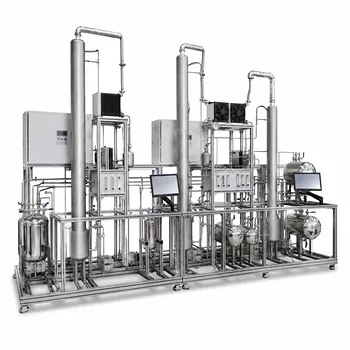
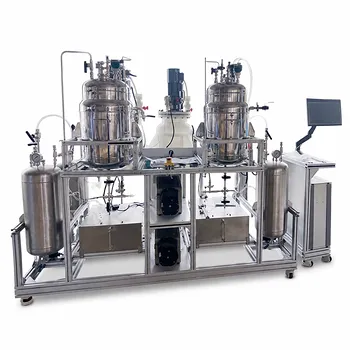
At its core, reflux transforms a basic boiling flask into a precision separation tool.
Returning a portion of the condensed overhead liquid back down the column is the defining operational step that turns simple distillation into rectification. In educational pilot plants, this is achieved through a reflux control system—typically a reflux splitter or a timed solenoid valve at the condenser outlet—that lets students adjust the reflux ratio ($R = L/D$) and immediately see its effect on both the slope of the operating line and the final distillate purity.
Simple distillation is a single‑stage, transient process that rapidly loses efficiency as the volatile component depletes. Reflux control introduces the counter‑current liquid flow necessary for repeated heat‑ and mass‑transfer on each tray, enabling the high‑purity separation that defines rectification. An educational pilot plant makes this invisible principle visible by letting students vary $R$ and trace the direct connection between a simple valve adjustment and the distillate’s composition.
The Fundamental Difference Between Simple Distillation and Rectification
A Tale of Two Processes
In a simple distillation setup, vapor rises from the still, enters the condenser, and the entire condensate is collected as product.
There is no intentional liquid returning to the column, so the vapor‑liquid contact is limited to a single equilibrium stage.
This is a transient process: as the lighter component is boiled off, the still composition continuously shifts, and the distillate purity drops.
You get one “shot” at separation, and the maximum enrichment is capped by the vapor‑liquid equilibrium at that moment.
Rectification: Reflux Creates Multiple Stages
Rectification—fractional distillation—starts with the same evaporation step but adds a crucial twist.
A portion of the condensed overhead liquid is deliberately returned to the top of the column as reflux.
That descending liquid wets the trays or packing, contacting the rising vapor.
Each tray now becomes a tiny equilibrium stage where heat and mass transfer occur: vapor gives up energy to vaporize more light components from the falling liquid, while the liquid absorbs heavy components from the vapor.
The result is a cascade of purification steps stacked on top of each other.
With enough reflux and enough stages, you can separate components whose boiling points differ by only a few degrees—something simple distillation can never achieve.
Why Reflux is Critical for High‑Purity Separation
The Counter‑Current Engine
Reflux establishes the counter‑current liquid flow that is the heart of every mass‑transfer column.
Vapor flows upward by buoyancy; liquid flows downward by gravity. The interface between these two phases is where separation happens.
Without reflux, there is no organized liquid phase inside the column—only vapor that passes through once.
The internal traffic of descending liquid dramatically increases the residence time and contact area, giving components many more opportunities to migrate between phases.
More Reflux, More Opportunities for Purification
Every time a molecule of the lighter component moves from liquid to vapor, it moves one tray higher.
Every time a heavier molecule condenses into the liquid, it drops one tray lower.
The more liquid you send back down (i.e., the higher the reflux ratio), the greater the driving force for this physical sorting.
On a McCabe‑Thiele diagram, increasing $R$ steepens the rectifying operating line ($\text{slope} = R/(R+1)$), which moves the line farther from the equilibrium curve and reduces the number of theoretical plates required for a given purity.
Thus, reflux is not just a convenience—it is the primary lever you have to control separation purity once the column hardware is fixed.
How Educational Pilot Plants Implement Reflux Control
Reflux Splitters and Timed Valves
An educational distillation pilot plant must turn the abstract concept of “returning some liquid” into a tangible, adjustable parameter.
The most common implementation is a reflux splitter mounted just below the condenser: a pivoting funnel or flap that divides the total condensate into two streams—one returning to the column (reflux, $L$) and the other going to product collection (distillate, $D$).
The split is often controlled by a timed solenoid valve or a motorized diverter.
For example, an electronic timer cycles a magnetic valve every few seconds; the fraction of time the valve is in the “reflux” position directly sets the reflux ratio.
This setup allows the reflux ratio to be dialed in precisely—from $R = 0$ (total take‑off, mimicking simple distillation) to total reflux ($R = \infty$, where all condensate returns and no product is withdrawn).
Modes of Operation: Two Teaching Paradigms
Educational plants typically demonstrate two fundamental control strategies:
-
Constant Reflux Ratio Mode
The splitter is fixed at a set ratio, and the system is allowed to run. As the volatile component in the still depletes, the distillate composition ($x_D$) steadily drops. This mode is ideal for teaching basic mass‑balance and McCabe‑Thiele graphical analysis, because the operating lines remain fixed and the process evolution follows a simple Rayleigh‑type curve. -
Constant Distillate Composition Mode
To keep $x_D$ steady, the reflux ratio must be continuously increased as the still composition falls—manually or through an automated control loop. This mode introduces students to process control, automation, and the non‑steady‑state nature of batch distillation, forcing them to grapple with the final, most difficult separation moment when the still is nearly pure in the heavy component.
Both modes give hands‑on experience that bridges the gap between textbook equations and real‑time column behavior.
Teaching the Difference Through Hands‑On Experimentation
From Simple to Fractional in the Same Frame
A well‑designed pilot plant can be operated like a simple still or a full rectification column with the flick of a switch.
Setting the reflux splitter to $R = 0$ yields a single‑stage, “simple distillation” mode; students can collect samples over time and watch the distillate purity plummet.
Then, switching to $R = 3$ or $5$ transforms the same column into a multi‑stage rectification tool.
The difference in product purity is immediately measurable with a refractometer or gas chromatograph, making the abstract concept of “theoretical stages” a physical reality.
Visualizing the McCabe‑Thiele Diagram
The pilot plant becomes a living McCabe‑Thiele diagram.
When students change the reflux ratio, they alter the slope of the rectifying operating line. They can then sample the liquid on different trays (if sampling ports are available) and map the actual concentration profile, directly comparing it to the staircase construction they drew on paper.
Under total reflux, the operating lines collapse onto the diagonal ($y = x$).
This is the condition for determining the minimum number of theoretical stages ($N_{\text{min}}$) using the Fenske equation. By operating the column at total reflux with a known test mixture, students can calculate $N_{\text{min}}$ and then benchmark the column’s tray or packing efficiency—a powerful capstone experiment.
Energy Balance and the Cost of Purity
Flow meters on the reflux, distillate, and cooling water lines, along with an adjustable reboiler heater, turn the plant into an energy‑balance laboratory.
Students quickly discover that raising $R$ means boiling more liquid in the reboiler and condensing more vapor at the top—both of which cost energy.
By logging heat input, cooling water temperature rise, and distillate purity at different reflux ratios, they identify an economic trade‑off between operating cost and separation performance, a lesson that sticks far better than a lecture slide.
Understanding the Trade‑offs
The Energy‑Stages Pendulum
The primary sacrifice for higher purity is energy.
A higher reflux ratio increases the vapor load ($V = L + D$), demanding more heating duty in the reboiler and more cooling water at the condenser. For a fixed column diameter, this pushes the column closer to flooding.
Conversely, lowering $R$ saves energy but then requires more theoretical stages to reach the same purity—implying a taller column or the same column operated harder.
Students must weigh capital cost (column height) against operating cost (energy) in a way that mirrors real industrial decisions.
Operational Complexity in Constant‑Composition Mode
Maintaining constant $x_D$ while the still changes forces the reflux ratio to climb over time.
At the start of the batch, the still is rich in the light component, so a modest $R$ suffices. By the end, the still is lean, and a much higher $R$ is needed to maintain purity.
This mode requires either diligent manual valve adjustments or an automated control system that senses distillate composition.
It introduces students to the practical challenges of process dynamics, sensor lag, and controller tuning, which go beyond simple steady‑state design.
The Limits of Pilot‑Plant Scale
An educational column’s diameter and tray spacing are typically small, meaning flooding and weeping limits differ from industrial towers.
The same reflux ratio may produce different hydraulic behavior. Students must learn to scale experimental data appropriately, recognizing that pilot‑plant results demonstrate principles, not exact blueprint numbers for a factory.
How to Leverage a Distillation Pilot Plant for Deep Learning
Your educational goals will determine which experiments to run first.
- If your primary focus is grasping the difference between simple distillation and rectification: Start with a zero‑reflux run to measure the single‑stage purity curve, then repeat with a moderate reflux ratio and observe the dramatic purity jump. This single A‑B comparison anchors all subsequent theory.
- If your primary focus is mastering McCabe‑Thiele construction: Operate at several constant reflux ratios, record the distillate and bottoms compositions, and plot your own operating lines. Confirm that changing $R$ pivots the slope exactly as the equation predicts.
- If your primary focus is understanding energy efficiency: Run the column at total reflux to find $N_{\text{min}}$, then perform a series of experiments where you trade off $R$ against stage requirement, while measuring heat and cooling loads. Plot the energy‑purity trade‑off curve.
- If your primary focus is process control: Implement constant‑distillate‑composition mode and manually adjust the reflux valve; note how the required $R$ increases with time. Then let an automated PID loop take over and compare the stability and overshoot.
The true power of an educational pilot plant is that it turns a black‑box unit operation into a transparent system where every valve turn, temperature reading, and composition sample tells a physical story.
Summary Table:
| Feature | Simple Distillation | Rectification (with Reflux) |
|---|---|---|
| Liquid Return (Reflux) | None ($R = 0$) | Controlled return ($R > 0$) |
| Separation Stages | Single equilibrium stage | Multiple theoretical stages |
| Product Purity | Declines rapidly as still depletes | High and customizable purity |
| Control Parameter | Heat input only | Reflux ratio ($R = L/D$) and heat |
| Teaching Value | Demonstrates transient behavior | Demonstrates McCabe-Thiele and dynamics |
Bring Chemical Engineering Theories to Life with LABPARK
Looking to enhance your hands-on training or academic curriculum? LABPARK provides state-of-the-art Educational and Vocational Unit Operations Pilot Plants in chemical engineering, bioprocess & biotech, and environmental & water treatment.
Tailored for universities, research institutes, and enterprises, our distillation pilot plants feature precise, adjustable reflux control systems that turn complex thermodynamic concepts into visual, measurable realities for your students and researchers.
Contact LABPARK today to upgrade your laboratory setup!
Related Products
- Continuous Sieve-Plate Distillation Pilot Plant for Unit Operations Laboratory Education
- Multi-Functional Special Distillation Educational Pilot Plant
- Continuous Batch Extractive Distillation Educational Pilot Plant
- Multi-Modal Distillation Unit Operations Training Pilot Plant
- Electrolyte Distillation Purification and Formulation Educational Pilot Plant
People Also Ask
- Why is vacuum operation capability an essential feature for a distillation unit operations pilot plant? Unlock Efficiency
- How does catalyst water concentration affect distillation pilot plant design? Key separation train choices.
- What are the primary reflux ratio control strategies? Master Distillation Unit Operations
- How to select the right activity coefficient model (Wilson, NRTL, UNIQUAC) for distillation pilot plants?
- How can real-time carbon number prediction improve distillation pilot plants? Optimize control.