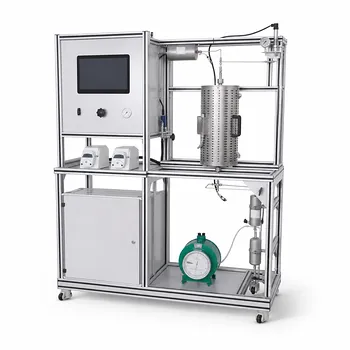
Your reaction data is only as trustworthy as your temperature control. When studying reaction kinetics in a chemical reactor pilot plant, precise thermal control is not a convenience—it is an absolute necessity. The exponential relationship between temperature and reaction rate means even a small fluctuation can invalidate a kinetic study. Without it, you cannot accurately determine activation energy, assess thermodynamic equilibrium shifts, or safely manage exothermic reaction hazards.
Understanding temperature's role in kinetics isn’t just about faster reactions. It’s about isolating a single variable to reveal the true kinetic fingerprint of a reaction. Precise thermal control in pilot plants is the gatekeeper that turns noisy, dangerous, and irreproducible experiments into clean, safe, and publishable data.
The Unforgiving Mathematics of Temperature Sensitivity
The need for precision begins with the exponential nature of the Arrhenius equation. A change of just a few degrees can double or halve the reaction rate, transforming your data from a clear straight line into a meaningless scatter.
How the Arrhenius Equation Magnifies Small Errors
The reaction rate constant (k) depends on temperature (T) through (k = Ae^{-E_a/RT}). The logarithmic form, (\lg k = A + B/T), shows that plotting (\lg k) against (1/T) should yield a straight line.
If the actual reactor temperature drifts by even 1°C during a run, the calculated (k) becomes tainted. When you later plot results from multiple runs, the supposedly constant-temperature points no longer lie on a perfect line. You lose the linearity needed to extract a reliable activation energy.
The Data Integrity Chain: From Sensor to Slope
Your pilot plant’s thermocouple might report a stable 60.0°C, but if the bulk fluid is only 58.5°C because of poor heat transfer, your measured rate constant doesn’t correspond to 60.0°C. Each imprecise point pulls the slope of (\lg k) vs. (1/T) away from the true value, corrupting the calculated (E_a).
This is why supplementary references stress the need to thermally equilibrate reactants in a constant-temperature bath before mixing. An initial temperature drop of even 2°C in the first seconds of reaction can shift the entire apparent rate profile. The pilot plant must maintain not just a setpoint but a uniform, bulk temperature throughout the liquid volume.
Beyond Kinetics: The Thermodynamic Trap
Kinetic measurements aren’t the only victim. Equilibrium constants are also highly temperature-dependent, which can silently mislead you if you think you’re studying kinetics under a fixed driving force.
How Temperature Wander Moves the Equilibrium Target
For a system where both forward and reverse reactions are significant, the equilibrium constant (K) can swing dramatically. The supplementary references note a jump from 0.36 at 373 K to 3.2 at 423 K for a nitrogen dioxide dissociation. If your temperature control is loose, you’re not just changing rates—you’re dynamically shifting the thermodynamic endpoint.
This is particularly dangerous when measuring apparent reaction rates near equilibrium. A minor temperature drop can make a forward reaction suddenly look slower, not because of a kinetic barrier, but because the equilibrium conversion has changed. Precise control lets you separate these effects and calculate standard Gibbs free energy changes ((\Delta G^\circ)) with confidence.
When the Reaction Fights Back: Exothermicity and Runaway
Precision is not only about data quality; it’s about safety and experimental viability. Many industrially relevant reactions release heat, and without tight control, they can self-accelerate into thermal runaway.
The Self-Heating Feedback Loop
Consider hydrogen peroxide decomposition or a persulfate-iodide reaction. These exothermic systems produce heat that, if not removed instantly, raises the local temperature. That temperature rise increases the rate, which produces more heat, and so on. The result is an unreproducible rate spike—or a sudden pressure surge that triggers a safety interlock.
Pilot plants counter this with responsive heating/cooling jackets and PID controllers. They maintain near-isothermal operation even when the reaction is trying to generate a thermal wave. The primary reference explicitly links this control to studying thermal runaway parameters, giving users a safe sandbox to explore dangerous operating regimes before scaling up.
The Timing Error Problem in Fast Reactions
When a reaction is too fast, simple human timing fails. The supplementary references describe high-temperature persulfate-iodide reactions that finish before you can take a sample. By precisely holding a lower, uniform temperature, the pilot plant slows the reaction into a measurable window without altering the fundamental kinetic pathway. You’re not just cooling things down—you’re designing a measurable experiment.
How Pilot Plant Design Delivers the Necessary Precision
Achieving this level of control requires an integrated system, not just a heater with a thermostat. The primary reference highlights three critical components.
The Thermal Cascade: Jacket, Fluid, and Thermowell
A temperature-controlled jacket surrounds the reactor, circulating a heating or cooling fluid. The jacket’s large surface area ensures even heat transfer. Inside the reactor, a thermowell protects a precision sensor that measures the true liquid temperature, not just an exterior wall temperature. This sensor feeds a PID controller that adjusts jacket fluid temperature dynamically, compensating for exothermic heat release or endothermic heat demand in real time.
Intelligent Gradients: Multi-Step Reaction Control
In multi-step processes like fuel processing, different stages have conflicting thermal needs. Steam reforming wants high heat input, while water-gas shift requires a falling temperature gradient to balance kinetics and thermodynamics. A pilot plant with zoned temperature control and rapid-response heaters can create these precise profiles, demonstrating how industrial reactors optimize yield and catalyst lifetime. Students see firsthand that a single setpoint isn’t enough—you need a programmable thermal path.
Understanding the Trade-offs and Pitfalls
No control strategy is free of compromise. Recognizing these limitations will prevent you from misinterpreting seemingly stable data.
The Cost of Uniformity: Mixing and Sensor Lag
Even with a perfect jacket, a poorly mixed reactor can have hot or cold spots. The temperature at the thermowell might not represent the average. Achieving uniform thermal conditions often requires aggressive agitation, which can shear sensitive catalysts or introduce unwanted aeration. You trade ultimate temperature uniformity for potential physical interference.
Control System Battles: PID Tuning and Oscillation
An over-tuned PID controller can overshoot and oscillate, creating temperature cycles around the setpoint. These regular fluctuations may average to the right value but still corrupt kinetic measurements because the rate responds nonlinearly to each swing. The supplementary references emphasize stability, not just accuracy, as the key requirement.
Pre-Equilibration vs. Reaction Timing
Thoroughly pre-warming reactants to the reactor temperature avoids an initial cold plunge, but it adds handling time. For reactions that begin at the moment of mixing, you might need to inject a pre-heated catalyst slug. Every delay or thermal mismatch introduces a systematic error that precision jackets alone cannot fix.
Making the Right Choice for Your Goal
Your experimental priorities will dictate how you balance these thermal control demands.
- If your primary focus is determining activation energy: Insist on a pilot plant with high-accuracy sensors and the ability to hold a constant temperature to within ±0.1°C across multiple runs. Pre-equilibrate all reactants and validate the linearity of your (\lg k) vs. (1/T) plot.
- If your primary focus is studying thermodynamic equilibrium: Prioritize temperature stability over speed. Allow longer soak times at each setpoint to confirm the equilibrium constant has truly stabilized before sampling.
- If your primary focus is safety and scale-up for exothermic reactions: Use a reactor with a fast-response cooling jacket and a well-tuned PID controller. Run temperature-programmed experiments that deliberately approach, but do not cross, the runaway threshold to map safe operating limits.
Precision is not an academic luxury—it is the foundation that gives your kinetic data the authority to guide industrial decisions.
Summary Table:
| Key Focus | Impact of Temperature Fluctuation | Pilot Plant Solution |
|---|---|---|
| Reaction Kinetics | Distorts Arrhenius plots; invalidates activation energy ($E_a$) | Precision sensors, uniform bulk fluid mixing |
| Thermodynamics | Shifts equilibrium constants ($K$), misrepresenting rates | High-stability, isothermal PID temperature control |
| Process Safety | Triggers self-accelerating thermal runaway reactions | Fast-response cooling jackets & zoned thermal control |
Ensure absolute precision in your kinetic studies with LABPARK. We provide advanced Educational and Vocational Unit Operations Pilot Plants in chemical engineering, bioprocess & biotech, and environmental & water treatment. Tailored for universities, research institutes, and enterprises, our systems deliver the thermal stability needed for clean, reproducible data and safe process scale-up.
Contact LABPARK today to discuss your laboratory or training requirements!
Related Products
- Fixed-Bed Chemical Reaction and Gas Dust Tar Removal Unit Operations Pilot Plant
- Fixed Bed Gas Solid Catalytic Reaction Educational Pilot Plant
- Multi-Reactor Educational Pilot Plant for Reaction Engineering Unit Operations
- Residence Time Distribution and Reactor Flow Characteristics Determination Educational Pilot Plant
- Tubular Reactor Flow Characteristics Determination Educational Unit Operations Pilot Plant
People Also Ask
- When to transition from PID to adaptive control in pilot plants? Key process indicators.
- How do deviations in estimating latent heat impact pilot plant thermal systems? Avoid hardware mis-sizing.
- Why Compare Predicted and Experimental Excess Enthalpy? Key to Accurate Pilot Plant Scale-up
- How to study gasification in pilot plants? Compare exit gas composition & efficiency
- Why Use PTFE & Hastelloy in Chemical Pilot Plants? Prevent Corrosion & Ensure Safety