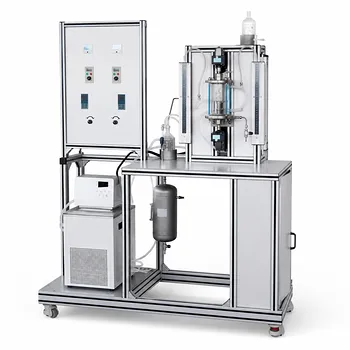
The classroom equation works flawlessly on the whiteboard. Yet in the real world, purification columns do not behave like idealized textbooks—integrating pilot plants for liquid chromatography and mass transfer ensures graduates can translate diffusion theories into reliable, scalable separation processes.
These pilot-scale systems give students direct, hands-on exposure to the very unit operations that dominate biopharmaceutical production, fine chemical synthesis, and biotechnology manufacturing. By operating actual columns, analyzing elution curves, and physically measuring parameters like pressure drop and retention time, students move beyond memorizing Fick’s laws to developing the intuition needed to design, troubleshoot, and optimize real separation cascades. This experiential bridge makes the difference between a student who knows the formula and an engineer who can safely deliver a commercial product to specification.
While academic courses excel at teaching transport equations and thermodynamic equilibrium, only pilot plant training converts that knowledge into the practical judgment required for industrial purification—closing the critical gap between calculated results and process reality.
The Core Skill Gap in Modern Engineering Education
The Limits of a Purely Theoretical Foundation
Chemical engineering curricula rightly emphasize fundamentals: heat transfer, mass transfer kinetics, thermodynamics, and reactor design. But too often, separation processes like chromatography are reduced to solving packed-bed column models or plotting van Deemter curves on paper.
Without physically operating equipment, students never experience how column packing heterogeneity creates flow maldistribution. They never feel the impact of a small temperature fluctuation on retention time reproducibility. These subtleties—essential for batch-to-batch consistency in GMP environments—remain invisible in a purely mathematical treatment.
Why Chromatography and Mass Transfer Are the Critical Junctions
Preparative liquid chromatography is not a niche technique; it is the backbone of downstream processing for modern biopharmaceuticals. Monoclonal antibodies, gene therapy vectors, and synthetic peptides all demand highly selective, gentle separation conditions that only liquid chromatography can provide under scale-up pressures.
Mass transfer operations, from cooling towers to distillation, similarly dominate chemical manufacturing. A pilot plant that integrates both disciplines replicates the full workflow a process engineer follows: selecting stationary phases, adjusting fluid velocities to minimize mass transfer resistance, and monitoring in-line sensors for breakthrough detection.
How Pilot Plants Build Competence and Confidence
Connecting Physical Observation to Engineering Intuition
When a student measures a molecular diffusion coefficient by physically sampling a diffusion cell over time, abstract equations gain physical meaning. They see the concentration gradient flatten, relate it to time and distance, and grasp why scaling a lab column to production size requires entirely different mass transfer considerations.
This sensory feedback—pressure gauges ticking upward, pump strokes becoming audible under higher viscosity loads—builds a deep, almost automatic understanding of process behavior. It is this intuition that later allows an engineer to instantly suspect a packed bed is fouling when a pressure trace deviates by 2 kPa.
Developing Data-Driven Decision-Making with Industrial Automation
Integrating PLC or SCADA systems into educational pilot plants exposes students to the same human-machine interfaces they will encounter in bioprocess facilities. They learn to convert raw sensor data (mPa·s, m³/h, bar) into actionable process decisions: when to switch from load to wash phase, how to fine-tune a gradient slope, or whether a pressure surge signals a clogged frit rather than a normal system fluctuation.
This real-time data fluency is not a nice‑to‑have—it is a prerequisite for operating continuous multi‑column chromatography systems where precise valve switching and solvent recycling directly determine purification economics.
Enabling Safe, Hands‑On Troubleshooting
Pilot plants provide a contained environment where students can safely make mistakes. A misjudged flow rate that leads to resin compression or a mobile phase mixing error becomes a memorable teaching moment, not a multi‑million‑dollar product loss.
By designing experiments that deliberately introduce deviations (e.g., air bubbles in the detector line, partially clogged inlet filters), instructors teach systematic troubleshooting logic that textbooks cannot convey. Students learn to isolate variables, verify sensor integrity, and correlate physical symptoms with root causes.
Understanding the Trade‑offs and Pitfalls
The Resource Intensive Nature of Pilot Plant Programs
Maintaining chromatography and mass transfer pilot plants requires significant investment in capital equipment, consumables (columns, resins, solvents), and skilled technical support. Not every institution can afford a fully automated preparative HPLC system with column packing stations and an associated clean‑in‑place utility set.
Furthermore, the time required for setup, equilibration, and cleaning can reduce the number of experimental cycles students can run in a semester. Courses must balance the depth of hands‑on training against the breadth of theoretical content, often forcing difficult curricular trade‑offs.
The Risk of Oversimplifying Scale‑Up Logic
A pilot plant is, by definition, a scaled‑down version of industrial equipment. However, directly extrapolating from a bench‑scale column (2–5 cm diameter) to a 1‑meter production column can mislead students if the pilot plant does not replicate the same dynamic similarity parameters (like the vessel‑to‑particle‑diameter ratio or wall effects).
If not carefully designed, such pilot plants can create a false sense of security—where a student believes a separation protocol that works in the lab will seamlessly transfer to manufacturing, only to later discover that pressure‑drop‑limited flow rates or packing density variations collapse the separation at scale.
Making the Right Choice for Your Institution’s Goals
Every chemical engineering and biotechnology program faces a unique set of constraints and educational priorities. The key is to align the depth of pilot plant integration with the career pathways you aim to open for your graduates.
- If your primary focus is producing process-ready bioprocess engineers: Invest in a preparative liquid chromatography system with multi‑wavelength detection and fraction collection, and mandate experiments on dynamic binding capacity determination and cleaning validation.
- If your primary focus is reinforcing fundamental transport phenomena: Use simpler, cost‑effective equipment like a diffusion cell array and a small packed bed with manometers to illustrate mass transfer coefficients and axial dispersion without heavy automation.
- If your primary focus is modernizing the curriculum with industry 4.0 skills: Prioritize sensors, PLC integration, and data connectivity so students can build dashboards, implement PID control loops, and practice alarm management as they would in a digitalized plant.
- If your primary focus is balancing multiple disciplines with limited resources: Consider a shared pilot plant facility that incorporates both heat exchangers and a small‑scale chromatography skid, allowing cross‑functional experiments (e.g., mobile phase temperature control) while minimizing dedicated footprint.
The ultimate measure of a chemical engineering education is not the complexity of the equations solved in class, but the confidence a graduate feels when they walk up to a real purification skid for the first time, read the pressure transmitter output, and know exactly what to do next. Pilot plants for liquid chromatography and mass transfer provide that irreplaceable confidence.
Summary Table:
| Focus Area | Key Student Outcomes | Industrial Value |
|---|---|---|
| Preparative Chromatography | Master dynamic binding capacity, elution curves, and column packing. | Critical for biopharma & downstream processing. |
| Mass Transfer Operations | Measure diffusion coefficients and analyze column pressure drops. | Key for scaling distillation & extraction. |
| Process Automation & SCADA | Translate real-time sensor data into operational decisions. | Prepares graduates for digitalized Industry 4.0 plants. |
Empower the Next Generation of Engineers with LABPARK
Bridge the gap between textbook equations and industrial reality. LABPARK provides premium Educational and Vocational Unit Operations Pilot Plants in chemical engineering, bioprocess & biotech, and environmental & water treatment. Tailored for universities, research institutes, and enterprises, our pilot systems equip students and professionals with the hands-on expertise needed to master real-world chromatography and mass transfer processes.
Ready to upgrade your curriculum or training facilities? Contact LABPARK today to explore our custom pilot plant solutions.
Related Products
- Liquid-Liquid Mass Transfer Coefficient Determination Educational Pilot Plant
- Dual-Drive Stirred Gas-Liquid Mass Transfer Coefficient Determination Pilot Plant
- High-Gravity Emulsification and Mass Transfer Educational Pilot Plant
- Dual-Mode Rectification Pilot Plant for Practical Training Unit Operations
- Absorption and Desorption Educational Unit Operations Pilot Plant
People Also Ask
- How do pilot plants study gas solubility in polymer melts at high pressures? Key Mass Transfer Insights
- Why Compare Membrane-Reservoir Models with Pilot Plant Data? Ensure Successful Process Scale-Up
- How does temperature affect mass transfer rates in chemical engineering educational pilot plants?
- How does column packing affect absorption intensification, and how is it evaluated experimentally?
- What key factors influence the rate of diffusion in liquids? Optimize Mass Transfer Pilot Plant Design