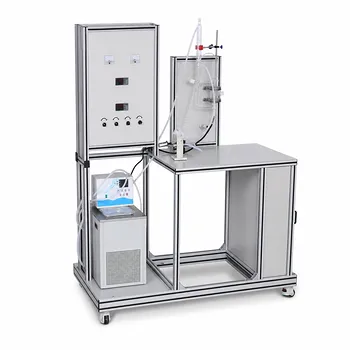
At its core, VLE is a pressure-sensitive equilibrium—and without the ability to vary pressure, a pilot plant offers only a partial view of reality.
Most textbook data and simple experiments happen at 1 atm, yet real distillation columns almost never operate there. Industrial units routinely run at elevated pressures—up to 15 atm—to optimize energy integration, column temperature profiles, and product purity. A unit operations pilot plant that supports pressurized VLE studies directly replicates those industrial conditions, letting students and researchers observe how phase behavior shifts under load and collect the data needed to design, validate, and scale up real separation processes.
Pressurized VLE capability in a pilot plant transforms it from a teaching demonstration into a genuine process-design tool. It exposes the pressure-dependent changes in relative volatility, azeotrope formation, and phase non-ideality that dictate column sizing and energy consumption—none of which can be seen at ambient pressure alone.
Why Atmospheric Pressure Data Falls Short
The Industrial Pressure Reality
The vast majority of VLE data in textbooks was measured at 1 atm. That is a legacy of simple glassware and undergraduate labs.
Industrial separations are different. Pressurized columns—often between 2 and 15 atm—allow higher condensation temperatures, enabling cheaper cooling utilities and better heat integration. A pilot plant limited to atmospheric pressure cannot simulate these conditions, leaving a critical gap between academic training and plant-floor reality.
How Pressure Alters Vapor-Liquid Equilibrium
Pressure directly reshapes the phase envelope. Higher pressure increases the boiling point and compresses the two-phase region, often reducing relative volatility and making separations harder. In some systems, it can move or even eliminate azeotropes.
Without controlling pressure, students never see these shifts. They only encounter the single-slice equilibrium that works for one set of conditions, not the multi-dimensional parameter space that governs industrial columns.
Bridging Theory and Reality with Pressurized VLE Studies
Validating Thermodynamic Models at Real Conditions
Process simulation software is only as good as its underlying data—and thermodynamic databases are severely incomplete, especially for multicomponent and high-molecular-weight systems. Public data for hydrocarbons above C10 is notoriously sparse.
A pressurized pilot plant generates real experimental data point-by-point. That direct measurement lets you check whether a model like NRTL or UNIFAC actually predicts phase compositions correctly under load. It turns the plant into a validation engine, not just a teaching tool.
Correcting for Non-Ideality in Both Phases
At low pressure, you can often ignore vapor-phase non-ideality and use activity coefficients only for the liquid. That simplification fails as pressure rises. Fugacity corrections become essential to accurately describe the vapor phase.
A pressurized pilot plant forces users to apply these dual corrections—calculating fugacity coefficients alongside activity coefficients—and see how they influence equilibrium K-values. This is exactly the rigor needed when moving from ideal textbook examples to real, non-ideal separations.
Building Practical Engineering Competence
Hands-On Training for Scale-Up
Engineering judgment isn’t born from watching a simulator converge. It comes from seeing a column react to a pressure change in real time—shifting temperature profiles, changing product purities, requiring new reflux ratios.
When students operate a pilot plant at several pressure setpoints and collect phase samples along the column, they learn to map the entire separation landscape. They also learn the patience of steady-state operation: waiting until macroscopic properties are truly constant before sampling. That discipline is at the heart of reliable VLE measurement.
Exposing the Limits of Simulation
Computer models can be seductively precise, but they often hide gaping data gaps. A pressurized pilot plant makes those gaps tangible. When a simulation predicts 95% purity at 10 atm and the plant delivers 88%, it’s a powerful lesson in the limitations of purely mathematical models.
This experience teaches engineers when to trust a model, when to demand pilot data, and how to invest experimental effort where it will most reduce risk. Pressurized capability turns the pilot plant into a truth machine for thermodynamic predictions.
Understanding the Trade-offs
Pressurized operation adds cost and complexity. Thicker vessels, staged pressure relief, and rigorous safety protocols are non-negotiable. The equipment is heavier, more expensive, and requires more operator training.
However, none of these trade-offs change the fact that you cannot learn pressure-dependent phase behavior without pressure control. The alternative—relying on atmospheric data plus extrapolation—is what leads to oversized columns, excessive energy consumption, or off-spec product after scale-up. In pilot-plant design, the real question is not “Can we afford to add pressure capability?” but “Can we afford to ignore the real conditions our students will face in industry?”
Making the Right Choice for Your Educational or Research Goal
Whether you’re designing a teaching lab or a research-grade pilot plant, the pressure capability should match the problems you intend to solve.
- If your primary focus is fundamental thermodynamics education: A pressurized VLE unit gives students direct, eye-opening experiments on phase-equilibrium pressure dependence, non-ideality corrections, and the gap between ideal and real behavior.
- If your primary focus is industrial separation design and scale-up: You need the ability to generate VLE data at the exact pressures your distillation or absorption columns will use—otherwise your model validation and column sizing remain uncalibrated guesswork.
- If your primary focus is bridging simulation accuracy: A pressurized pilot plant becomes the indispensable reference standard to challenge and refine the thermodynamic models that underpin every process simulation.
The ability to study vapor-liquid equilibrium at non-atmospheric pressures doesn’t just add a feature to a pilot plant—it transforms it into a true simulator of industrial reality, where every pressure setting tells a different separation story.
Summary Table:
| Feature | Atmospheric VLE (1 atm) | Pressurized VLE (2–15 atm) |
|---|---|---|
| Industrial Relevance | Low (limited to textbook/academic theory) | High (mirrors real distillation & separation) |
| Phase Behavior | Static; misses pressure-dependent changes | Dynamic; reveals shifts in azeotropes & volatility |
| Thermodynamic Rigor | Liquid-phase activity corrections only | Dual corrections (fugacity & activity coefficients) |
| Scale-Up Value | High risk of column sizing errors | Reliable validation of simulation models |
Bring Industrial Reality to Your Lab with LABPARK
Bridging the gap between textbook theory and industrial scale-up requires robust, high-fidelity experimental equipment. LABPARK provides state-of-the-art Educational and Vocational Unit Operations Pilot Plants in chemical engineering, bioprocess & biotech, and environmental & water treatment for universities, research institutes, and enterprises.
Our advanced systems allow your students and researchers to perform critical pressurized VLE studies, validate thermodynamic models under real industrial loads, and master process control.
Ready to upgrade your lab? Contact LABPARK today to consult with our experts on the perfect pilot plant solution for your goals!
Related Products
- Binary System Vapor Liquid Equilibrium Data Determination Educational Unit Operations Pilot Plant
- Ternary Liquid-Liquid Equilibrium Educational Pilot Plant
- Comprehensive Liquid-Liquid Extraction Pilot Plant for Engineering Education
- Liquid-Liquid Mass Transfer Coefficient Determination Educational Pilot Plant
- Multi-Functional Special Distillation Educational Pilot Plant
People Also Ask
- How can pilot plants assist in validating VLE models? Bridge theory and physical reality.
- Why Collect Isothermal vs. Isobaric VLE Data? Key Pilot Unit Advantages
- How Do Equations of State Predict VLE in Pilot Plants? Optimize Your Separation Design
- How do intermolecular forces and molecular kinetic energy govern gas liquefaction and vaporization? Explore VLE pilot plants
- For VLE Experiments: Fugacity vs. Activity Coefficient Method Selection Criteria