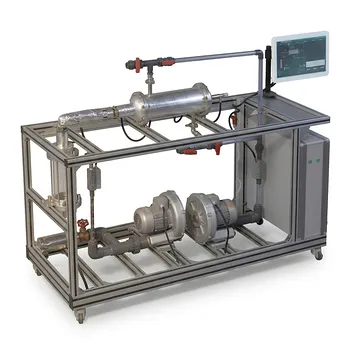
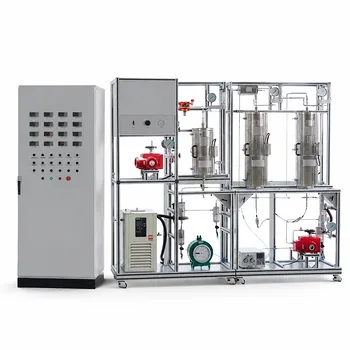
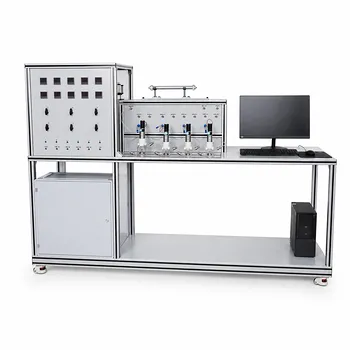
Understanding heat management isn’t optional for chemical engineers—it’s the core difference between a textbook idea and a profitable, safe industrial reactor. A unit operations pilot plant must support both adiabatic and isothermal temperature profiling because these two thermal regimes represent fundamentally different industrial operating strategies with massive implications for reaction kinetics, catalyst volume, and reactor economics. Without the ability to physically measure and compare these profiles in a single pilot unit, you cannot bridge the critical gap between idealized kinetic models and the harsh thermal realities of full-scale manufacturing.
The central value of a dual-mode (adiabatic and isothermal) tubular reactor pilot plant is that it transforms abstract thermodynamic and kinetic equations into visual, measurable data. It directly demonstrates why an adiabatic endothermic reaction might require a significantly larger, more expensive reactor than its isothermal counterpart—a lesson in engineering economics that no simulation alone can reliably teach due to the complexity of scale-up.
The Kinetic and Economic Link to Temperature Profiling
Your primary goal is to achieve a target conversion safely and economically. How you manage heat directly dictates the size of your reactor and the amount of catalyst you need to buy. The primary reference makes this connection explicit: the temperature profile is not just a thermal signature; it is a direct indicator of your reaction rate and, therefore, your capital expenditure.
The Isothermal Advantage: Sustaining Kinetic Potential
In an isothermal tubular reactor, external multi-zone heating or cooling jackets work to maintain a constant temperature along the entire reaction path. For an endothermic reaction, this means the reaction rate does not drop due to cooling.
Because the reaction rate remains high at a constant, optimized temperature, you need less catalyst and a smaller reactor volume to achieve the same conversion. A pilot plant that can demonstrate this visually, by showing a flat temperature line alongside high reactant conversion, turns a theoretical principle into an undeniable engineering advantage.
The Adiabatic Reality: Watching the Rate Collapse
When you switch the same pilot plant to adiabatic mode, you insulate it to prevent heat exchange with the surroundings. For an endothermic reaction, the energy required to drive the reaction is pulled directly from the process fluid itself, causing the temperature to drop rapidly down the length of the tube.
This temperature drop is directly coupled to a decline in reaction rate, as described by the Arrhenius equation. As detailed in the supplementary references, the relationship between temperature, conversion, and the adiabatic temperature rise index is predictable, but its practical impact—requiring a significantly larger catalyst volume—can only be truly internalized by observing the profile and calculating the consequent reactor size difference on the pilot plant.
The Educational Power of Axial Temperature Sensors
The value of a pilot plant is not just in setting a mode, but in seeing the result. Equipping the reactor with multiple sensors along its axis allows you to plot the actual temperature profile.
This profile becomes experimental proof. You can perform a live heat balance, compare the measured temperature drop against kinetic predictions based on the Arrhenius equation, and calculate the exact impact on required catalyst volume. This data-rich environment is critical for understanding why sophisticated, multi-zone heating jackets are often not an academic luxury but an industrial necessity for economic viability.
Connecting Profile Data to Industrial Scale-up
Why can’t you just learn this from simulation software? Because scale-up is a fundamentally hydrodynamically complex process that breaks the assumptions of simple models. The pilot plant data is your only semi-empirical bridge to a reliable commercial design.
Why Simulation Alone Is Insufficient
As noted in the supplementary references, scaling up fixed-bed catalytic reactors cannot rely on similarity theory alone. Commercial-scale units exhibit complex gas redistribution behaviors and hydrodynamics that are absent in small labs.
Furthermore, different thermodynamic models can give conflicting simulation results when experimental data is missing. The pilot plant becomes the definitive physical arbiter. By running the physical reaction under both adiabatic and isothermal conditions, you collect the data that validates or corrects your mathematical models, tuning their "effective" parameters to what is physically real.
Demonstrating Worst-Case Scenarios with Adiabatic Profiling
Understanding the maximum possible temperature change is a critical safety function. The concept of an adiabatic temperature rise (for exothermic reactions) or drop (for endothermic ones) represents a thermodynamic limit.
Running an exothermic reaction under adiabatic conditions in a well-instrumented pilot plant allows you to safely measure this upper thermal stress limit. This data is non-negotiable for selecting appropriate construction materials, designing emergency cooling systems, and setting high-temperature safety interlocks for the full-scale plant, preventing catastrophic thermal damage.
Understanding the Trade-offs
A pilot plant capable of both modes does not imply that one mode is universally superior; it is the only way to teach when to accept the compromises of each. There is a fundamental design conflict between operational simplicity and kinetic efficiency.
- Capital Cost vs. Operating Cost: An isothermal reactor requires a complex, multi-zone heating system with sophisticated controls, dramatically increasing capital expenditure (CapEx). An adiabatic reactor is simpler and cheaper to build but may require vastly more catalyst and volume, increasing operating and materials costs. The pilot plant allows you to quantify this exact CapEx vs. OpEx trade-off.
- Operational Complexity vs. Intrinsic Safety: An adiabatic reactor can seem "safer" in its simplicity, but for a highly exothermic reaction, the loss of active cooling can lead to a dangerous temperature runaway. Conversely, an isothermal system introduces more points of control failure. The pilot plant lets students and engineers experiment with these failure modes in a controlled environment, developing safe operating procedures.
- The Scale-Up Paradox: Your best choice at the pilot scale might not be the best at the commercial scale. A key pitfall is using the simplicity of an adiabatic pilot plant to justify an adiabatic commercial design without quantifying the resulting catalyst volume penalty. The dual-mode capability forces this calculation, preventing economically disastrous design decisions.
Making the Right Choice for Your Training or Research Goal
The power of a dual-mode tubular reactor pilot plant is that it can serve different objectives, from fundamental education to critical process validation. Your specific goal determines which mode’s data is most vital.
- If your primary focus is fundamental kinetic and thermodynamic education: Use the adiabatic mode to plot the direct link between temperature and conversion. This visualizes the Arrhenius equation and the concept of an adiabatic temperature rise in real-time, solidifying core theoretical concepts through physical observation.
- If your primary focus is industrial reactor design and economic optimization: Use both modes to benchmark catalytic efficiency. You must run the same reaction isothermally and then adiabatically to calculate the exact difference in required catalyst volume, transforming a kinetic equation into a clear business case for heat management.
Ultimately, a unit operations pilot plant that cannot profile both adiabatic and isothermal operations is blind to the single most consequential design decision in reactor engineering. It is in the measurable contrast between these two thermal extremes that a student or researcher moves from typing a kinetic constant into a simulator to truly understanding the scale, cost, and safety of the steel structure they are about to design.
Summary Table:
| Feature | Adiabatic Mode | Isothermal Mode |
|---|---|---|
| Heat Exchange | None (fully insulated) | Active heating/cooling (multi-zone) |
| Temperature Profile | Drops/rises along the reactor | Maintained constant |
| Reaction Rate | Declines as temperature drops | Sustained at optimum level |
| Catalyst & Volume | Requires larger volume | Minimizes catalyst & footprint |
| Primary Utility | Safety limits & thermal stress | Kinetic and economic optimization |
Bridge the Gap Between Theory and Industrial Reality with LABPARK
Are you looking to equip your facility with advanced chemical engineering systems? LABPARK provides premium Educational and Vocational Unit Operations Pilot Plants in chemical engineering, bioprocess & biotech, and environmental & water treatment.
Designed for universities, research institutes, and enterprises, our dual-mode pilot plants help you:
- Visualize Real Kinetics: Contrast adiabatic and isothermal profiles with precision axial sensors.
- Optimize Reactor Design: Safely calculate catalyst volume differences and scale-up economics.
- Enhance Practical Training: Bridge the gap between textbook equations and industrial operations.
Contact LABPARK today to find the perfect pilot plant solution for your institution!
Related Products
- Tubular Reactor Flow Characteristics Determination Educational Unit Operations Pilot Plant
- Residence Time Distribution and Reactor Flow Characteristics Determination Educational Pilot Plant
- Educational Unit Operations Pilot Plant for Intraparticle Diffusion Effective Factor Measurement
- O-Xylene Oxidation to Phthalic Anhydride Educational Unit Operations Pilot Plant
- Fixed-Bed Chemical Reaction and Gas Dust Tar Removal Unit Operations Pilot Plant
People Also Ask
- How do educational unit operations pilot plants address safety and waste management when scaling up?
- How do educational unit operations pilot plants bridge theory and design? Bridge the Engineering Gap
- What are the formulas for single-pass vs overall conversion in pilot plants? Master reactor mass balances
- How Do Pilot Plants Teach Limiting Reactants, Yield, & Selectivity? Real-World ChE Practice
- Why are implicit numerical methods preferred for stiff kinetics? Optimize Reactor Simulation