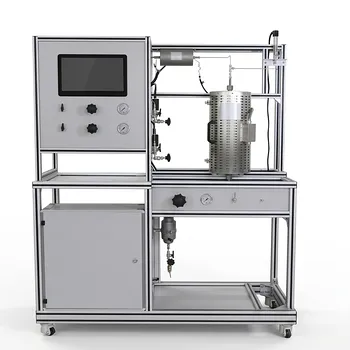
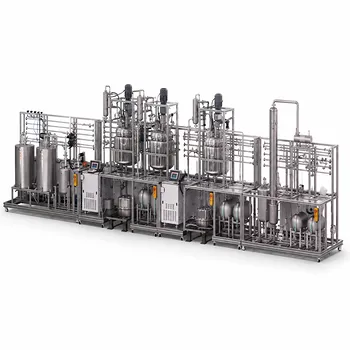
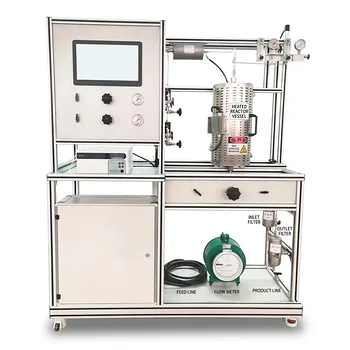
Catalyst selection is not a problem you can solve with a glass flask.
Laboratory-scale bench tests, while essential for early screening, can only measure initial activity under idealized conditions. A chemical engineering unit operations pilot plant is critical because it reveals a catalyst’s true industrial personality—its selectivity, lifetime, and regeneration behavior under the relentless influence of recycle streams, impurity accumulation, thermal gradients, and mechanical stress. Without this intermediate step, the cost of getting it wrong at commercial scale can erase a project’s economics long before the catalyst’s unit price ever matters.
The core of catalyst selection is de-risking the long-term operating expenditure, not the upfront material cost. Pilot plants inject reality into the data by forcing the catalyst to endure the dynamic, impure, and stressed environment of a real process—something no benchtop rig can ever replicate. The result is a confident prediction of selectivity and lifetime, which are the true drivers of plant profitability.
The Limits of Laboratory-Scale Catalyst Screening
The Illusion of Initial Activity
A fresh catalyst pellet in a well-stirred, isothermal lab reactor can look spectacular. You can tune the active phase, promoters, and support to get a dazzling single-pass conversion. But initial activity measured with pure feeds is a vanity metric when the commercial plant recycles unreacted material for days. Lab protocols rarely close the loop, so they never see the by-products that return with the recycle and slowly poison active sites or promote undesired side reactions.
Missing the Long-Term Deactivation Story
Catalyst lifetime—not its day-one performance—determines how often you shut down a multi-million-dollar plant for regeneration or replacement. Bench tests often run for hours, but industrial catalysts must survive weeks or months of continuous exposure to trace poisons and coking agents. A pilot plant lets you observe the slow accumulation of fouling species in a recycle loop over realistic duty cycles, giving you an empirical deactivation curve that no accelerated aging test can accurately mimic.
The Purity Trap
Lab experiments typically use reagent-grade chemicals to ensure repeatability. Yet real feedstocks contain contaminants—sulfur, metals, oxygenates—that can quietly corrode active sites or alter promoter chemistry. The pilot plant introduces these impurities at realistic concentrations and with continuous exposure, exposing whether your carefully designed catalyst formulation will fall apart when faced with the “dirty” truth of raw industrial feed.
Why Pilot Plants Capture the True Industrial Environment
Closed-Loop Recycle and Impurity Buildup
A pilot plant’s greatest gift is its ability to run as a continuous, closed-loop system. When you recycle unreacted feed and separate products, you create a dynamic reservoir where low-boiling by-products or non-condensable impurities accumulate. Over days, their concentration can climb from a few parts per million to several percent—a scenario no open-loop bench test can foresee. This buildup directly impacts catalyst selectivity, often driving the formation of unwanted heavies or degrading the active surface.
Realistic Heat and Mass Transfer
In a commercial fixed-bed reactor, the catalysts don’t sit in a perfectly mixed bath. Gas redistribution between beds, hot spots at the inlet, and the complex interplay of axial dispersion and radial temperature profiles govern real selectivity. Pilot plants replicate these hydrodynamic and thermal realities at a scale where the dimensionless numbers start to behave like the full-size unit. You can measure how shell-and-tube heat exchange patterns and flow maldistribution affect hot-spot formation and, consequently, sintering or runaway side reactions.
Mechanical and Thermal Stress Testing
A catalyst pellet must survive more than just the reaction. Start-up and shutdown cycles impose thermal shocks; flow pulsations and bed settling cause attrition and dusting. Pilot-scale equipment exposes the catalyst to these mechanical rigors over hundreds of hours, producing empirical data on crush strength, attrition loss, and pressure drop build-up. A lab spoonful of catalyst tells you nothing about the dust cloud that could plug a downstream heat exchanger.
Understanding the Trade-offs
The Cost of Information vs. the Cost of Ignorance
Running a dedicated pilot plant for months is expensive and time-consuming. There is a real temptation to leap from a promising bench recipe directly to a demo unit, using theoretical kinetics and computational fluid dynamics models to fill the gaps. However, mathematical models require semi-empirical “effective” parameters—like the gas redistribution coefficient in a multibed reactor—that can only be measured at pilot scale. The trade-off is clear: you pay now in time and capital for the pilot plant, or you gamble on a scale-up that could suffer single-digit yield losses that destroy profitability for the life of the asset.
Not a Perfect Copy, but a Necessary Bridge
A pilot plant is not a miniature commercial unit. The surface-to-volume ratio is still higher, and some phenomena (like wall effects) are exaggerated. Yet it is the only practical bridge where you can isolate the scale-dependent physics from the intrinsic chemistry. Skilled engineers use this to calibrate models that then reliably extrapolate to full scale. The alternative—direct extrapolation from a microreactor—assumes a chemical similarity that simply does not hold when hydrodynamics and transport phenomena dominate.
Making the Right Choice for Your Scale-Up Goal
Your decision on how much pilot testing to invest in should align with your primary risk profile. Use the following as a guide for your catalyst development strategy.
- If your primary focus is a novel, high-value product where yield dictates economics: Invest in a long-duration, closed-loop pilot campaign that deliberately spikes the feed with expected recycle impurities. The data on selectivity decay over time will be the most important financial number in your project.
- If your primary focus is a known reaction but with a new, cheaper feedstock: Use a pilot plant to run that specific feedstock continuously, watching for unexpected corrosion or catalyst poisons. Focus on material compatibility and regeneration cycles, not just initial conversion.
- If your primary focus is reactor design and scale-up of a proven catalyst: Run the pilot plant with extensive instrumentation to capture temperature profiles and pressure drops for model tuning. Aim to extract the hydrodynamic and kinetic parameters that will make your commercial design equations trustworthy.
- If your primary focus is minimizing time to market with a well-understood chemistry: A shorter, purpose-driven pilot campaign is still non-negotiable. Validate that your specific reactor geometry and recycle loops don’t inadvertently kill selectivity due to back-mixing or channeling—problems a bench test will never show.
The data you gather at pilot scale transforms a speculative catalyst candidate into a predictable, insurable part of your commercial plant. Skip it, and you’re not saving money—you’re simply postponing the real test until the worst possible moment.
Summary Table:
| Feature | Lab-Scale Bench Tests | Unit Operations Pilot Plants |
|---|---|---|
| System Dynamics | Open-loop, idealized conditions | Closed-loop continuous recycle |
| Impurity Impact | Pure reagents hide poisoning risks | Realistic feedstocks expose fouling & coking |
| Lifetime Testing | Short-term initial activity only | Long-term deactivation curves |
| Heat & Mass Transfer | Isothermal, perfectly mixed | Realistic thermal gradients & hydrodynamics |
| Mechanical Stress | Minimal physical wear | Tests attrition, pressure drop & thermal shock |
Bring Industrial Reality to Your Research & Training
Don't let scale-up assumptions compromise your project's success. LABPARK provides state-of-the-art Educational and Vocational Unit Operations Pilot Plants in chemical engineering, bioprocess & biotech, and environmental & water treatment.
Designed specifically for universities, research institutes, and enterprises, our pilot plants bridge the gap between benchtop chemistry and industrial reality—helping you confidently predict catalyst lifetime, optimize selectivity, and prevent costly design failures.
Ready to elevate your process engineering capabilities? Contact LABPARK today to discuss your project requirements!
Related Products
- Carbon Dioxide Hydrogen Methanol Synthesis Educational Unit Operations Pilot Plant
- Multi Pump Fluid Transport Process Piping Unit Operations Training Pilot Plant
- Natural Product Extraction Unit Operations Training Pilot Plant
- Multi-Modal Distillation Unit Operations Training Pilot Plant
- Multi-Reactor Educational Pilot Plant for Reaction Engineering Unit Operations
People Also Ask
- How do temp & pressure affect methanol synthesis pilot plants? Optimize equilibrium and catalyst performance.
- Why is a purge system necessary when operating a gas recirculation loop in a methanol synthesis pilot plant? (Guide)
- Why do modern methanol pilot plants operate at lower pressures? Catalyst & Feed Requirements Explained
- What are the operational requirements for catalyst activation? Safe Methanol Pilot Plant Operation
- Why is the chemical plant startup schedule crucial? De-risk scale-up with pilot plants.