The critical reason is one of physics and economics: free water separates easily by gravity, while emulsified water demands energy‑intensive electrostatic treatment. If you size an electrostatic dehydrator for total water content instead of just the emulsified fraction, you will drastically overdesign the vessel, wasting capital and operational resources. In educational pilot plants, this principle is taught by having students physically remove the gravity‑separable water in a knockout drum first, then route only the stubborn emulsion to the heated coalescer, allowing them to measure stage‑wise water cuts and perform accurate mass balances.
Free water drops out under gravity and often makes up the bulk of the total water. An electrostatic coalescer designed to handle that entire volume would be grossly oversized. The correct process sequence—gravity knockout first, then electrostatic dehydration—is reinforced in pilot plants through staged separation, letting future engineers see exactly why mixing these phases in a single step is a design error.
The Physics of Free, Emulsified, and Soluble Water
Why Free Water Must Be Handled Separately
Free water exists as large, continuous droplets that settle quickly under gravity. Because no chemical or electrical field is needed, it’s the least expensive phase to remove. In most crude streams, this free water can represent the majority of the water cut, so removing it upstream dramatically reduces the load on downstream equipment.
Emulsified water consists of microscopic droplets stabilized by surfactants, asphaltenes, or other natural emulsifiers. These droplets won’t coalesce without introducing an external driving force—heat, chemicals, or a high‑voltage electric field. Attempting to treat a mixture still loaded with free water in an electrostatic treater forces the treater to process a much larger volume than necessary.
The Sizing Trap: Designing for Total Water Instead of Emulsion
If an engineer mistakes total water for emulsified water, the electrostatic coalescer’s residence time and electrode area will be calculated for a flow that is artificially high. This leads to severe vessel oversizing, increased capital cost, and often larger transformers and higher energy consumption. The true capacity requirement is only the emulsion’s water fraction—what’s left after the free water has been dumped.
The concept also clarifies why soluble water is outside this scope. Soluble water is molecularly dispersed and cannot be removed by physical coalescence methods. It stays in the oil phase regardless of gravity or electrostatics, so no physical separator is designed to target it.
The Staged Separation Principle
A correct design follows a minimum of two stages:
- A gravity knockout (free‑water knockout drum, FWKO) that removes bulk, easily settled water.
- A downstream heater‑coalescer that breaks the emulsion and removes the remaining dispersed droplets.
This sequence respects the energy‑input hierarchy: use no energy when gravity works, apply heat and electricity only to the persistent emulsion.
How Educational Pilot Plants Bring This to Life
The Multi‑Stage Pilot Plant Setup
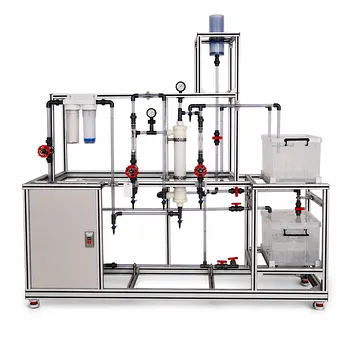
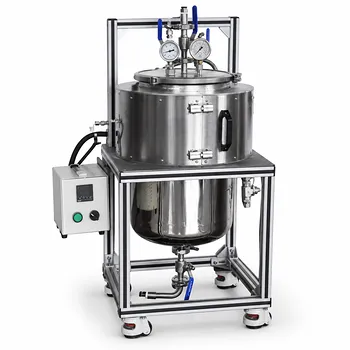
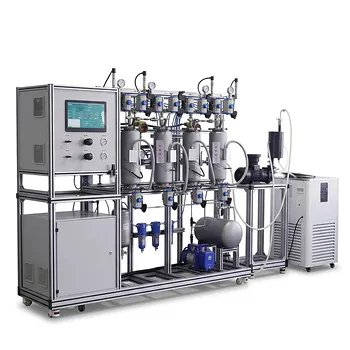
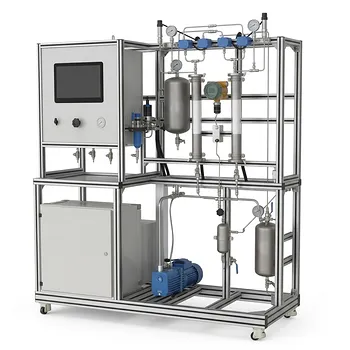
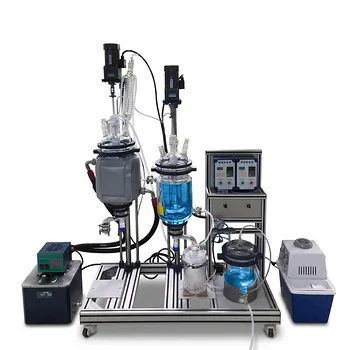
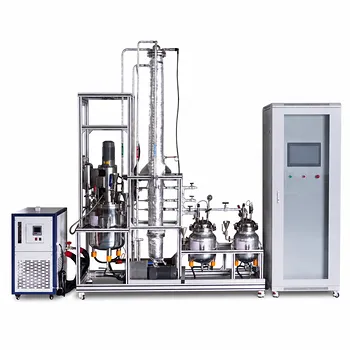
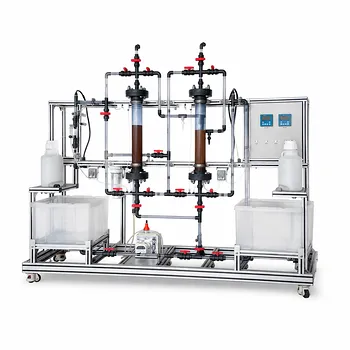
A typical educational unit operations pilot plant mirrors field‑scale architecture in miniature. It starts with an upstream gravity knockout vessel where students can see free water collect and be drained off. The remaining emulsion then passes through a feed heater and into a small electrostatic coalescer equipped with high‑voltage electrodes.
This layout is not just for demonstration—it’s instrumented. Students sample the water cuts at each stage: after the knockout drum, after the heater, and after the coalescer. They record temperatures, residence times, and voltage settings, then calculate stage‑wise removal efficiencies.
Mass Balances Across Stages
The pedagogical value lies in the numbers. By measuring the volume of water removed in the gravity vessel versus the electrostatic treater, students learn that most of the water volume leaves in the first, cheapest stage. The coalescer’s role is to polish, not to do the heavy lifting.
They also quantify how a change in upstream conditions—like an upset that forces more free water into the emulsion stream—immediately overloads the coalescer and degrades its performance. This visual, hands‑on lesson burns the principle into memory far more effectively than a textbook equation.
Connecting Equipment to Water Type
The pilot plant forces a direct link between water type and equipment choice.
- The knockout drum handles the free water.
- The electrostatic coalescer targets the emulsified water.
- Soluble water remains untouched, teaching students that no mechanical separation can address it.
This is the core separation hierarchy that real process designs must follow.
Understanding the Limitations and Pitfalls
When Gravity Knockout Alone Isn’t Enough
Even after a properly sized FWKO, some emulsions are too tight to break. The coalescer can still be undersized if the emulsion’s water cut is higher than anticipated. Students learn to read interfacial tension trends and drop‑size distributions, not just water‑cut percentages, to judge treatability.
The Danger of Misinterpreting Water‑Cut Measurements
Sampling at only one point masks the real story. A total‑water‑cut reading of 20 % might be 15 % free water and 5 % emulsified. A naive one‑stage design would be sized for 20 %, exaggerating the coalescer duty by a factor of four. The pilot plant’s multi‑point sampling eliminates this misperception.
Overreliance on Electrostatics as a Catch‑All
Another trap is to assume the electrostatic treater can handle whatever comes its way. If the free water is not removed first, it floods the electrodes, short‑circuits the electric field, and can cause emulsion carry‑over. The pilot plant lets students deliberately overload the coalescer and watch the separation fail, reinforcing that the process sequence is non‑negotiable.
Making the Right Decision in Design and Training
- If your primary focus is designing a crude dehydration system: Size the electrostatic coalescer based solely on the emulsified water content after a properly functioning FWKO. Use staged sampling to confirm that gravity removal is complete.
- If your primary focus is training operators or engineering students: Use a pilot‑scale separation train that physically separates the gravity and electrostatic steps. Have learners perform stage‑wise water‑cut measurements and mass balances to internalize why the sequence matters.
- If your primary focus is troubleshooting an existing plant: Check whether the water entering the electrostatic treater contains a significant free‑water fraction. If so, fix the upstream knockout—do not try to compensate by enlarging the treater—because the correct sequence is both more economical and more reliable.
Mastering the sequence of free‑water removal before electrostatic dehydration is not just a design rule—it’s the foundation of energy‑efficient, correctly sized, and educationally sound oil‑water separation.
Summary Table:
| Water Type | Characteristics | Separation Method | Process Priority |
|---|---|---|---|
| Free Water | Large droplets, settles quickly under gravity | Gravity Knockout (FWKO) | 1st Stage (Cheapest, removes bulk volume) |
| Emulsified Water | Microscopic droplets stabilized by surfactants | Electrostatic Coalescer + Heat | 2nd Stage (Energy-intensive, polishing) |
| Soluble Water | Molecularly dispersed in the oil phase | None (Chemical/Thermal only) | Excluded (Cannot be physically separated) |
Elevate Chemical Engineering Education with LABPARK
Teaching complex concepts like electrostatic dehydration requires hands-on, high-fidelity equipment. LABPARK provides advanced Educational and Vocational Unit Operations Pilot Plants in chemical engineering, bioprocess & biotech, and environmental & water treatment for universities, research institutes, and enterprises.
Our customized pilot plants empower your students and researchers to:
- Physically model multi-stage separations and perform precise mass balances.
- Understand the real-world economic impacts of proper equipment sizing.
- Gain practical troubleshooting experience with industrial-grade controls.
Help your students master essential engineering principles—contact LABPARK today to discuss your laboratory requirements!
Related Products
- Multifunctional Membrane Separation Educational Pilot Plant with Ultrafiltration, Nanofiltration, Reverse Osmosis
- Ultrafiltration Membrane Separation Educational Pilot Plant
- Hot Filtration Educational Unit Operations Pilot Plant Laboratory System
- Multi-Functional Membrane Separation Educational Pilot Plant for Unit Operations Lab
- Bio-fermentation Ethanol Production Practical Training Unit Operations Pilot Plant
People Also Ask
- Pervaporation vs. Vapor Permeation: Handling Suspended Solids in Membrane Pilot Plants
- How do PEI, PVDF, and PSU membranes compare in pilot plants? Find the best fit.
- What are the trade-offs of polymer vs inorganic membranes in teaching pilot plants? Key laboratory comparison.
- What are the advantages of membrane separation in pilot plants? Efficient Organic Vapor Recovery
- How can operators optimize operating conditions and cleaning protocols in membrane separation pilot plants to mitigate fouling?