Knowledge Chemical Engineering Education Why is high-efficiency agitation critical for nitration? Safe unit operations teaching reactor design.
Author avatar

Tech Team · LABPARK

Updated 1 month ago

Why is high-efficiency agitation critical for nitration? Safe unit operations teaching reactor design.


The criticality of high-efficiency agitation in a teaching nitration reactor can be summed up in two words: safety and surface area. For a liquid-liquid heterogeneous reaction, without intense, continuous mixing, the two immiscible phases will rapidly separate, drastically reducing the interfacial area where the reaction occurs. This not only kills the reaction rate but, far more dangerously, allows unreacted material to accumulate until the agitator is restarted, at which point it can react in a sudden, uncontrollable thermal runaway.

In liquid-liquid nitration, agitation isn't just about mixing; it's the primary engineering control that dictates the available reaction surface area and prevents the phase separation that leads to catastrophic energy release. The unit operations teaching reactor is the perfect scaled-down environment to witness and quantify this make-or-break relationship.

Why Agitation Defines the Reaction Rate

Overcoming the Mass Transfer Bottleneck

Nitration is a classic liquid-liquid heterogeneous reaction where the organic substrate and the mixed acid are mutually insoluble. The reaction only occurs at the interface where the two phases meet. If you simply pour them together, that interface is a single, flat layer of minimal area. High-efficiency agitation disperses one phase as fine droplets within the other, creating an enormous interfacial area. The reaction rate is directly proportional to this area, making agitation the primary “amplifier” of process throughput.

From Benchtop Principle to Teaching Reactor Design

In a unit operations teaching reactor, this principle becomes tangible. Students measure how varying the stirrer speed changes the observed reaction rate. The supplementary reference underscores that measuring kinetic parameters is fundamental to reactor design. If a student ignores mass transfer effects and tries to extract intrinsic kinetics from a poorly mixed system, their data will be dominated by the physical mixing rate, not the true chemical kinetics. The teaching reactor thus demonstrates why mass transfer must be decoupled from kinetics for valid scale-up.

The Critical Safety Function of Continuous Agitation

Preventing Reactant Accretion and Thermal Runaway

This is the most critical lesson the teaching reactor imparts. Nitration is highly exothermic. If agitation fails or is paused, the dispersed organic droplets coalesce and the phases separate. Unreacted nitric acid accumulates in the acid phase, and unreacted organic accumulates in the organic phase. The moment agitation is restored, these concentrated pockets rush together. The reaction proceeds instantly on a massive scale, releasing heat faster than the reactor's cooling jacket can remove it. The result is a thermal runaway, a leading cause of industrial nitration disasters.

Teaching Heat Transfer Integration

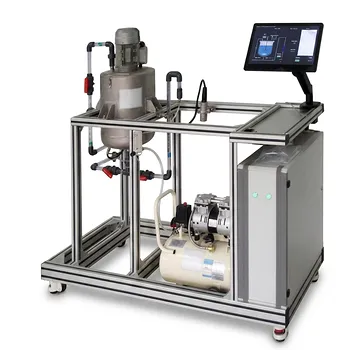
The teaching reactor, with its thermal jacket and sensors, allows students to see this linkage in real time. They can observe that steady, high-efficiency agitation provides a stable heat generation profile that the jacket can handle. If the agitator stops, the temperature might drop falsely low, hiding the latent danger. This bridges the gap between bench-scale chemistry and the imperative of reliable mechanical design in process scale-up, exactly as the supplementary reference highlights for temperature control.

Understanding the Trade-offs

The Limits of “More is Better”

High-efficiency agitation does not mean simply maximizing RPM. An impeller running too fast can create a deep vortex, pulling gas into the liquid and reducing the effective interfacial area. It can also form an excessively stable emulsion that later complicates downstream separation. The teaching reactor is the perfect platform to find the optimal operating window—sufficient dispersion without entraining gas—by measuring power consumption and reaction yield.

Mechanical Complexity and Scale

On a teaching scale, the agitator’s seal and motor are trivial, but the lesson imparted is profound. In an industrial reactor, maintaining a reliable, high-efficiency agitation system under corrosive conditions is a major engineering challenge and cost. The teaching reactor plants the seed of this understanding: agitation reliability is a process safety safeguard, not a commodity.

Applying These Insights in Your Teaching Reactor

Your operational protocol should turn these principles into deliberate, measured actions.

  • If your primary focus is validating kinetic models: Run a series of experiments at increasing agitation speeds until the measured reaction rate plateaus. The plateau indicates mass transfer limitations are minimized, allowing you to measure true intrinsic kinetics.
  • If your primary focus is demonstrating safe operating procedures: Design a classic “agitator failure” simulation. Show the temperature profile when stirring stops versus when it continues, and discuss the hidden accumulation of reactants that makes restart dangerous.
  • If your primary focus is bridging to industrial scale-up: Use the lab data to calculate the required power per unit volume and predict the required industrial agitator duty, emphasizing that geometric similarity of mixing doesn't guarantee equivalent mass transfer.

A unit operations teaching reactor turns the abstract warning “do not let the stirrer stop” into a quantified, visible, and unforgettable lesson in both reaction engineering and process safety.

Summary Table:

Key Parameter Process Role Educational & Safety Value
Interfacial Area Disperses immiscible phases to increase reaction rate. Helps students decouple mass transfer from intrinsic chemical kinetics.
Thermal Safety Prevents phase separation and accumulation of unreacted acid. Teaches thermal runaway prevention and heat jacket integration.
Agitation Speed Optimizes dispersion while avoiding gas entrainment/emulsions. Allows student analysis of power consumption versus reaction yield.

Elevate Your Engineering Lab with LABPARK

Hands-on experience with reactor dynamics is key to mastering process safety and mass transfer. LABPARK provides state-of-the-art Educational and Vocational Unit Operations Pilot Plants in chemical engineering, bioprocess & biotech, and environmental & water treatment.

We empower universities, research institutes, and enterprises to train the next generation of engineers with safe, reliable, and industry-grade teaching equipment.

Ready to upgrade your lab's capabilities? Contact our technical team today to discuss your project requirements!

Related Products

People Also Ask

Related Products

Multi-Reactor Educational Pilot Plant for Reaction Engineering Unit Operations

Multi-Reactor Educational Pilot Plant for Reaction Engineering Unit Operations

Integrated bench-scale educational pilot plant for chemical engineering teaching featuring fixed bed fluidized bed and stirred tank reactors with web-based digital twin controls and safety interlocks for hands-on unit operations and reaction engineering comparative studies in one compact system.

100L Continuous Loop Hydrogenation Educational Unit Operations Pilot Plant

100L Continuous Loop Hydrogenation Educational Unit Operations Pilot Plant

This 100L continuous loop hydrogenation pilot plant is designed for chemical engineering education, featuring 316 stainless steel construction, advanced gas-liquid mass transfer components, explosion-proof safety systems, and a 15.6-inch touchscreen with 5G connectivity, cloud data logging, bridging theory and industry.

Crude Benzene Hydrogenation Educational Unit Operations Pilot Plant

Crude Benzene Hydrogenation Educational Unit Operations Pilot Plant

Advanced pilot plant for higher education, enabling hands-on study of crude benzene hydrogenation and gas-liquid catalytic reactions. Triple-stage reactor system with precision flow and temperature control, AI-driven PID, remote monitoring, and comprehensive safety interlocks. Customizable for curriculum integration.

Multi Functional Catalytic Reaction and Reactor Evaluation Educational Unit Operations Pilot Plant

Multi Functional Catalytic Reaction and Reactor Evaluation Educational Unit Operations Pilot Plant

Bench-scale educational pilot plant for catalytic reaction and reactor evaluation, integrating fixed bed, fluidized bed, and stirred tank reactors. Students compare reactor designs, evaluate catalysts, and study reaction kinetics and hydrodynamics. Perfect for unit operations labs in chemical engineering curricula.

Fixed-Bed Chemical Reaction and Gas Dust Tar Removal Unit Operations Pilot Plant

Fixed-Bed Chemical Reaction and Gas Dust Tar Removal Unit Operations Pilot Plant

Integrated educational pilot plant for studying catalytic gas-solid reactions and downstream gas purification. Features dual fixed-bed reactor, three-stage heating, and touchscreen control for hands-on engineering training. Ideal for chemical and environmental engineering curricula.

Multi-Functional Membrane Separation Educational Pilot Plant for Unit Operations Lab

Multi-Functional Membrane Separation Educational Pilot Plant for Unit Operations Lab

The Multi-functional Membrane Separation Educational Unit Operations Pilot Plant is an integrated bench-scale laboratory system designed for teaching undergraduate engineering education. It features Ultrafiltration, Nanofiltration, and Reverse Osmosis modules in a compact, mobile unit for practical hands-on learning.

Educational Unit Operations Pilot Plant for Intraparticle Diffusion Effective Factor Measurement

Educational Unit Operations Pilot Plant for Intraparticle Diffusion Effective Factor Measurement

Designed for chemical engineering university labs, this pilot plant allows hands-on determination of catalyst particle intraparticle diffusion effective factors and gas-solid reaction kinetics using a fixed-bed tubular reactor with industrial touchscreen control, bridging theory and practical reactor design.

Three-Tube Heat Transfer Educational Pilot Plant for Unit Operations Training

Three-Tube Heat Transfer Educational Pilot Plant for Unit Operations Training

Three-tube heat transfer pilot plant for studying convective heat transfer enhancement and condensation. Allows comparison of smooth, corrugated, turbulent tubes, verifying empirical correlations. Ideal for chemical engineering education with safety and closed-loop steam recovery.

Tubular Reactor Flow Characteristics Determination Educational Unit Operations Pilot Plant

Tubular Reactor Flow Characteristics Determination Educational Unit Operations Pilot Plant

Educational pilot plant for investigating tubular reactor flow characteristics and residence time distribution Features adjustable recycle for plug flow and backmixing studies industrial touchscreen interface and real-time data acquisition Ideal for chemical engineering unit operations laboratory training and education

Two-Dimensional Fluidization Hydrodynamics Educational Pilot Plant for Unit Operations Training

Two-Dimensional Fluidization Hydrodynamics Educational Pilot Plant for Unit Operations Training

Explore gas-solid and liquid-solid fluidization hydrodynamics with our transparent 2D educational pilot plant. Ideal for chemical engineering unit operations labs, it demonstrates fixed to fluidized bed regimes, measures pressure drop, and integrates QR-code digital learning for enhanced student training.

Gas Phase Mixing and Residence Time Distribution Determination Educational Unit Operations Pilot Plant

Gas Phase Mixing and Residence Time Distribution Determination Educational Unit Operations Pilot Plant

Integrated lab system for gas-phase mixing and RTD determination. Supports pulse and step tracer methods with dual CSTR and PFR reactors, industrial components, and PC data logging. Provides hands-on study of non-ideal flow and reactor behavior for university students.

Multi-Modal Distillation Unit Operations Training Pilot Plant

Multi-Modal Distillation Unit Operations Training Pilot Plant

Multi-modal distillation pilot plant for practical unit operations training in chemical engineering education. Features real, analog, and semi-physical simulation modes, industrial construction, customizable for university labs. Hands-on fractionation columns, SCADA control, safety systems. Includes sight glasses, sampling ports, closed-loop recycling.

Agitation and Mixing Educational Unit Operations Pilot Plant

Agitation and Mixing Educational Unit Operations Pilot Plant

This bench-scale educational pilot plant enables investigation of agitation and mixing characteristics through real-time torque, speed, and conductivity measurements, supporting power number, Reynolds number, and scale-up experiments for chemical engineering students with customizable impellers and interactive control for practical education.

Dual Mode Heat Transfer Pilot Plant for Unit Operations Training

Dual Mode Heat Transfer Pilot Plant for Unit Operations Training

Engineering-scale dual-mode heat transfer pilot plant for hands-on unit operations training in chemical engineering. Features real and simulated modes, multiple heat exchanger types, comprehensive coefficient determination, and advanced process control with data acquisition for engineering students and researchers.

Multi-Functional Drying Educational Unit Operations Pilot Plant

Multi-Functional Drying Educational Unit Operations Pilot Plant

Versatile multi-functional drying educational unit operations pilot plant integrating tunnel, fluidized bed, and spray drying. Enables hands-on study of drying curves, psychrometry, and gas-solid separation for chemical engineering curriculum in higher education labs.

Dual-Mode Rectification Pilot Plant for Practical Training Unit Operations

Dual-Mode Rectification Pilot Plant for Practical Training Unit Operations

Industrial-scale dual-mode rectification pilot plant for chemical engineering practical training. Features real-material and simulated-material operation modes, sieve-plate column with sight glasses for visual observation of hydrodynamics, and customizable SCADA control for safe, hands-on learning of unit operations and mass transfer.

Multi Pump Fluid Transport Process Piping Unit Operations Training Pilot Plant

Multi Pump Fluid Transport Process Piping Unit Operations Training Pilot Plant

Industrial-scale multi-pump pilot plant for unit operations training in fluid transport and process piping, featuring real-material and semi-physical simulation modes, comprehensive pump and flowmeter calibration, and safety-enhanced two-tier platform, bridging academic theory and industrial practice for chemical engineering education.

Solid Waste Pyrolysis and Refining Educational Pilot Plant for Unit Operations

Solid Waste Pyrolysis and Refining Educational Pilot Plant for Unit Operations

This pilot plant for solid waste pyrolysis and refining integrates pyrolysis, separation, distillation, and catalytic hydrogenation into one educational unit. It provides visual process observation, smart data logging, and industrial safety for hands-on learning of engineering unit operations.

Comprehensive Heat Transfer Coefficient Determination Educational Unit Operations Pilot Plant

Comprehensive Heat Transfer Coefficient Determination Educational Unit Operations Pilot Plant

Advanced industrial-grade educational pilot plant for comprehensive heat transfer coefficient determination. Enables quantitative convective heat transfer analysis, evaluates double-pipe and shell-and-tube exchanger configurations, and includes digital data acquisition. Customizable for engineering curriculum. Ideal for engineering unit operations labs.

Rising and Falling Film Evaporation Educational Unit Operations Pilot Plant

Rising and Falling Film Evaporation Educational Unit Operations Pilot Plant

Hands-on educational pilot plant for studying rising and falling film evaporation, flow regimes, and heat transfer. Customizable for university labs with industrial instrumentation and data acquisition. Enables comparative evaluation of evaporation modes and energy efficiency.


Leave Your Message