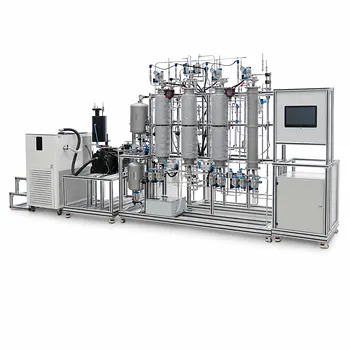
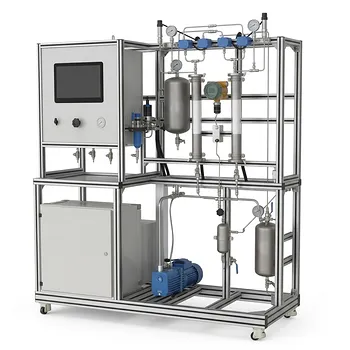
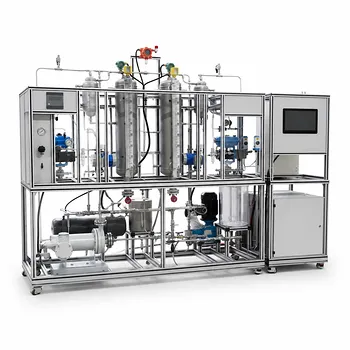
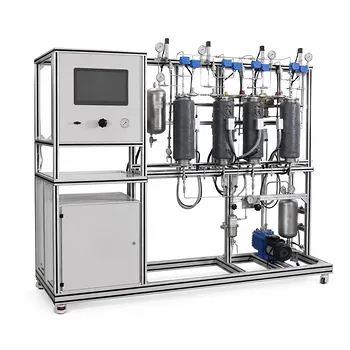
A pilot plant without rigorous feed air pretreatment is not demonstrating nitrogen generation—it’s demonstrating how to quickly and permanently destroy an expensive membrane module. Impurities like moisture, compressor oil vapors, and fine particulates will rapidly and irreversibly degrade membrane performance by chemically attacking the polymer structure and physically plugging the microscopic flow channels. The criticality lies in proving that stable, high-purity nitrogen production is impossible without first mastering the upstream purification unit operations.
A nitrogen membrane is an exquisite, highly sensitive separation device, not a filter. Demonstrating its operation is fundamentally about protecting that device. A pilot plant’s primary pedagogical value is in teaching the integrated process: showing that the success of the core separation is completely dependent on the invisible, protective work done by pretreatment stages to remove moisture, organic vapors, and particulates.
The Membrane’s Achilles’ Heel: Sensitivity to Contaminants
Membrane gas separation relies on a thin, selective polymeric layer. Its entire function can be compromised by trace components in what seems like ordinary compressed air.
Chemical Degradation from Moisture
Many commercial membrane polymers are susceptible to hydrolysis, especially when operated at elevated temperatures and pressures. Water molecules chemically attack the polymer backbone, permanently altering its structure and leading to a rapid loss of selectivity. What students and researchers must witness is not just a gradual decline in performance, but the fundamental cause of that failure.
Physical Fouling from Organic Vapors and Oils
Compressor lubricants and atmospheric hydrocarbons pose a silent but lethal threat. These organic vapors strongly sorb onto and into the membrane surface, swelling the polymer. This swelling collapses the free volume elements responsible for size-based separation, causing an irreversible drop in permeability that no amount of "cleaning" can restore.
Complete Blockage by Particulates
The fiber bores in a hollow-fiber membrane are micron-scale. Incoming particulates, pipe scale, or condensed liquid slugs will not pass through—they will lodge in and block the feed end of the fibers. This immediately reduces the effective membrane area, creating a pressure drop and permanently crippling the module's capacity.
Pretreatment is a Foundational Unit Operation
In an educational setting, relegating pretreatment to a "black box" accessory misses the entire point. The pretreatment train is a core chemical engineering separation sequence in its own right.
An Integrated System of Purification Stages
The pilot plant must explicitly showcase a logical sequence of operations. This teaches the principle that each downstream component is protected by the one before it, mirroring industrial best practices where a coalescing filter catches aerosols first, protecting the carbon bed that follows, which in turn protects the membrane.
Drawing a Parallel to Catalytic Pilot Plants
This principle of protecting a high-value core is universal in chemical engineering unit operations. Just as a platinum reforming catalyst is worthless without a hydrotreater to remove sulfur—a lesson derived from supplementary references on petrochemical pilot plants—a nitrogen membrane is worthless without its pretreatment. The core message is identical: a sensitive active element (whether a noble metal crystal or a polymer film) demands a pristine feed stream, and the pilot plant must make this dependency tangible.
Controlling the Most Critical Performance Variable
The pretreatment system is what enables the membrane to perform its primary function. A dry feed air stream is what makes a product dew point below -80°C possible. Without demonstrating the dehumidification stage—and its monitoring via a dew point analyzer—the operator cannot prove the membrane’s capability to produce instrument-grade dry nitrogen.
Understanding the Trade-offs
A rigorous pretreatment system is essential, but a thoughtful pilot plant design must also demonstrate its complexities and potential failure modes to be truly educational.
The Hidden Cost of Inadequate Monitoring
An adsorbent bed, such as a carbon filter for oil vapor removal, has a finite capacity that remains invisible until breakthrough occurs. A well-designed pilot plant will instrument the bed to show temperature profiles or use sample ports to measure breakthrough curves. This teaches the operational reality that pretreatment is a consumable service that must be actively managed, not a fix-it-and-forget-it component.
The Danger of a False Sense of Security
A poorly maintained coalescing filter can be a source of contamination itself if it saturates and releases a slug of trapped liquids. The design must include automatic drains and differential pressure indicators to demonstrate that a filter is only an asset when properly monitored; without this, it's a latent liability for catastrophic failure.
Over-Complexity Masking the Core Objective
For a teaching lab, there's a balance to strike. An overwhelmingly complex pretreatment train with too many parallel beds can obscure the core membrane separation objective. The instructional design must ensure the pretreatment stages are clearly labeled, individually valved, and logically laid out so their protective function is obvious, not a confusing maze of pipes that detracts from the central learning goal.
Making the Right Choice for Your Demonstration Goals
A pilot plant’s design should be dictated by the specific learning outcomes you intend to highlight. The pretreatment system’s configuration changes depending on your focus.
- If your primary focus is membrane science: Select a simple, well-instrumented pretreatment system with real-time dew point and organics analyzers. This allows students to precisely correlate a single impurity's concentration in the feed with the membrane's loss of selectivity.
- If your primary focus is industrial process design: Include a full-scale, industrial-style train with coalescing, carbon adsorption, and regenerative drying. The lesson here is on system integration, maintenance procedures, and the true operational cost of delivering a clean gas stream.
- If your primary focus is process control and troubleshooting: Design the pretreatment with bypass loops and injection ports. This allows you to deliberately introduce contaminants in a controlled way, letting students diagnose the symptoms of wet feed air, oil breakthrough, or frozen condensate in real-time.
A nitrogen generation pilot plant's true value is realized not when it simply runs, but when it reveals the unseen dependency of a high-tech separation on robust, elegantly simple upstream purification.
Summary Table:
| Contaminant | Effect on Membrane Module | Pretreatment / Mitigation Stage |
|---|---|---|
| Moisture | Causes chemical hydrolysis & loss of selectivity | Dehumidification / Dryers |
| Organic Vapors & Oils | Causes polymer swelling & loss of permeability | Carbon adsorption filters |
| Particulates & Scale | Blocks hollow-fiber bores & reduces active area | Coalescing & particulate filters |
Enhance Your Engineering Curriculum with LABPARK
Teaching the complexities of chemical separations requires robust, industrial-grade equipment. LABPARK provides advanced Educational and Vocational Unit Operations Pilot Plants in chemical engineering, bioprocess & biotech, and environmental & water treatment for universities, research institutes, and enterprises.
Our pilot plants are engineered to demonstrate critical processes—like pretreatment sequences and membrane protection—giving your students and researchers hands-on experience with real-world operational challenges.
Contact LABPARK today to find the perfect pilot plant solution for your laboratory or training facility!
Related Products
- Multi-Functional Membrane Separation Educational Pilot Plant for Unit Operations Lab
- Photocatalytic Membrane Separation and Degradation Unit Operations Pilot Plant
- Ultrafiltration Membrane Separation Educational Pilot Plant
- Multifunctional Membrane Separation Educational Pilot Plant with Ultrafiltration, Nanofiltration, Reverse Osmosis
- Gas-Solid Heterogeneous Separation Demonstration Educational Unit Operations Pilot Plant
People Also Ask
- What are the key differences in membrane configurations? Choose the Right Unit Operations Pilot Plant
- How Do Pervaporation, Vapor, and Gas Permeation Differ in Pilot Plants? Key Comparison
- What are the advantages of membrane separation pilot plants? Energy-saving process intensification.
- Pervaporation vs. Vapor Permeation: Handling Suspended Solids in Membrane Pilot Plants
- How do PEI, PVDF, and PSU membranes compare in pilot plants? Find the best fit.